
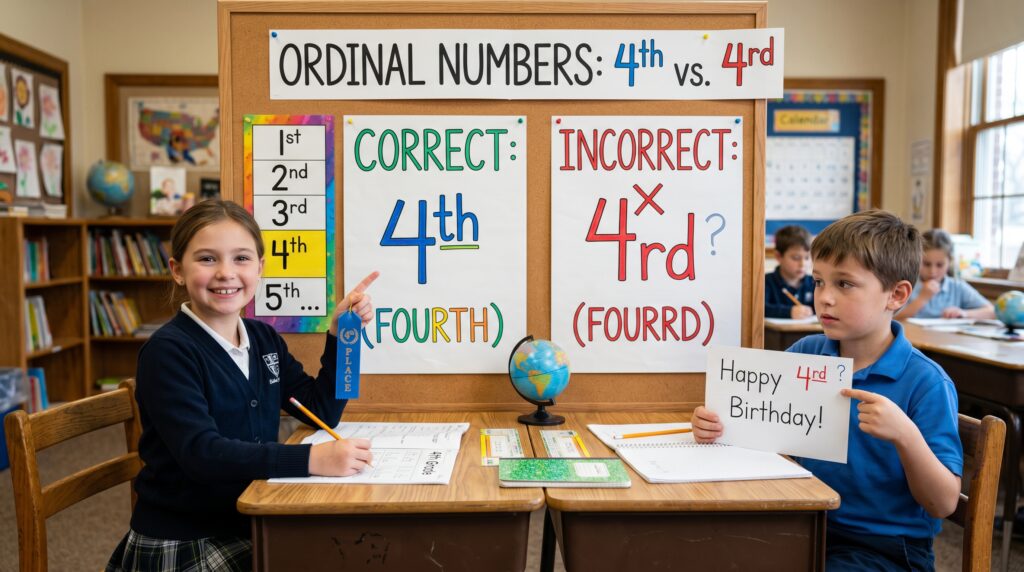
If you are writing dates, rankings, or lists, you may wonder whether to write 4th or 4rd.
This is a very common confusion for English learners because most ordinal numbers follow a pattern like 1st, 2nd, 3rd, 4th. But when people try to apply rules quickly, mistakes like “4rd” can appear.
Although it looks logical at first glance, only one of these is correct in standard English.
Quick Answer
The correct form is 4th.
❌ 4rd is incorrect
✔️ 4th is correct
In English, ordinal numbers from 4 onward (except 11th, 12th, 13th) use “th”.

What Does “4th” Mean?
Definition
4th (fourth) is an ordinal number that shows position, order, or ranking.
Usage Rules
Use 4th when referring to:
- Dates (4th of June)
- Rankings (4th place)
- Lists or sequences (4th item)
- Floors (4th floor)
Examples
Example 1
She arrived on the 4th of July.
Example 2
He finished in 4th place in the race.
Example 3
This is the 4th chapter of the book.
Key Insight
“4th” always uses “th” because English ordinal rules assign “th” to most numbers after 3.
Why “4rd” Is Incorrect
Explanation
The suffix “rd” is only used with numbers ending in 3, such as:
- 3rd
- 23rd
- 33rd
Since 4 does not end in 3, it cannot take “rd.”
Rule Breakdown
English ordinal suffix rules:
- 1 → 1st
- 2 → 2nd
- 3 → 3rd
- 4 and most others → th
Key Insight
Suffixes depend on the last digit of the number, not how the word sounds.
Ordinal Number Pattern (Simple Rule)
| Number | Correct Form |
|---|---|
| 1 | 1st |
| 2 | 2nd |
| 3 | 3rd |
| 4 | 4th |
| 5 | 5th |
| 11 | 11th |
| 12 | 12th |
| 13 | 13th |
| 21 | 21st |
| 22 | 22nd |
| 23 | 23rd |
| 24 | 24th |
Real-World Usage Scenarios
Scenario 1
Student: “Today is the 4rd of March.”
Teacher: “It should be 4th of March.”
🎯 Lesson: Dates always use correct ordinal rules.
Scenario 2
Runner: “I came 4rd in the race.”
Coach: “You came 4th.”
🎯 Lesson: Rankings always follow ordinal suffix rules.
Scenario 3
Writer: “This is the 4rd chapter.”
Editor: “It should be 4th chapter.”
🎯 Lesson: Book structure uses ordinal forms correctly.
Scenario 4
User: “Why does 3 use rd but 4 doesn’t?”
Answer: “Because suffixes depend on the last digit rule.”
🎯 Lesson: The rule is mechanical, not phonetic.
Scenario 5
Learner: “Can I ever use 4rd?”
Answer: “No, it is never correct in standard English.”
🎯 Lesson: Some forms are simply invalid.
Common Mistakes
Mistake 1: Copying Sound Instead of Rule
Why it happens:
People think pronunciation controls spelling.
Correction:
Ordinal numbers follow fixed suffix rules.
Mistake 2: Mixing 3rd Rule with 4th
Why it happens:
Learners overgeneralize “rd” usage.
Correction:
Only numbers ending in 3 use “rd.”
Mistake 3: Forgetting Teen Exceptions
Why it happens:
11th, 12th, and 13th look like they should follow 1st, 2nd, 3rd rules.
Correction:
Teens always use “th.”
Memory Tricks
Remember This Rule
1, 2, 3 are special. Everything else is “th.”
Easy Shortcut
Think:
- 3rd = only for 3 endings
- 4th = default form
Expert Insight
Ordinal suffix rules in English are based on historical numbering conventions rather than pronunciation logic. The system prioritizes digit-based rules (last digit of the number) rather than phonetic spelling.
This is why learners often find ordinal numbers confusing at first. However, once the pattern is memorized, it becomes automatic and consistent across all numbers.
Conclusion
When comparing 4th or 4rd, the answer is simple:
- ✔️ 4th is correct
- ❌ 4rd is incorrect
Remember the rule: only numbers ending in 1, 2, and 3 take special endings. Everything else uses “th.”
Once you learn this pattern, ordinal numbers become easy and consistent in all writing.
