
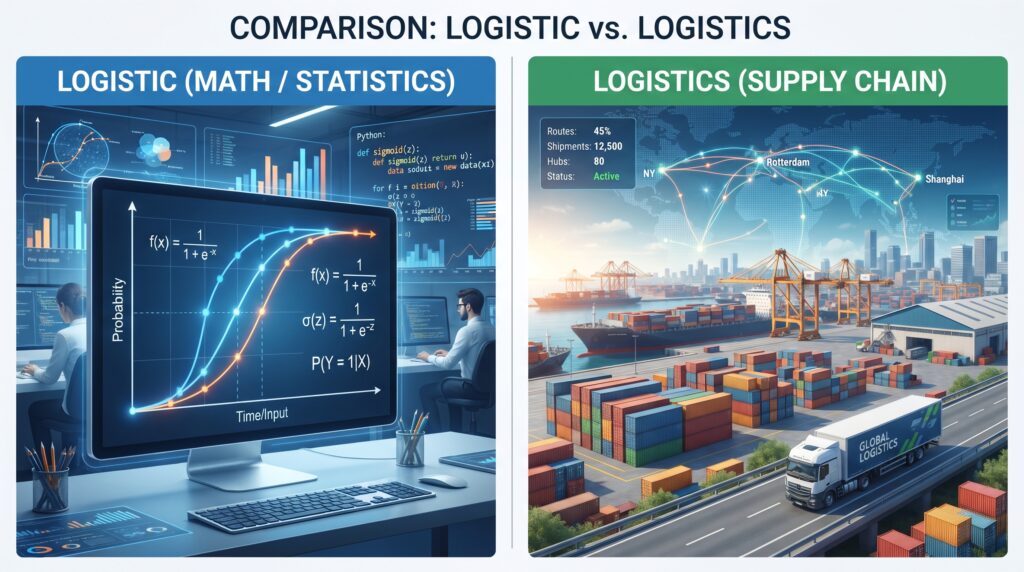
Logistic or logistics is a common comparison because the two words are closely related but are not always used in the same way. Both terms are connected to planning, organization, transportation, supply chains, and the movement of people or goods.
The word logistic is generally used as an adjective when describing something related to logistics. It can also appear as a noun in specific contexts, particularly in mathematics and statistics. Logistics, meanwhile, is the much more common word in business, transportation, supply chain management, military operations, and event planning.
Understanding the difference between logistic and logistics can help you choose the right word in professional communication, job descriptions, business documents, and everyday writing.
Quick AnswerÂ
Logistics is the standard term when referring to the planning and management of the movement, storage, and delivery of goods, people, or resources.
Logistic is usually an adjective used to describe something related to logistics. For example, you might say logistic planning, logistic support, or logistic challenges.
In simple terms:
Logistics = the overall process or field
Logistic = relating to that process
The correct choice depends on the sentence and the intended meaning.

What Does Logistic Mean?
Logistic is commonly used as an adjective meaning related to the organization, planning, transportation, or coordination of resources.
Examples of Logistic
- Logistic planning
- Logistic support
- Logistic operations
- Logistic requirements
- Logistic challenges
- Logistic coordination
For example:
The team faced several logistic challenges during the event.
In this sentence, logistic describes the type of challenges involved.
The word can also have specialized meanings. In mathematics and statistics, logistic appears in terms such as logistic regression and logistic functions.
What Does Logistics Mean?
Logistics is a noun that refers to the detailed organization and coordination required to move, store, supply, or manage resources.
It is widely used in business and supply chain management.
Examples include:
- Transportation logistics
- Warehouse logistics
- Supply chain logistics
- International logistics
- Event logistics
- Military logistics
- Reverse logistics
For example:
The company improved its logistics system to deliver products faster.
Here, logistics refers to the broader process of managing the movement and delivery of products.
Logistic vs Logistics: Key Differences
| Feature | Logistic | Logistics |
|---|---|---|
| Part of speech | Usually adjective | Noun |
| Main meaning | Related to logistics | Planning and management of resources |
| Common usage | Logistic planning | Logistics management |
| Business use | Describes activities | Names the overall field or process |
| Transportation | Logistic requirements | Transportation logistics |
| Supply chain | Logistic challenges | Supply chain logistics |
| Frequency | Less common | Very common |
| Example | Logistic support | Logistics operations |
| Best use | Before a noun | As the main subject or concept |
Common Uses of Logistics
Logistics plays an important role in many industries.
Business Logistics
Businesses use logistics to manage inventory, transportation, warehousing, and product delivery.
Supply Chain Logistics
Supply chain logistics coordinates the movement of materials from suppliers to manufacturers, retailers, and customers.
Event Logistics
Event organizers use logistics to coordinate venues, equipment, transportation, staffing, food, and other resources.
Military Logistics
Military logistics involves supplying personnel with equipment, food, fuel, medical supplies, and other resources.
International Logistics
International logistics involves transporting goods across countries while managing customs, documentation, shipping, and regulations.
Examples of Logistic in Sentences
Here are some examples showing how logistic is commonly used:
- The company developed a logistic plan for the new warehouse.
- We discussed the logistic requirements for the conference.
- Several logistic problems delayed the project.
- The organization provided logistic support during the operation.
- The team reviewed the logistic arrangements before the event.
Examples of Logistics in Sentences
Here are examples using logistics as a noun:
- The company manages its logistics internally.
- Logistics is an important part of international trade.
- We need to organize the logistics for the event.
- The business invested in better logistics software.
- Poor logistics can increase delivery costs.
Why the Difference Matters
Understanding logistic or logistics is particularly useful in professional communication. Using the correct form makes business documents, job applications, reports, and marketing content clearer.
For example, a company may advertise a position as a Logistics Manager, not a Logistic Manager. Similarly, a department is commonly called the Logistics Department.
However, when the word describes another noun, logistic can be appropriate, such as logistic planning or logistic support.
Common Mistakes
One common mistake is using logistic as a replacement for logistics in every situation.
For example:
Incorrect or unnatural:
The company manages its logistic.
Better:
The company manages its logistics.
Another mistake is assuming that logistics can never describe something. In most standard business contexts, logistic is used as an adjective before another noun.
FAQs
Is logistic or logistics correct?
Both words are correct, but they have different grammatical roles. Logistics is usually a noun referring to the planning and management of resources, while logistic is commonly an adjective describing something related to logistics.
Is it logistics management or logistic management?
Logistics management is the standard and much more common expression. It refers to managing transportation, inventory, warehousing, and related activities.
Is it a logistic problem or a logistics problem?
Both may appear, but logistic problem is generally used when logistic functions as an adjective. In many professional contexts, people may also simply say logistics problem when referring to an issue involving logistics.
Is Logistics a good career?
Yes. Logistics offers career opportunities in transportation, warehousing, supply chain management, procurement, inventory control, distribution, and operations.
What is a logistics department?
A logistics department manages activities related to the movement, storage, distribution, and delivery of goods or resources within an organization.
What is logistic support?
Logistic support refers to the resources and organizational assistance needed to keep an operation running. This can include transportation, supplies, equipment, storage, and maintenance.
ConclusionÂ
When deciding between logistic or logistics, focus on the grammatical role and meaning of the word. Logistics is the standard noun used for the planning and coordination of transportation, storage, supplies, and resources. Logistic is generally used as an adjective to describe something related to logistics.
For business, supply chain, transportation, and professional contexts, logistics is usually the word you’ll need when referring to the field or overall process. Use logistic when it directly describes another noun, such as logistic planning, logistic support, or logistic requirements.
Understanding this simple distinction can help you write clearer professional documents and communicate more accurately in business and workplace settings.
