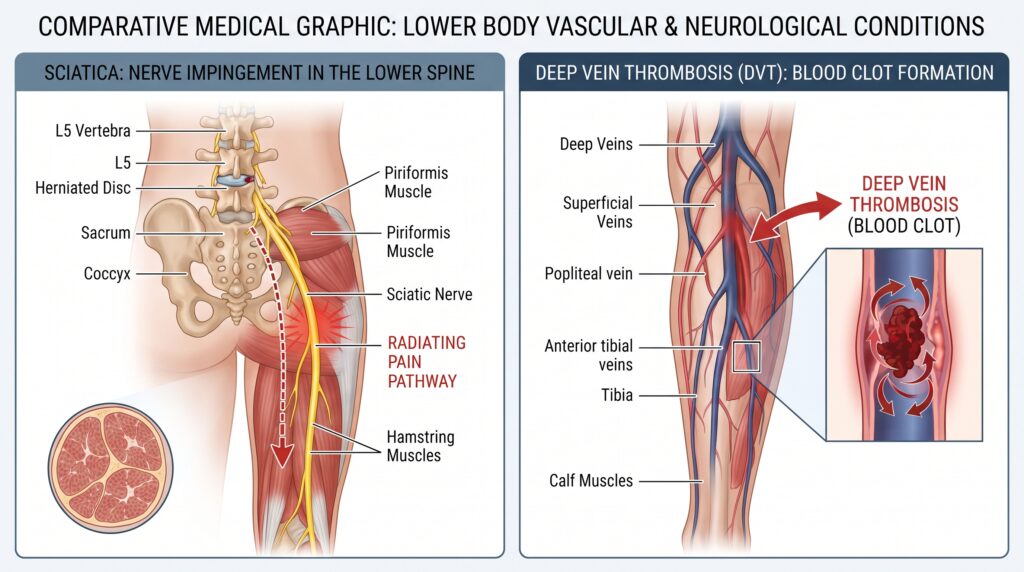
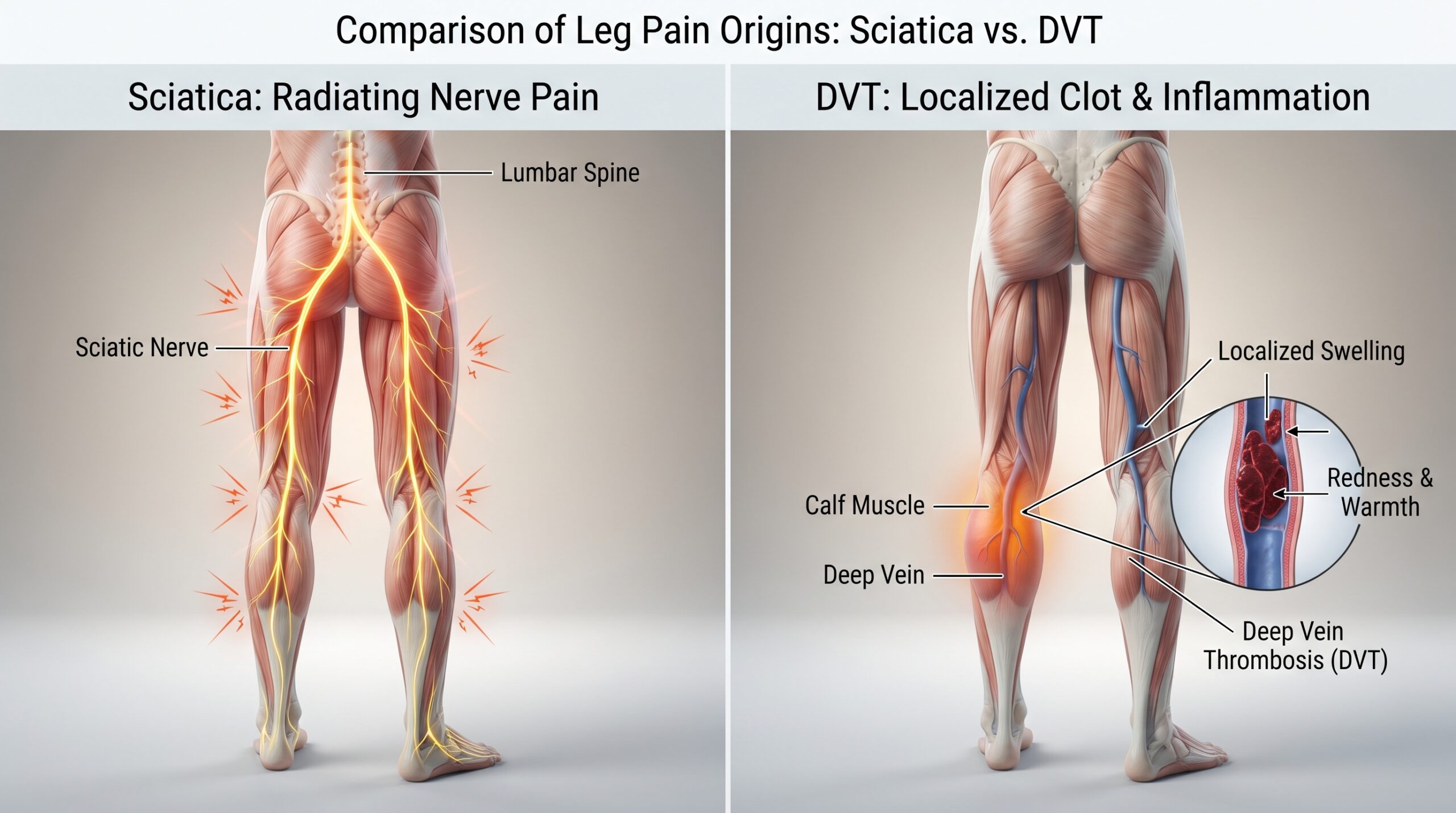
Sciatica or DVT can be difficult to distinguish because both conditions may cause pain in the leg. However, they have very different causes. Sciatica is related to irritation or compression of a nerve in the lower back, while deep vein thrombosis (DVT) occurs when a blood clot develops in a deep vein, usually in the leg.
Knowing the difference between sciatica and DVT matters because the two conditions require very different approaches. Sciatica may improve with conservative care, depending on its cause, while DVT needs prompt medical evaluation because a clot can potentially travel to the lungs.
Leg pain should therefore be considered alongside other symptoms, such as swelling, numbness, tingling, warmth, skin changes, and breathing problems.
Quick Answer
The main difference is the type and pattern of symptoms.
Sciatica commonly causes sharp, burning, shooting, or electric pain that travels from the lower back or buttock into the leg. Tingling, numbness, and weakness can also occur.
DVT more commonly causes pain or tenderness in one leg along with swelling, warmth, or a change in skin color. The discomfort often occurs in the calf or thigh.
A simple comparison is:
Sciatica = nerve related pain
DVT = blood clot related problem
However, symptoms alone cannot reliably rule out DVT. If you have unexplained swelling and pain in one leg, especially if you have DVT risk factors, seek medical assessment.

What Is Sciatica?
Sciatica refers to symptoms caused by irritation or compression of the sciatic nerve or one of the nerve roots that contribute to it.
The sciatic nerve is a large nerve that travels from the lower spine through the buttocks and into the leg. When a spinal problem irritates one of these nerves, pain and other symptoms can travel along the nerve pathway.
Sciatica commonly affects one side of the body.
Common Causes of Sciatica
Several conditions can cause sciatic nerve irritation.
Herniated Disc
A herniated disc occurs when material from a spinal disc pushes outward and irritates a nearby nerve. This is one of the common causes of sciatica.
Spinal Stenosis
Spinal stenosis involves narrowing of spaces within the spine. The narrowing can place pressure on nerves and produce leg symptoms.
Bone Spurs
Age related changes in the spine can produce bone growths called bone spurs. These may contribute to nerve compression.
Spondylolisthesis
This occurs when one vertebra shifts relative to another and can sometimes narrow the space available for spinal nerves.
Common Symptoms of Sciatica
Sciatica can produce several different symptoms.
Shooting Pain
Pain may travel from the lower back or buttock down the back or side of the leg.
Burning Sensation
Some people describe the pain as burning, hot, or electrical.
Tingling
Pins and needles may occur along the affected nerve pathway.
Numbness
Some areas of the leg or foot may feel less sensitive.
Weakness
More significant nerve compression can cause weakness in certain muscles of the leg or foot.
Symptoms may become worse with prolonged sitting or certain movements. Coughing or sneezing can sometimes increase the pain.
What Is DVT?
Deep vein thrombosis, or DVT, occurs when a blood clot forms in a deep vein.
DVT most commonly develops in the lower leg, thigh, or pelvis. Some cases produce noticeable symptoms, while others may cause few or no symptoms.
DVT is important to recognize because a blood clot can sometimes break away and travel through the bloodstream to the lungs. This is called a pulmonary embolism and can be life threatening.
Common Symptoms of DVT
Possible DVT symptoms include:
- Swelling in one leg
- Pain or tenderness
- Calf discomfort
- Thigh discomfort
- Warmth over the affected area
- Red or discolored skin
- A feeling of heaviness in the affected leg
These symptoms can also occur with other conditions, so they do not prove that someone has DVT.
Sciatica vs DVT: Key Differences
| Feature | Sciatica | DVT |
|---|---|---|
| Main problem | Nerve irritation or compression | Blood clot in a deep vein |
| Typical location | Lower back, buttock, back or side of leg | Usually calf or thigh |
| Pain type | Shooting, burning, electric, aching | Aching, cramping, tenderness |
| Swelling | Not usually a main symptom | Common possible symptom |
| Numbness | Common possible symptom | Not typical |
| Tingling | Common possible symptom | Not typical |
| Weakness | Can occur | Not typical |
| Warmth | Usually absent | Can occur |
| Skin changes | Not typical | Can occur |
| One sided symptoms | Common | Common |
| Major complication | Nerve damage in severe cases | Pulmonary embolism |
| Diagnosis | Clinical assessment and sometimes imaging | Medical assessment and often ultrasound |
9 Important Differences Between Sciatica and DVT
1. Cause
The fundamental difference is the cause.
Sciatica is related to nerve irritation or compression, usually involving the lower spine.
DVT is caused by a blood clot developing in a deep vein.
2. Location of Pain
Sciatica often begins around the lower back or buttock and travels down the leg.
DVT pain is more commonly concentrated in the calf or thigh.
3. Type of Pain
Sciatica is often described as shooting, burning, sharp, or electric.
DVT may produce aching, cramping, tenderness, or discomfort in the affected area.
4. Swelling
Visible swelling is much more concerning for DVT than typical sciatica.
Sciatica primarily affects nerves and does not usually cause significant swelling of the entire leg.
5. Numbness and Tingling
Numbness and tingling are common nerve related symptoms.
Therefore, these symptoms are more suggestive of sciatica than DVT, although they cannot establish a diagnosis by themselves.
6. Warmth
A leg affected by DVT may feel warmer than the other leg.
Localized warmth is not usually a characteristic symptom of uncomplicated sciatica.
7. Skin Color
DVT can sometimes cause redness or another visible change in the color of the affected leg.
Skin discoloration is not a typical feature of sciatica.
8. Muscle Weakness
Sciatica can cause weakness when a spinal nerve is significantly affected.
Weakness is not a typical feature of DVT.
9. Serious Complications
Severe nerve compression can cause serious neurological problems.
DVT has a different major concern. The clot can travel to the lungs and cause a pulmonary embolism.
What Does Sciatica Pain Feel Like?
Sciatic nerve pain can feel different from person to person.
Common descriptions include:
- Sharp pain
- Burning pain
- Shooting pain
- Electric shock like sensations
- Tingling
- Pins and needles
- Numbness
- Weakness
The pain often follows a path from the lower back or buttock into the leg.
For some people, the back pain is mild while the leg pain is more noticeable.
What Does DVT Pain Feel Like?
DVT may cause an aching or cramping sensation in the affected leg.
Some people experience tenderness, particularly in the calf or thigh. Swelling and warmth can occur at the same time.
Importantly, DVT does not always cause severe pain. Some people may have relatively mild symptoms or no obvious symptoms.
This is why a possible blood clot should not be dismissed simply because the pain isn’t severe.
DVT Risk Factors
Certain situations can increase the likelihood of developing DVT.
These include:
- Recent major surgery
- Prolonged bed rest
- Long periods of immobility
- Extended travel
- Previous DVT
- Certain medical conditions
- Cancer
- Pregnancy and the period after childbirth
- Some medications
- Increasing age
- Certain inherited or acquired clotting conditions
Having one of these factors does not mean you have DVT. However, symptoms should be taken more seriously when they occur alongside known risk factors.
Sciatica Risk Factors
Sciatica can become more likely with factors such as:
- Age related spinal changes
- Disc problems
- Physically demanding work
- Repetitive lifting
- Poor lifting technique
- Prolonged sitting
- Certain spinal conditions
- Previous back problems
Maintaining appropriate physical activity and using safe lifting techniques may help reduce some back related risks.
Can Sciatica Cause Leg Swelling?
Significant swelling is not a typical symptom of sciatica.
If you have leg pain together with noticeable swelling, warmth, or skin discoloration, don’t automatically assume that the problem is sciatica.
A healthcare professional can determine whether further evaluation is needed.
Can DVT Cause Back Pain?
DVT usually causes symptoms in the affected limb rather than the characteristic radiating lower back and leg pain associated with sciatica.
Back pain combined with shooting pain down the leg is more consistent with a nerve related problem, although other conditions can cause similar symptoms.
When Should You See a Doctor?
You should seek medical advice when you have new, unexplained, persistent, or worsening leg pain.
Medical evaluation is especially important when leg pain is accompanied by:
- New swelling in one leg
- Warmth
- Redness or discoloration
- Significant tenderness
- Recent surgery
- Prolonged immobility
- A previous blood clot
- Other known DVT risk factors
Don’t rely on symptoms alone to determine whether you have a blood clot.
DVT Emergency Warning Signs
A DVT can sometimes lead to a pulmonary embolism.
Seek emergency medical attention immediately if you develop:
- Sudden shortness of breath
- Sudden chest pain
- Coughing up blood
- Fainting
- Severe dizziness
- A rapid heartbeat accompanied by concerning symptoms
These symptoms require urgent assessment.
Sciatica Emergency Warning Signs
Most cases of sciatica are not medical emergencies. However, certain symptoms require urgent assessment.
Seek urgent medical care if back and leg symptoms are accompanied by:
- New loss of bladder control
- New loss of bowel control
- Numbness around the genitals or inner thighs
- Severe or rapidly worsening weakness
- Severe symptoms affecting both legs
These symptoms can indicate serious nerve compression.
How Are Sciatica and DVT Diagnosed?
Diagnosing Sciatica
A healthcare professional may assess:
- Pain location
- Muscle strength
- Reflexes
- Sensation
- Walking ability
- Range of movement
- Medical history
Imaging such as MRI may sometimes be recommended when symptoms are severe, persistent, or associated with concerning findings.
Diagnosing DVT
DVT cannot reliably be diagnosed through symptoms alone.
Healthcare professionals may consider medical history, risk factors, physical examination, and appropriate testing. Ultrasound is commonly used to evaluate suspected DVT.
Blood tests may also be used in some situations as part of the diagnostic process.
Treatment Differences
Sciatica Treatment
Treatment depends on the underlying cause and severity.
Possible approaches include:
- Staying appropriately active
- Physical therapy
- Exercise
- Pain management
- Addressing the underlying spinal problem
- Medical treatment when necessary
Severe cases may require additional treatment depending on the cause.
DVT Treatment
DVT requires medical management. Treatment commonly involves medicines that reduce the blood’s ability to form or extend clots, known as anticoagulants.
The exact treatment depends on the location of the clot, its severity, underlying risk factors, and the individual’s health.
Do not attempt to treat a suspected DVT yourself.
Common Mistakes When Comparing Sciatica and DVT
Mistake 1: Assuming All Leg Pain Is Sciatica
Leg pain can have many causes. A new pattern of swelling or warmth should not simply be blamed on a nerve problem.
Mistake 2: Ignoring One Sided Swelling
Unexplained swelling affecting one leg can be an important warning sign.
Mistake 3: Waiting for Severe DVT Symptoms
DVT symptoms can be mild or even absent. Risk factors and clinical assessment matter.
Mistake 4: Trying to Massage a Suspected Blood Clot
If DVT is suspected, don’t attempt to treat it yourself with massage or other home methods. Seek medical advice.
Mistake 5: Diagnosing Yourself From a Symptom List
Symptoms can overlap with muscle injuries, nerve problems, infections, and other conditions. Professional assessment may be necessary.

FAQs
How can I tell if I have sciatica or DVT?
Sciatica commonly produces shooting or burning pain that travels from the lower back or buttock into the leg. DVT more often causes one sided leg swelling, tenderness, warmth, or skin changes. However, symptoms alone cannot reliably diagnose or exclude DVT.
Is sciatica pain worse than DVT pain?
Pain severity varies significantly. Neither condition always causes severe pain, so pain intensity alone cannot distinguish between sciatica and DVT.
Does sciatica cause swelling?
Significant swelling isn’t typical of sciatica. If your leg is swollen as well as painful, particularly on one side, you should seek medical evaluation.
Does DVT cause tingling or numbness?
Tingling and numbness aren’t typical DVT symptoms. They are more commonly associated with nerve irritation, including sciatica.
Can you have sciatica and DVT at the same time?
It is possible for someone to have more than one condition at the same time. Having a history of sciatica doesn’t protect someone from developing a blood clot.
Which is more dangerous, sciatica or DVT?
DVT can become life threatening if a clot travels to the lungs and causes a pulmonary embolism. Severe nerve compression from a spinal condition can also require urgent treatment, particularly when accompanied by bladder, bowel, or significant neurological changes.
Does walking help sciatica?
Some people with sciatica benefit from remaining appropriately active rather than staying in bed for long periods. However, the right activity depends on the underlying cause and severity of symptoms.
Should I exercise if I think I have DVT?
If you think you may have DVT, don’t use exercise as a way to treat or test the condition. Seek medical assessment promptly, particularly if you have swelling, warmth, or unexplained pain in one leg.
Can DVT go away on its own?
A suspected DVT should not be left untreated without medical assessment. Blood clots can cause serious complications, so appropriate diagnosis and treatment are important.
Can sciatica go away on its own?
Many cases of sciatica improve over time, depending on the underlying cause. Persistent, severe, or worsening symptoms should be evaluated by a healthcare professional.
ConclusionÂ
The comparison between sciatica or DVT is important because both can cause leg pain but have completely different causes and potential complications.
Sciatica is generally associated with nerve irritation or compression and commonly causes shooting, burning, tingling, numbness, or weakness that travels from the lower back or buttock into the leg.
DVT is a blood clot in a deep vein. It may cause pain, tenderness, swelling, warmth, and skin discoloration in one leg. Because DVT can potentially lead to a pulmonary embolism, suspected symptoms should receive prompt medical attention.
If you have new unexplained one sided leg swelling, warmth, tenderness, or pain, don’t assume it’s sciatica. And if you develop sudden breathing difficulty, chest pain, coughing up blood, or fainting, seek emergency medical care immediately.
The safest approach is to use symptom patterns as clues, not as a diagnosis. A qualified healthcare professional can determine whether your symptoms are related to sciatica, DVT, or another condition