
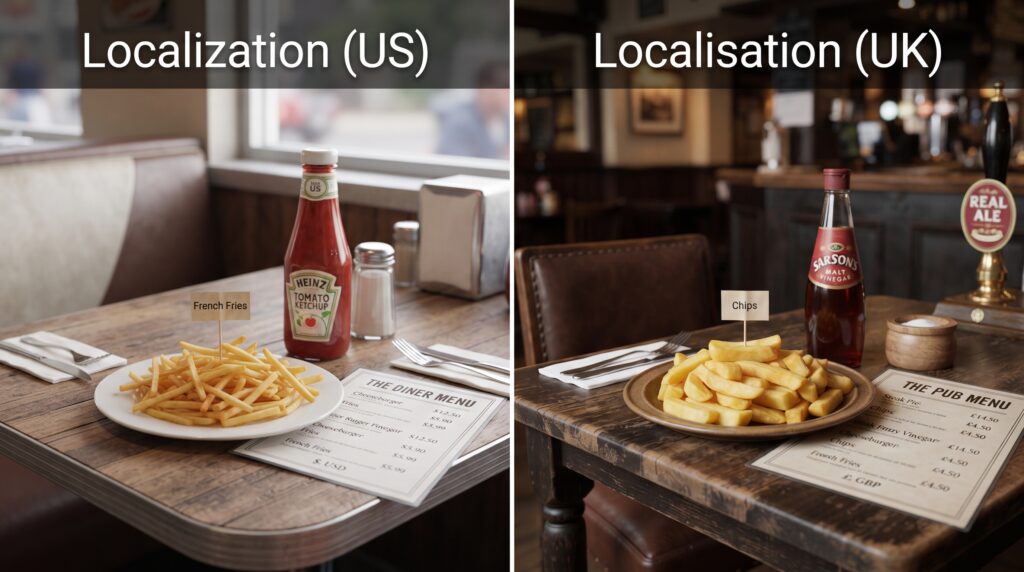
Localization or localisation is a common spelling question in English. Both words have the same basic meaning, but the spelling depends mainly on the variety of English being used.
Localization is the standard spelling in American English, while localisation is commonly used in British English and other varieties that follow British spelling conventions.
The two terms describe the process of adapting a product, service, website, software, document, or content to suit a particular country, region, language, or culture.
Knowing the difference between localization or localisation can help you choose the correct spelling for academic writing, business communication, websites, software documentation, and professional content.
Quick Answer
Localization and localisation mean the same thing.
The main difference is spelling:
- Localization is preferred in American English.
- Localisation is preferred in British English.
The difference comes from the spelling of the related verb:
- American English: localize
- British English: localise
Both forms are correct. Your choice should match your target audience and the English style used by your organization or publication.

What Does Localization Mean?
Localization is the American English spelling of the word.
It refers to adapting something for a particular local market, language, culture, or audience.
For example, a software company may adapt its application for users in different countries. This can involve changing:
- Language
- Currency
- Date formats
- Time formats
- Measurements
- Images
- Payment methods
- Cultural references
- Legal information
- User interface content
Example
The company invested in software localization before launching its product internationally.
In this sentence, localization is the standard American spelling.
What Does Localisation Mean?
Localisation has the same meaning as localization, but it follows British English spelling conventions.
It is commonly found in countries and organizations that use British English.
Example
The company invested in software localisation before launching its product internationally.
The meaning is exactly the same. Only the spelling changes.
Localization vs Localisation: Key Differences
| Feature | Localization | Localisation |
|---|---|---|
| Meaning | Adapting something for a local market or audience | Adapting something for a local market or audience |
| Spelling | American English | British English |
| Related verb | Localize | Localise |
| Common in | United States | United Kingdom and many British English contexts |
| Pronunciation | Essentially the same | Essentially the same |
| Grammar | Same | Same |
| Business usage | Common | Common |
| Software usage | Very common | Very common |
| Academic usage | Depends on style guide | Depends on style guide |
| International communication | Widely recognized | Widely recognized |
| Best use | American English content | British English content |
Is Localization or Localisation More Correct?
Neither spelling is universally more correct.
The correct choice depends on the English variety you’re using.
If your document follows American English, use localization.
If your document follows British English, use localisation.
The most important rule is consistency. Avoid switching between the two spellings within the same document unless you are specifically discussing the spelling difference.
American English: Localization
American English generally uses z in words such as:
- Localization
- Organization
- Realization
- Modernization
- Standardization
Therefore, American English writers normally use:
localization
American English Example
Our localization strategy focuses on the needs of American customers.
British English: Localisation
British English commonly uses s in these forms:
- Localisation
- Organisation
- Realisation
- Modernisation
- Standardisation
Therefore, British English writers commonly use:
localisation
British English Example
Our localisation strategy focuses on the needs of British customers.
Localization or Localisation in Business
Both spellings are widely used in international business.
Localization can involve adapting a company’s products or services for a specific market.
For example, a company entering a new country may need to change:
- Product information
- Website content
- Pricing
- Currency
- Customer support
- Marketing messages
- Payment systems
- Legal notices
The spelling should match the company’s chosen English style.
Localization or Localisation in Software
The term is especially common in the technology industry.
Software localization involves adapting software for users in different countries or regions.
This can include:
- Translating interface text
- Adjusting date formats
- Changing currencies
- Adapting measurements
- Supporting local keyboards
- Adjusting cultural references
- Adapting legal requirements
Both software localization and software localisation describe the same process.
Localization or Localisation in Websites
Website localization involves adapting a website for a specific audience.
A localized website may include:
- Local language
- Local currency
- Regional spelling
- Local contact information
- Appropriate date formats
- Local payment methods
- Culturally suitable images
- Region specific legal information
For example, an American website may use color and localization, while a British website may use colour and localisation.
Localization or Localisation in Marketing
Marketing localization goes beyond direct translation.
A successful localized marketing campaign considers the culture, expectations, language, and buying habits of a specific audience.
A slogan that works well in one country may not have the same effect in another.
This is why companies often adapt their:
- Advertising
- Social media content
- Product descriptions
- Brand messages
- Promotional offers
- Customer communications
The goal is to make content feel appropriate for the intended market.
Localization vs Translation
Localization and translation are related, but they aren’t exactly the same.
Translation focuses primarily on converting text from one language into another.
Localization can include translation, but it also considers cultural and regional differences.
For example, localization may change:
- Currency
- Measurements
- Images
- Humor
- Dates
- Cultural references
- Legal requirements
Therefore, translation can be part of localization, but localization usually involves a broader adaptation process.
Localization or Localisation Examples
Here are examples using both spellings.
American English
Website localization helped the company reach new customers.
The software requires additional localization for the Japanese market.
Localization improves the user experience.
British English
Website localisation helped the company reach new customers.
The software requires additional localisation for the Japanese market.
Localisation improves the user experience.
Both sets of sentences are grammatically correct.
Common Words Related to Localization
The same spelling difference appears in several related words.
| American English | British English |
|---|---|
| Localize | Localise |
| Localization | Localisation |
| Localized | Localised |
| Localizing | Localising |
The general pattern is easy to remember.
American English commonly uses z.
British English commonly uses s.
Common Mistakes When Using Localization and Localisation
Using Both Spellings Randomly
Switching between localization and localisation can make your writing look inconsistent.
Choose one spelling based on your target audience.
Assuming One Form Is Wrong
Both forms are accepted in their respective English varieties.
Localization isn’t an incorrect version of localisation, and localisation isn’t an incorrect version of localization.
Confusing Localization With Translation
Localization includes more than language translation.
It can involve cultural, technical, legal, and regional adaptation.
Ignoring Your Style Guide
Businesses, universities, publishers, and websites may have specific spelling preferences.
Follow the style guide when one exists.
Mixing American and British English
Using American and British spelling randomly can reduce consistency.
For example, using color with localisation may be appropriate in some contexts, but if you’re following a strict American English style, you would normally use color and localization together.
When Should You Use Localization?
Use localization when:
- You’re writing in American English.
- Your audience is primarily in the United States.
- Your organization uses American English.
- Your style guide uses American spelling.
- You’re writing American English software documentation.
- You’re creating content for an American publication.
Example
Our localization team is preparing the application for the US market.
When Should You Use Localisation?
Use localisation when:
- You’re writing in British English.
- Your audience primarily uses British English.
- Your organization follows British spelling.
- Your style guide uses British English.
- You’re writing for a British publication.
- Your content is intended for markets that commonly follow British spelling.
Example
Our localisation team is preparing the application for the UK market.
Localization or Localisation for SEO
From an SEO perspective, the choice depends on the audience and keyword being targeted.
If your target audience searches primarily in American English, localization may be the more appropriate primary keyword.
If your target audience uses British English, localisation may be more appropriate.
Search engines can generally understand that the two terms are closely related, but your content should still use the spelling that matches your intended audience.
For SEO content, don’t force both spellings unnaturally. Use the primary form naturally throughout the article and mention the alternative spelling where it helps answer the user’s search intent.
FAQs
Are localization and localisation the same?
Yes. Localization and localisation have the same meaning. The main difference is regional spelling.
Which is correct, localization or localisation?
Both are correct. Localization is the standard American English spelling, while localisation is commonly used in British English.
Which spelling is more common?
Localization is widely used in American English and international technology contexts. Localisation is common in British English and other regions that follow British spelling.
Should I use localization or localisation on my resume?
Use the spelling that matches the English style used by your target employer or industry. If you’re applying to an American company, localization is usually appropriate. For a British organization, localisation may be preferable.
Do localization and localisation have different meanings?
No. They have the same basic meaning. The difference is primarily spelling.
Is localization American or British English?
Localization is the standard American English spelling.
Is localisation British English?
Yes. Localisation is commonly used in British English.
What is the difference between localize and localise?
Localize is the American English spelling, while localise is the British English spelling.
Is localization the same as translation?
No. Translation changes text from one language to another. Localization is broader and can include language, cultural, technical, legal, and regional adaptations.
Which spelling should I use for an international website?
Choose the spelling that matches your main audience and website style. If the site serves multiple English speaking markets, maintain a consistent style or follow your organization’s preferred English convention.
Conclusion
The difference between localization or localisation is mainly a matter of regional spelling, not meaning.
Localization is the standard American English form, while localisation is widely used in British English and other English varieties influenced by British spelling.
Both terms describe adapting products, software, websites, services, or content for a particular local audience or market.
If you’re writing for an American audience, choose localization. If you’re writing for a British English audience, choose localisation.
The most important point is consistency. Select the spelling that matches your audience, organization, publication, or style guide, and use it consistently throughout your content.