

The question of sarcoma or lipoma can be worrying when you discover a new lump under the skin. Both can appear as a mass or lump, but they are very different conditions.
A lipoma is a common benign growth made mainly of fat cells. It is usually soft, movable under the skin, and slow growing. Most lipomas are harmless and do not require treatment unless they cause symptoms or other concerns.
A sarcoma, on the other hand, is a type of cancer that can develop in bone or soft tissues such as muscle, fat, blood vessels, nerves, and connective tissue. Soft tissue sarcomas are uncommon, but recognizing concerning features can help people seek appropriate medical assessment. (cancer.gov)
Not every lump is cancer, and most lumps have harmless causes. However, a new or changing lump should not be diagnosed from appearance alone.
Quick Answer
A lipoma is usually a harmless, slow growing fatty lump, while a sarcoma is a cancerous tumor that can develop in soft tissue or bone.
A typical lipoma is often:
- Soft or rubbery
- Movable under the skin
- Slow growing
- Painless
- Located just beneath the skin
A soft tissue sarcoma may be:
- Firm
- Deeper under the skin
- Difficult to move
- Increasing in size
- Sometimes painful
- Located in the arms, legs, abdomen or other parts of the body
These features are clues, not a diagnosis. Some sarcomas may initially be painless, and some lipomas can be firm or uncomfortable.
If a lump is new, growing, deep, painful, or otherwise concerning, a healthcare professional should evaluate it.
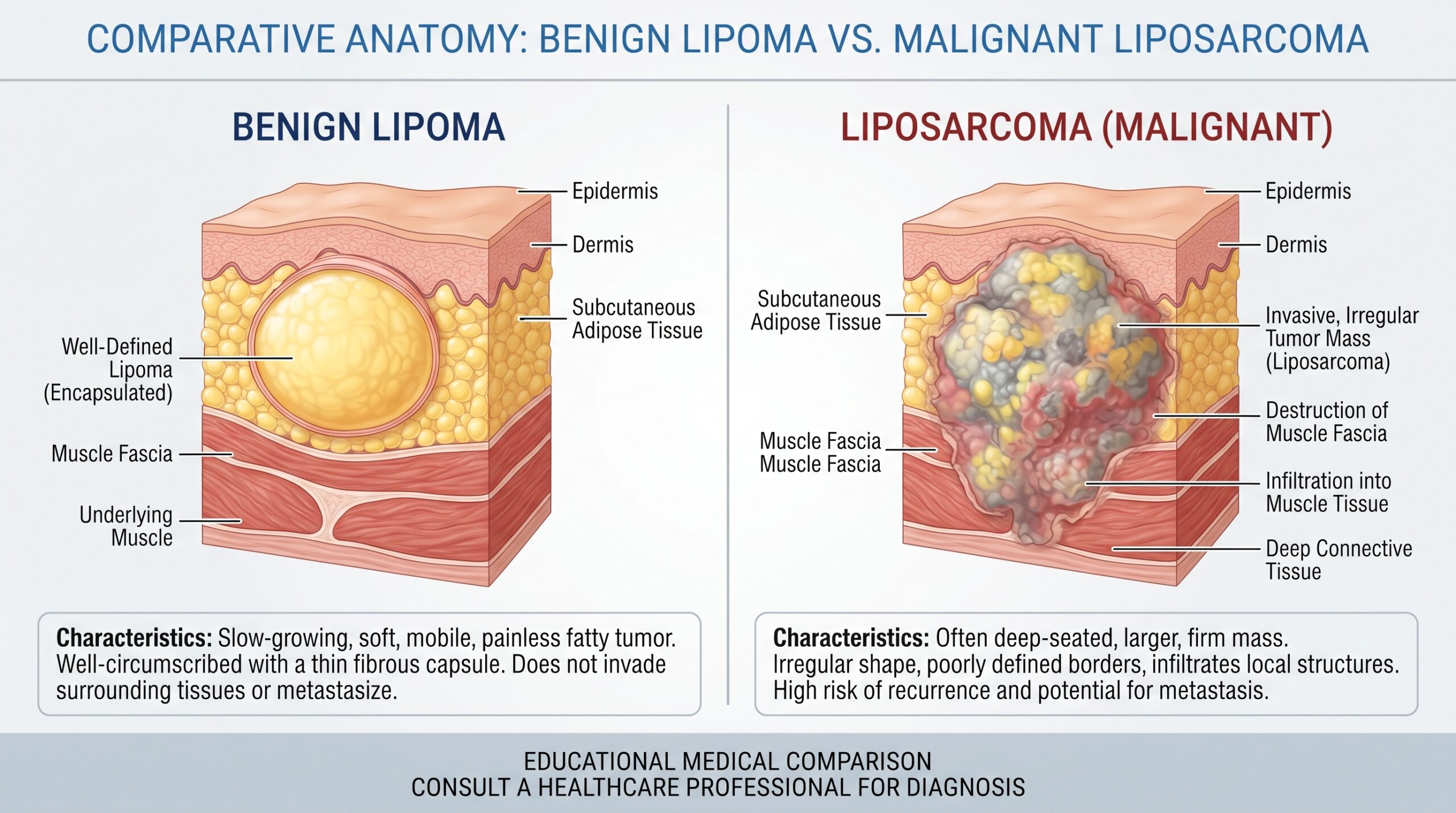
What Is a Lipoma?
A lipoma is a benign tumor made of fat cells.
Lipomas commonly develop beneath the skin and can occur almost anywhere on the body. They are often slow growing and may remain the same size for years.
According to the NHS, lipomas are usually harmless and generally do not need treatment unless they become troublesome. (nhs.uk)
Common characteristics include:
- Soft or doughy texture
- Easy movement when pressed
- Slow growth
- Usually painless
- Located under the skin
- Usually harmless
Lipomas can occur at any age but are particularly common in middle aged adults.
What Is Sarcoma?
Sarcoma is a group of cancers that develop in bone or soft tissues.
Soft tissue sarcoma can develop in tissues such as:
- Muscle
- Fat
- Blood vessels
- Nerves
- Tendons
- Fibrous tissue
- Deep connective tissue
There are many different types of sarcoma, and they can behave differently.
The National Cancer Institute explains that soft tissue sarcomas can begin in soft tissues and may occur in many areas of the body. (cancer.gov)
Sarcomas are uncommon compared with many other types of cancer, but a suspicious lump should be evaluated rather than assumed to be a lipoma.
Sarcoma or Lipoma: Key Differences
| Feature | Lipoma | Sarcoma |
|---|---|---|
| Nature | Usually benign | Cancerous |
| Tissue | Fat tissue | Soft tissue or bone |
| Growth | Usually slow | May grow progressively |
| Texture | Often soft or rubbery | May be firm |
| Movement | Often movable | May be deeper or less mobile |
| Pain | Usually painless | May cause pain, but can be painless |
| Location | Often just under skin | Can occur deep in tissue |
| Size | Often small or moderate | Can become large |
| Skin changes | Usually absent | May occur depending on location |
| Treatment | Often observation | Usually requires cancer treatment |
| Diagnosis | Clinical exam, imaging or biopsy when needed | Imaging and biopsy are often required |
A key point is that you cannot reliably distinguish a lipoma from a sarcoma just by touching a lump. Medical assessment is important when a lump has concerning features.
1. Growth Rate
Growth rate is one factor doctors consider.
Lipomas generally grow slowly. Some remain unchanged for long periods.
A lump that grows noticeably over a short period deserves medical assessment.
Sarcomas can grow progressively, although growth patterns vary between different types and individual patients.
A rapidly growing lump does not automatically mean cancer, but it is a reason to seek professional evaluation.
2. Size
Size can provide useful information, but it cannot diagnose a sarcoma.
Many lipomas are relatively small, although some can become large.
Soft tissue sarcomas may also grow to a significant size before diagnosis, particularly when they develop deep inside the body.
According to the NHS, a lump that is larger than about 5 cm, increasing in size, painful, or deep within tissue may require urgent assessment. (nhs.uk)
3. Location
Lipomas commonly appear directly beneath the skin.
Sarcomas can occur deeper in the body.
A deep lump that cannot easily be moved may require additional investigation, particularly if it continues to grow.
Location alone cannot determine whether a lump is benign or malignant.
4. Texture
Lipomas often feel soft and rubbery.
Some may feel slightly firmer depending on their composition and location.
Sarcomas can feel firm or hard, but this is not universal.
Because lumps can vary considerably, texture should never be used as the only way to determine whether a growth is cancerous.
5. Movement
A typical lipoma often moves slightly when pressure is applied.
This is because it is usually located in the tissue beneath the skin.
A deeper mass may feel fixed or difficult to move.
However, a movable lump is not automatically harmless, and an immovable lump is not automatically cancerous.
A professional examination provides much more reliable information.
6. Pain
Most lipomas do not cause pain.
Some can become painful if they press against nearby nerves or other structures.
Sarcomas can cause pain, but they can also be painless.
This is important because lack of pain does not rule out sarcoma.
A painless lump that continues to grow should still be assessed.
7. Skin Changes
Lipomas usually do not cause major changes to the skin covering them.
Sarcomas can sometimes produce changes depending on their size, depth and location.
Possible changes may include swelling or a visible mass.
However, skin appearance alone cannot determine whether a lump is malignant.
8. Depth
One of the important differences between sarcoma and lipoma is depth.
A typical lipoma is often found directly beneath the skin.
Soft tissue sarcomas can develop deeper within muscle or other tissues.
A lump that appears deep or cannot easily be moved may need further investigation.
9. Warning Signs
Certain features make a lump more important to investigate.
These include:
- Rapid growth
- Increasing size
- Deep location
- Firm or hard texture
- Difficulty moving the lump
- Persistent pain
- A lump larger than approximately 5 cm
The NHS recommends urgent medical assessment for a lump that is growing, painful, hard, or difficult to move, particularly when it is larger than 5 cm. (nhs.uk)
Having one of these signs does not mean you have sarcoma. It means the lump deserves appropriate medical evaluation.
10. Diagnosis
Doctors may use several methods to investigate a lump.
These can include:
- Physical examination
- Ultrasound
- MRI
- CT scan
- Other imaging
- Biopsy
For a suspected sarcoma, imaging can help determine the size and location of a mass, while a biopsy can provide tissue for laboratory examination.
The exact diagnostic process depends on the location and characteristics of the lump.
The NHS notes that ultrasound may be used to investigate a lump, while further scans and biopsy may be required if sarcoma is suspected. (nhs.uk)
11. Treatment
Treatment depends on the diagnosis.
Lipoma Treatment
Most lipomas do not need treatment.
A doctor may recommend monitoring a lipoma if it is small, painless and not causing problems.
Removal may be considered if it:
- Causes pain
- Interferes with movement
- Continues to grow
- Becomes troublesome
- Causes concern about the diagnosis
Surgical removal is a common treatment when removal is necessary. (nhs.uk)
Sarcoma Treatment
Sarcoma treatment depends on the type, stage, location and other factors.
Treatment may involve:
- Surgery
- Radiotherapy
- Chemotherapy
- Targeted treatments
- Other specialist cancer treatments
The treatment plan is normally developed by a specialist team.
Sarcoma or Lipoma: Diagnosis Comparison
| Diagnostic Method | Lipoma | Sarcoma |
| Physical examination | Commonly used | Commonly used |
| Ultrasound | May be used | May be used |
| MRI | Sometimes used | Frequently useful |
| CT scan | Sometimes used | May be used |
| Biopsy | Sometimes needed | Important when cancer is suspected |
| Laboratory examination | May confirm tissue type | Determines tumor characteristics |
| Specialist assessment | Sometimes | Often required |
Not every lump requires every test. The appropriate investigation depends on the individual case.
Common Types of Lipoma
Several variations of lipoma exist.
Common examples include:
- Conventional lipoma
- Fibrolipoma
- Angiolipoma
- Intramuscular lipoma
- Spindle cell lipoma
Most lipomas are benign.
Some types can have different characteristics, which is another reason medical assessment may be useful when a lump changes.
Common Types of Soft Tissue Sarcoma
There are many types of soft tissue sarcoma.
Examples include:
- Liposarcoma
- Leiomyosarcoma
- Synovial sarcoma
- Undifferentiated pleomorphic sarcoma
- Rhabdomyosarcoma
- Angiosarcoma
Each type can behave differently and may require different treatment.
The National Cancer Institute provides detailed information about soft tissue sarcoma types and treatment. (cancer.gov)
Lipoma or Liposarcoma: Are They the Same?
No.
A lipoma is a benign fatty tumor.
A liposarcoma is a malignant tumor that develops from fat tissue.
The names can sound similar, but they are different conditions.
A typical lipoma does not simply “turn into” liposarcoma. However, a mass initially thought to be a lipoma may require investigation if it has unusual features.
When Should You See a Doctor?
You should arrange a medical assessment if you notice a lump that:
- Is growing
- Is painful
- Feels hard or firm
- Is difficult to move
- Is deep beneath the skin
- Is larger than approximately 5 cm
- Has changed noticeably
- Remains unexplained
The NHS specifically advises seeking medical attention for lumps that are increasing in size or are painful, hard or difficult to move. (nhs.uk)
Don’t panic if you notice one of these features. Many lumps are still benign. The purpose of medical assessment is to determine the cause rather than to assume the worst.
Common Mistakes When Comparing Sarcoma and Lipoma
Mistake 1: Assuming Every Lump Is Cancer
Most lumps are not cancer.
A lump can have many causes, including benign growths, cysts, infections and other conditions.
Mistake 2: Assuming Every Soft Lump Is a Lipoma
A soft lump should not automatically be diagnosed as a lipoma.
A healthcare professional may need to examine it.
Mistake 3: Ignoring a Growing Lump
Growth is an important feature to discuss with a doctor.
Don’t ignore a lump simply because it does not hurt.
Mistake 4: Using Internet Photos for Diagnosis
Online images can be useful for education but cannot determine what a particular lump is.
Different conditions can look similar.
Mistake 5: Waiting Because the Lump Is Painless
Some serious tumors can initially be painless.
A growing or otherwise concerning lump should be evaluated even when there is no pain.
Mistake 6: Trying to Remove a Lump Yourself
Never attempt to puncture, cut or remove an unexplained lump at home.
Medical evaluation is safer and can help determine the correct diagnosis.
Pros and Cons of Self Assessment
Pros
- Helps you notice changes
- Helps you describe symptoms to a doctor
- Can help you monitor growth
- Encourages awareness of warning signs
Cons
- Cannot provide a reliable diagnosis
- Different lumps can look similar
- Internet information can cause unnecessary anxiety
- Serious conditions can sometimes appear without obvious symptoms
Self assessment should be used to decide when to seek professional advice, not to replace professional diagnosis.
FAQs
Is a lipoma the same as a sarcoma?
No. A lipoma is usually a benign fatty tumor, while sarcoma is a type of cancer that can develop in soft tissue or bone.
How can you tell a lipoma from a sarcoma?
A typical lipoma is often soft, movable and slow growing. A sarcoma may be deeper, firm, difficult to move or progressively increasing in size. However, these characteristics cannot reliably diagnose a tumor.
Can a lipoma become cancerous?
A typical lipoma is benign. Lipomas do not normally transform into sarcoma. However, a new or changing lump should be medically assessed rather than self diagnosed.
Is a sarcoma always painful?
No. Sarcomas can be painless, particularly during their early stages. A painless lump can still require assessment if it grows or has other concerning features.
Is a growing lipoma dangerous?
Many lipomas are harmless, but a rapidly growing or changing lump should be checked by a healthcare professional to determine the cause.
What size lump should be checked for sarcoma?
A lump larger than approximately 5 cm, particularly if it is growing, painful, hard or deep, should receive medical assessment. (nhs.uk)
Can ultrasound tell if a lump is a lipoma?
Ultrasound can provide useful information about a lump, but additional imaging or a biopsy may sometimes be needed to establish the diagnosis.
Can an MRI detect sarcoma?
MRI can provide detailed images of soft tissues and is commonly used when a soft tissue sarcoma is suspected. A biopsy may still be required to confirm the diagnosis.
Which is more common, sarcoma or lipoma?
Lipomas are much more common than soft tissue sarcomas. Sarcomas are considered rare cancers.
Should every lump be removed?
No. Many harmless lumps do not require removal. Treatment depends on the diagnosis, symptoms, size, location and other factors.
What are the warning signs of sarcoma?
Important warning signs include a growing lump, a lump larger than approximately 5 cm, a deep or firm mass, difficulty moving the lump and persistent pain. These signs do not prove cancer, but they warrant medical evaluation. (nhs.uk)
Conclusion
The difference between sarcoma or lipoma is important, but it cannot always be determined simply by looking at or touching a lump.
A lipoma is usually a harmless fatty growth that is soft, movable and slow growing. A sarcoma is a cancer that can develop in soft tissue or bone and may present as a growing mass.
Some warning signs deserve particular attention, including a lump that is growing, painful, firm, deep, difficult to move, or larger than approximately 5 cm. (nhs.uk)
However, having one or more of these features does not automatically mean that a lump is cancerous. Many benign conditions can produce similar symptoms.
If you discover a new or changing lump, the safest approach is to have it assessed by a healthcare professional rather than trying to diagnose it yourself.