

Are you comparing Contrave or Qsymia for prescription weight management? Both are FDA approved medicines used along with a reduced calorie diet and increased physical activity, but they contain different active ingredients and have different safety considerations.
Contrave contains naltrexone and bupropion, while Qsymia contains phentermine and topiramate extended release. Because these medicines work differently and have different contraindications, the right choice depends on a person’s medical history, other medicines, treatment goals, and response to therapy.
This guide explains the key differences between Contrave or Qsymia, including ingredients, how they work, eligibility, dosing, common side effects, important warnings, and questions to discuss with a healthcare professional.
Important: This article is for general education and isn’t a substitute for medical advice. Don’t start, stop, or switch prescription weight management medicine without discussing it with your healthcare professional.
Quick Answer
Contrave is an extended release combination of naltrexone and bupropion.
Qsymia combines phentermine with extended release topiramate.
Both are prescription medicines used as part of a broader weight management plan. However, they aren’t interchangeable, and each has important contraindications and warnings.
The best choice isn’t simply the medicine that sounds stronger. A healthcare professional should consider your health history, current medications, potential side effects, and individual treatment needs.
What Is Contrave?
Contrave is a prescription extended release tablet containing two active ingredients:
- Naltrexone hydrochloride
- Bupropion hydrochloride
The FDA indicates Contrave, together with a reduced calorie diet and increased physical activity, for chronic weight management in adults with obesity or adults with overweight plus at least one weight related condition.
Contrave isn’t intended to replace healthy eating or physical activity. It is part of a broader weight management program.
What Is Qsymia?
Qsymia is an extended release capsule containing:
- Phentermine
- Topiramate
The FDA indicates Qsymia with a reduced calorie diet and increased physical activity for long term weight management in adults with obesity and adults with overweight who have at least one weight related condition. It is also approved for certain pediatric patients aged 12 years and older with obesity.
Qsymia has specific safety requirements and contraindications that should be reviewed before treatment.
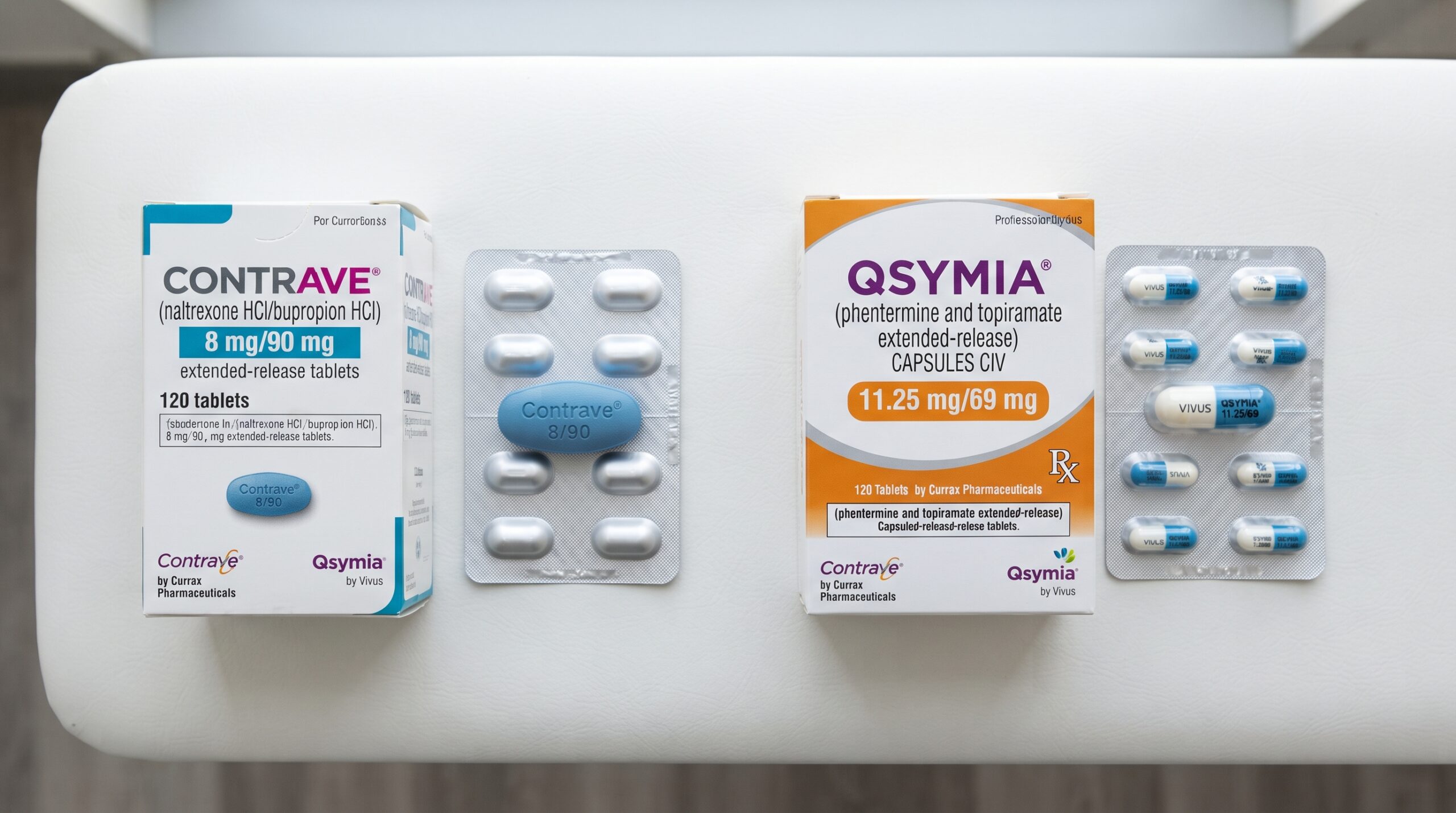
Contrave or Qsymia: Key Differences
| Feature | Contrave | Qsymia |
|---|---|---|
| Active ingredients | Naltrexone + bupropion | Phentermine + topiramate |
| Form | Extended release tablets | Extended release capsules |
| Main use | Chronic weight management | Long term weight management |
| Diet and exercise | Used with both | Used with both |
| Adult obesity indication | Yes | Yes |
| Adult overweight with weight related condition | Yes | Yes |
| Pediatric indication | Not the same indication | Approved for certain patients aged 12 and older |
| Important pregnancy concern | Contraindicated | Contraindicated |
| Controlled substance | No | Yes, Qsymia contains phentermine |
| Key safety concerns | Seizures, blood pressure, opioid interactions, mood related warnings | Pregnancy related fetal harm, glaucoma, cognitive effects, metabolic acidosis, mood and sleep effects |
The exact prescribing requirements and warnings should always be checked against current official labeling.
1. Contrave or Qsymia: Which Ingredients Are Different?
The ingredients are one of the most important differences.
Contrave combines naltrexone and bupropion.
Qsymia combines phentermine and topiramate.
Because the medicines contain different active ingredients, their effects, interactions, contraindications, and side effect profiles differ.
This is why you shouldn’t assume that one medicine is automatically appropriate simply because another prescription weight management medicine didn’t work for you.
2. Contrave or Qsymia: How Do They Work?
The two medicines work through different mechanisms.
Contrave combines two medicines that affect pathways involved in appetite and reward related processes.
Qsymia combines phentermine, which has appetite suppressant activity, with topiramate, which affects several neurological pathways associated with appetite and food intake.
The exact biological effects are more complicated than simply describing either medicine as an appetite suppressant.
Your healthcare professional can explain how each option fits your individual situation.
3. Contrave or Qsymia: Who May Be Eligible?
FDA labeling for both medicines includes adults with obesity and certain adults with overweight who also have at least one weight related condition.
However, eligibility doesn’t mean that either medicine is appropriate for everyone.
A healthcare professional may consider:
- BMI
- Weight related medical conditions
- Current medicines
- Blood pressure
- Mental health history
- Seizure history
- Kidney or liver function
- Pregnancy status
- Other health conditions
Qsymia also has an FDA approved indication for certain pediatric patients aged 12 years and older with obesity.
4. Contrave or Qsymia: Pregnancy Considerations
Pregnancy is an especially important consideration.
Contrave is contraindicated during pregnancy.
Qsymia is also contraindicated during pregnancy, and its labeling includes a specific warning about fetal harm associated with topiramate exposure. Pregnancy testing is recommended before starting treatment and monthly during therapy for patients who can become pregnant.
If you are pregnant, planning pregnancy, or could become pregnant, discuss this with your healthcare professional before using either medicine.
5. Contrave or Qsymia: Common Side Effects
Both medicines can cause side effects, but their profiles differ.
Common adverse reactions reported with Contrave include:
- Nausea
- Constipation
- Headache
- Vomiting
- Dizziness
- Insomnia
- Dry mouth
- Diarrhea
Common adverse reactions reported with Qsymia include:
- Paresthesia
- Dizziness
- Changes in taste
- Insomnia
- Constipation
- Dry mouth
Side effects vary from person to person. A healthcare professional can help determine whether a symptom is expected or requires medical attention.
6. Contrave or Qsymia: Important Contraindications
This is one of the most important areas to compare.
Contrave has important contraindications involving conditions and medicines such as uncontrolled hypertension, seizure disorders, certain eating disorders, opioid use, abrupt withdrawal from certain substances, monoamine oxidase inhibitors, and allergy to its ingredients.
Qsymia is contraindicated during pregnancy and in people with certain conditions or medication exposures, including glaucoma, hyperthyroidism, recent monoamine oxidase inhibitor use, and hypersensitivity to sympathomimetic amines.
These differences are a major reason why medication selection should be individualized.
7. Contrave or Qsymia: Drug Interactions Matter
Prescription weight management medicines can interact with other drugs.
Contrave is particularly important to review if someone uses opioid medicines because naltrexone blocks opioid receptors. The FDA labeling also identifies other important medication related contraindications and interactions.
Qsymia also has important medication interactions and precautions. Its labeling includes considerations involving monoamine oxidase inhibitors, central nervous system depressants, certain diuretics, and oral contraceptives.
Before starting either medicine, provide your healthcare professional with a complete list of prescription medicines, over the counter products, and supplements you use.
8. Contrave or Qsymia: Monitoring and Follow Up
Weight management medication usually requires follow up rather than simply taking a prescription indefinitely without evaluation.
Your healthcare professional may monitor:
- Weight
- BMI
- Blood pressure
- Heart rate
- Side effects
- Other medical conditions
- Medication interactions
- Treatment response
Qsymia labeling includes specific recommendations for monitoring pregnancy, blood chemistry, bicarbonate, creatinine, potassium, and glucose in certain patients.
The appropriate monitoring plan depends on the individual medicine and the patient’s health.
9. Contrave or Qsymia: Which Is Better?
There isn’t one universally best option for everyone.
Contrave may be considered when its ingredients and safety profile fit a person’s medical situation.
Qsymia may be considered when its ingredients and treatment profile are appropriate.
However, the choice should be based on medical factors rather than online comparisons alone.
A healthcare professional may consider:
- Your health conditions
- Your current medications
- Your weight management goals
- Previous treatment response
- Potential side effects
- Pregnancy considerations
- Blood pressure
- Seizure history
- Opioid use
- Kidney and metabolic considerations
Contrave vs Qsymia: Side By Side Comparison
| Question | Contrave | Qsymia |
| What does it contain? | Naltrexone and bupropion | Phentermine and topiramate |
| Used for chronic weight management? | Yes | Yes |
| Used with diet and exercise? | Yes | Yes |
| Can pregnancy affect use? | Yes, contraindicated | Yes, contraindicated |
| Important seizure considerations? | Yes | Yes, particularly with abrupt discontinuation of high dose Qsymia |
| Opioid interaction concern? | Major consideration | Different interaction profile |
| Glaucoma concern? | Important warning | Contraindication |
| Blood pressure concern? | Important | Requires monitoring |
| Controlled substance? | No | Yes |
| Pediatric indication? | Not the same indication | Certain patients aged 12 years and older |
Always use the current official prescribing information when making treatment decisions.
Contrave or Qsymia: What Should You Ask Your Doctor?
Before choosing a prescription weight management medicine, consider asking:
- Which medication is appropriate for my health history?
- Do any of my current medicines interact with it?
- What side effects should I watch for?
- How will my progress be monitored?
- What should I do if I don’t respond adequately?
- How long should treatment continue?
- What happens if I need to stop the medication?
- Are there pregnancy related concerns?
- Do I have any conditions that make this medication unsafe?
These questions can help make the discussion more useful and personalized.
Common Mistakes When Comparing Contrave and Qsymia
Mistake 1: Choosing Based Only on Weight Loss Claims
Medication response varies between individuals. Online claims shouldn’t replace medical evaluation.
Mistake 2: Ignoring Drug Interactions
Always tell your healthcare professional about all medicines and supplements you use.
Mistake 3: Ignoring Pregnancy Considerations
Both medicines have important pregnancy restrictions. Qsymia carries a specific fetal harm warning related to topiramate.
Mistake 4: Treating Them Like Over The Counter Products
Both are prescription medicines with important safety considerations.
Mistake 5: Stopping Medication Without Guidance
Some medicines require specific discontinuation procedures. For example, the Qsymia prescribing information states that the highest dose should be gradually discontinued to reduce the risk of seizures.
FAQs
Is Contrave better than Qsymia?
Neither is universally better. The appropriate choice depends on individual health factors, medication interactions, treatment response, and safety considerations.
What is the main difference between Contrave and Qsymia?
Contrave contains naltrexone and bupropion, while Qsymia contains phentermine and topiramate. They have different mechanisms, contraindications, interactions, and side effect profiles.
Can Contrave and Qsymia be taken together?
Do not combine prescription weight management medicines unless a qualified healthcare professional specifically directs you to do so. The safety and effectiveness of combining these medicines with other weight loss products have not necessarily been established.
Which has fewer side effects?
There is no universal answer. Side effects differ between the medicines and between individuals.
Can I take Contrave if I use opioid pain medicine?
This requires careful medical evaluation. Contrave contains naltrexone, which blocks opioid receptors, and opioid use is an important contraindication or treatment consideration.
Can I take Qsymia during pregnancy?
No. Qsymia is contraindicated during pregnancy because it can cause fetal harm.
Is Qsymia a controlled substance?
Yes. Qsymia contains phentermine and is classified as a controlled substance in the United States.
Can Contrave cause nausea?
Yes. Nausea is among the common adverse reactions reported with Contrave.
Can Qsymia cause insomnia?
Yes. Insomnia is among the commonly reported adverse reactions, and the prescribing information recommends taking Qsymia in the morning rather than in the evening.
Which one should I choose?
The decision should be made with a healthcare professional who knows your medical history and current medications.
Conclusion
When comparing Contrave or Qsymia, the most important point is that these are different prescription medicines with different ingredients, mechanisms, contraindications, interactions, and safety considerations.
Contrave contains naltrexone and bupropion, while Qsymia contains phentermine and topiramate. Both are intended to be used alongside a reduced calorie diet and increased physical activity for appropriate patients.
There is no single medicine that is automatically the best choice for everyone. The right option depends on individual health factors, current medications, treatment goals, and potential risks.
If you’re considering Contrave or Qsymia, discuss both options with your healthcare professional before starting or changing treatment.