

Enforce or Inforce: Complete Guide to Understanding the Difference
English spelling can be confusing, especially when two words look almost identical. Enforce or Inforce is a common confusion because both words appear similar, but only one is widely accepted in modern English.
Many people use these words incorrectly because they sound close when spoken. Understanding the correct usage helps improve writing, communication, and grammar accuracy.
Although they look similar, they do not have the same meaning or usage.
This guide explains the difference between Enforce or Inforce, including definitions, examples, common mistakes, and easy memory tricks.
.
Quick Answer: Enforce or Inforce?
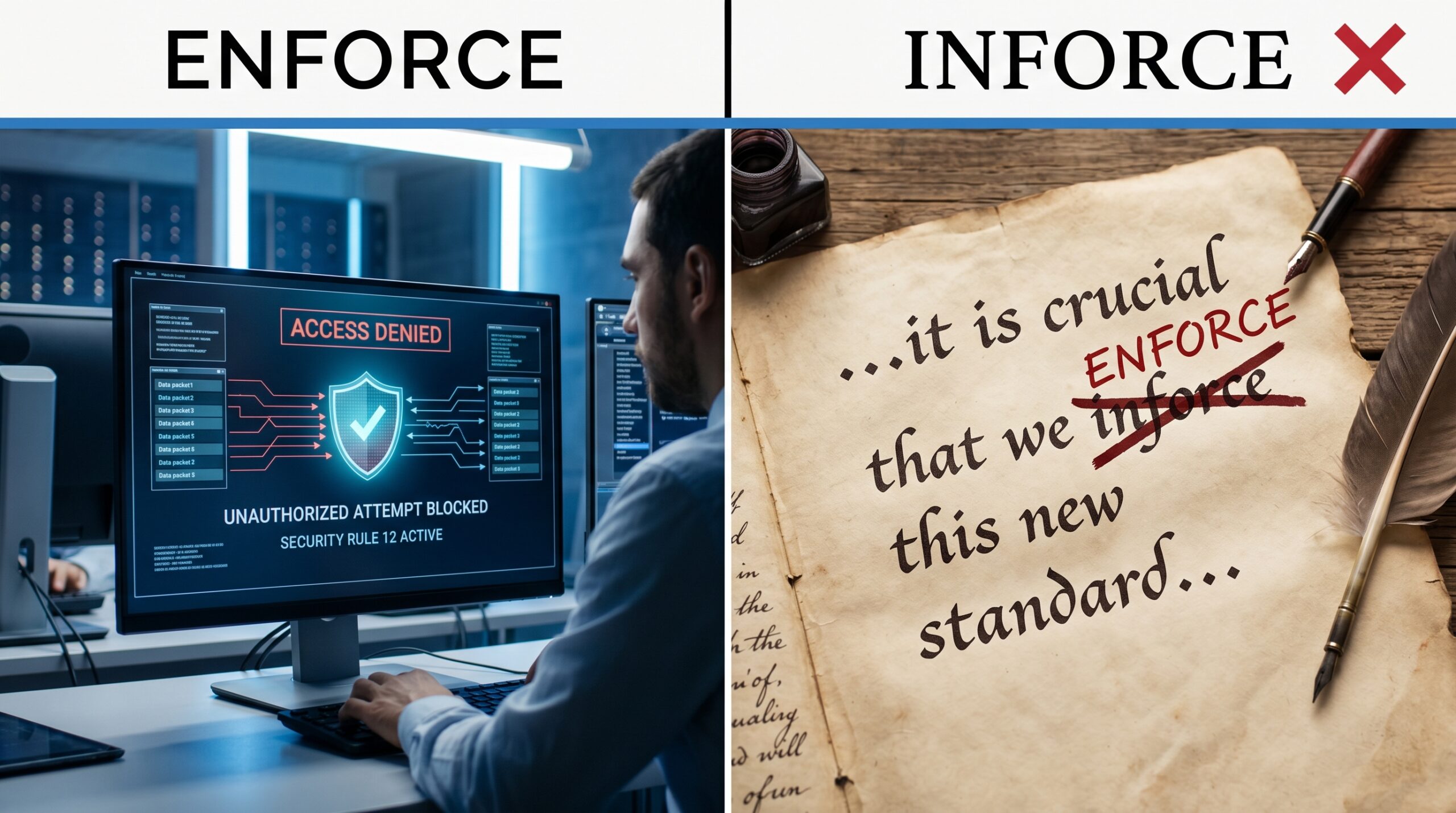
Enforce is the correct and commonly used English word. It means to make sure a rule, law, or agreement is followed. Inforce is generally considered incorrect or a rare outdated spelling.
Use:
✅ Enforce the law
❌ Inforce the law
What Does Enforce Mean?
Enforce means to make people follow a rule, law, requirement, or agreement.
It is commonly used in legal, workplace, and social situations.
Common Uses of Enforce
Enforce is used with:
• Laws
• Rules
• Regulations
• Policies
• Agreements
Examples
• “The police enforce traffic laws.”
• “The company enforces strict safety rules.”
• “Teachers enforce classroom guidelines.”
Key Insight: Enforce means to make something happen or ensure compliance.
What Does Inforce Mean?
Inforce is not considered standard modern English in most situations.
It may appear as:
• A spelling mistake of enforce
• A rare historical variation
• A specialized term in limited contexts
For everyday writing and communication, enforce is the correct choice.
Examples of Incorrect Usage
❌ “The government will inforce the new rule.”
Correct:
✅ “The government will enforce the new rule.”
Key Insight: In most cases, avoid using inforce.
Enforce or Inforce: Main Differences
| Feature | Enforce | Inforce |
|---|---|---|
| Meaning | Make rules happen | Usually incorrect spelling |
| Usage | Common modern English | Rare or outdated |
| Grammar | Correct verb | Not normally accepted |
| Example | Enforce a law | Avoid using |
| Context | Rules, policies, agreements | Limited usage |
Real World Usage Scenarios
Scenario 1
Police: “We will enforce the law strictly.”
🎯 Lesson: Enforce is used for rules and authority.
Scenario 2
Student: “Teachers inforce discipline rules.”
Teacher: “Correct word is enforce.”
🎯 Lesson: Inforce is incorrect.
Scenario 3
Insurance document: “The policy is in force.”
🎯 Lesson: The correct phrase is “in force,” not “inforce.”
Scenario 4
Government: “We enforce safety regulations.”
🎯 Lesson: Enforce is standard in official language.
Scenario 5
Writer: “The rule is inforce.”
Editor: “Use ‘in force’ or rewrite the sentence.”
🎯 Lesson: Space matters in legal phrases.
Common Mistakes
Mistake 1: Writing Inforce Instead of Enforce
Why it happens:
Confusion from pronunciation.
Correction:
Always use enforce.
Mistake 2: Mixing “inforce” and “in force”
Why it happens:
Misunderstanding legal terms.
Correction:
“In force” is the correct phrase.
Mistake 3: Using Enforce in Non-rule Contexts Incorrectly
Why it happens:
Overgeneralization.
Correction:
Enforce applies to rules, laws, and authority.
Mistake 4: Assuming Both Are Correct
Why it happens:
Visual similarity.
Correction:
Only enforce is standard verb usage.
Memory Tricks
Remember Enforce
Enforce = Ensure Force of Law
Think authority applying rules.
Remember In Force
In Force = In effect
Think something is active or valid.
Expert Insight
The word enforce comes from the idea of applying force or authority to make something happen.
Modern English uses enforce as the standard spelling for applying laws, rules, and agreements.
The spelling inforce may appear in older texts or specific situations, but it is not the normal choice for everyday English writing.
Using the correct spelling improves clarity and prevents confusion
Conclusion
When comparing enforce or inforce, the rule is simple.
- Enforce is correct and widely used in English
- Inforce is incorrect as a verb in modern usage
- The correct phrase is “in force”, not “inforce”
- Enforce is used for applying rules, laws, and authority
If you are writing or speaking in English, always choose enforce for correct and professional usage.
