
Are you confused about whether something is an atom or ion? These two chemistry terms are closely related, but they are not exactly the same. An atom is the basic unit of an element and normally has no overall electrical charge. An ion is an atom or group of atoms that has gained or lost electrons and therefore carries an electrical charge.
Understanding the difference between an atom or ion is essential for learning chemistry, especially when studying chemical bonding, reactions, electricity, and the periodic table. In this guide, you’ll learn the key differences between atoms and ions, how electrons affect charge, and simple examples that make the concept easier to understand.
Quick Answer
An atom is electrically neutral when it has an equal number of protons and electrons.
An ion is electrically charged because it has gained or lost one or more electrons.
For example, a neutral sodium atom has 11 protons and 11 electrons. When sodium loses one electron, it becomes a positively charged sodium ion, written as Na⁺.
The simplest rule is:
Atom = neutral
Ion = charged
What Is an Atom?
An atom is the smallest unit of an element that retains the chemical properties of that element.
Atoms contain three main subatomic particles:
- Protons
- Neutrons
- Electrons
Protons and neutrons are found inside the nucleus, while electrons occupy regions around the nucleus.
The number of protons determines which element an atom represents.
For example:
- Hydrogen has 1 proton
- Carbon has 6 protons
- Oxygen has 8 protons
- Sodium has 11 protons
A neutral atom has the same number of protons and electrons.
What Is an Ion?
An ion is an atom or group of atoms with a net electrical charge.
An ion forms when an atom gains or loses electrons.
If an atom loses electrons, it becomes positively charged.
If an atom gains electrons, it becomes negatively charged.
There are two major types of ions:
Cations: Positively charged ions
Anions: Negatively charged ions
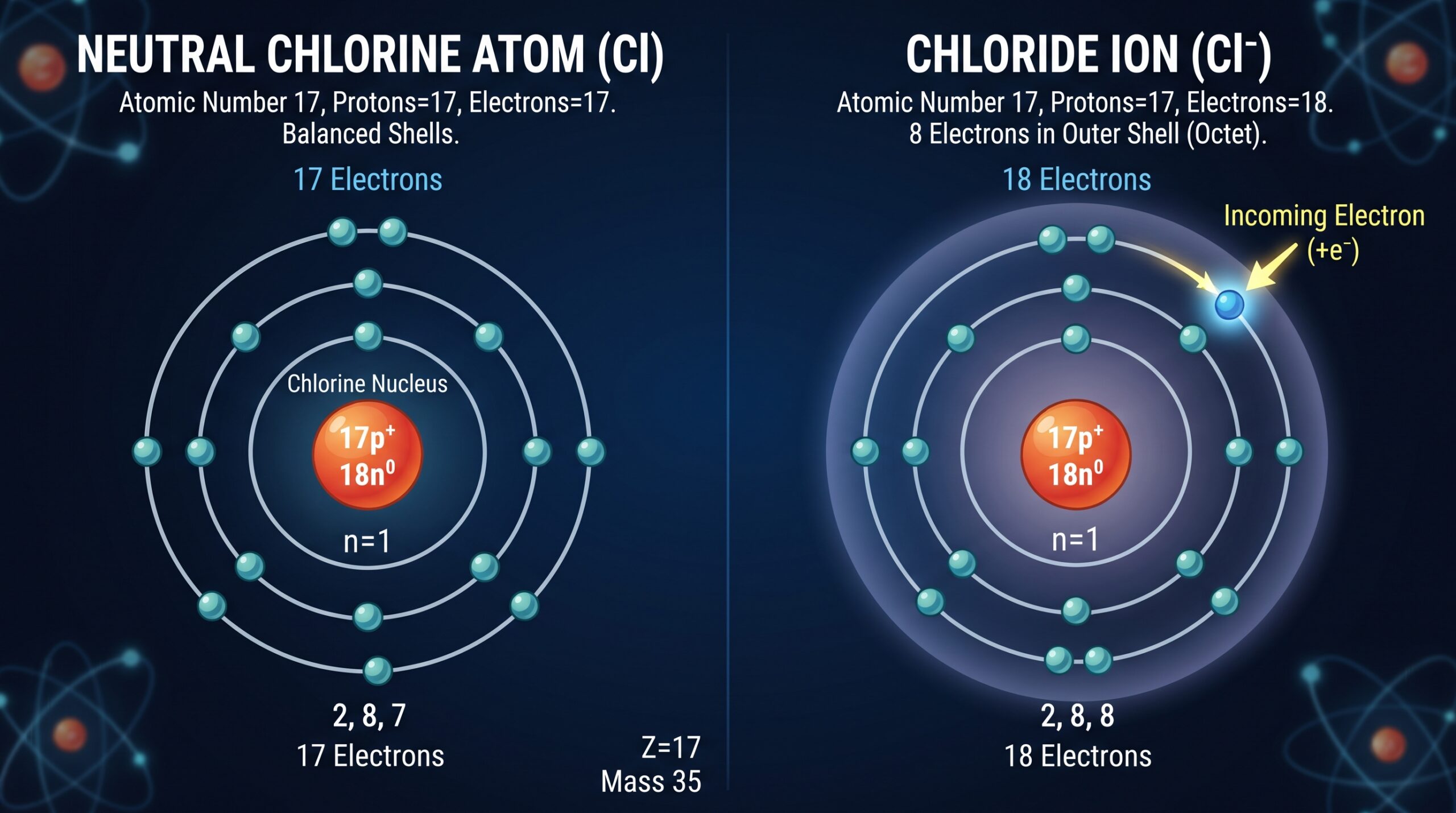
For example, sodium loses one electron to become Na⁺, while chlorine gains one electron to become Cl⁻.
Atom or Ion: Key Differences
| Feature | Atom | Ion |
|---|---|---|
| Electrical charge | Neutral | Positive or negative |
| Protons | Equal to electrons | Not equal to electrons |
| Electrons | Normal neutral count | Gained or lost |
| Formation | Exists as an element unit | Forms when electrons are transferred or otherwise changed |
| Types | Neutral atoms | Cations and anions |
| Example | Na | Na⁺ |
| Chemical behavior | Depends on electron configuration | Often differs from the neutral atom |
| Role in bonding | Can participate in bonding | Commonly involved in ionic interactions |
1. Atom or Ion: What About Electrical Charge?
The biggest difference between an atom and an ion is electrical charge.
A neutral atom has equal numbers of protons and electrons.
Protons have a positive charge, while electrons have a negative charge. When their numbers are equal, the charges cancel.
An ion has an imbalance between positive protons and negative electrons.
For example, if a particle has 12 protons and 12 electrons, its net charge is zero.
If it has 12 protons and 10 electrons, its net charge is +2.
If it has 12 protons and 14 electrons, its net charge is −2.
2. Atom or Ion: What Happens to Electrons?
Electrons are the particles that usually change when an atom becomes an ion.
The number of protons does not normally change when an ordinary ion forms.
Consider magnesium.
A neutral magnesium atom has:
- 12 protons
- 12 electrons
When it loses two electrons, it becomes Mg²⁺:
- 12 protons
- 10 electrons
The element is still magnesium because it still has 12 protons.
3. Atom or Ion: What Happens to Protons?
The number of protons identifies an element.
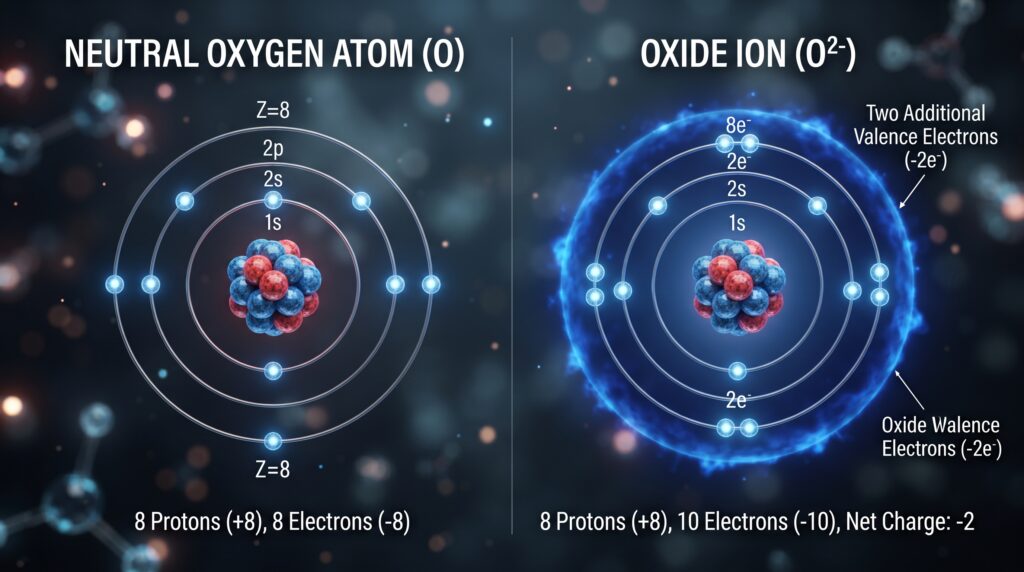
For example, every atom or ion of oxygen has 8 protons.
A neutral oxygen atom has 8 electrons.
An oxygen ion may have gained two electrons and become O²⁻, but it still has 8 protons.
Therefore, gaining or losing electrons changes the charge, not the identity of the element.
4. Atom or Ion: Cations Explained
A cation is a positively charged ion.
Cations form when atoms lose electrons.
For example:
Na → Na⁺ + e⁻
A sodium atom loses one electron and becomes a sodium ion with a +1 charge.
Other common cations include:
- K⁺
- Mg²⁺
- Ca²⁺
- Al³⁺
Cations are commonly found in ionic compounds and chemical solutions.
5. Atom or Ion: Anions Explained
An anion is a negatively charged ion.
Anions form when atoms gain electrons.
For example:
Cl + e⁻ → Cl⁻
A chlorine atom gains one electron and becomes a chloride ion.
Other common anions include:
- F⁻
- O²⁻
- S²⁻
- N³⁻
The negative charge results from having more electrons than protons.
6. Atom or Ion: Which Is More Stable?
Atoms often gain or lose electrons because their electron arrangements can become more favorable.
Many elements, particularly those in ionic compounds, form ions that have a more stable outer electron arrangement.
For example, sodium can lose one electron to form Na⁺, while chlorine can gain one electron to form Cl⁻.
These ions can then attract each other and form sodium chloride, commonly known as table salt.
However, stability is more complex than simply saying every atom wants eight electrons. Some elements follow different electron configurations and bonding patterns.
7. Atom or Ion: Examples in Everyday Chemistry
Atoms and ions are involved in many everyday chemical processes.
Examples include:
- Sodium ions in body fluids
- Potassium ions in cells
- Calcium ions in bones and biological processes
- Chloride ions in salt
- Hydrogen ions in acidic solutions
- Hydroxide ions in basic solutions
Understanding ions is therefore important not only in chemistry class but also in biology, medicine, environmental science, and materials science.
8. Atom or Ion: How Do You Identify One?
You can often identify an ion by looking for a charge.
For example:
Na = neutral sodium atom
Na⁺ = sodium ion
Cl = neutral chlorine atom
Cl⁻ = chloride ion
Mg = neutral magnesium atom
Mg²⁺ = magnesium ion
If a chemical symbol has a positive or negative charge written beside it, it represents an ion.
9. Atom or Ion: Why Does the Difference Matter?
The difference between atoms and ions is important because electrical charge strongly affects chemical behavior.
Ions can attract oppositely charged ions and participate in ionic bonding.
They can also move through solutions and conduct electricity.
Atoms can also form covalent bonds by sharing electrons.
Understanding whether a species is neutral or charged helps you predict how it may interact with other substances.
Atom vs Ion: Simple Examples
| Element | Neutral Atom | Common Ion |
| Sodium | Na | Na⁺ |
| Potassium | K | K⁺ |
| Magnesium | Mg | Mg²⁺ |
| Calcium | Ca | Ca²⁺ |
| Aluminum | Al | Al³⁺ |
| Chlorine | Cl | Cl⁻ |
| Oxygen | O | O²⁻ |
| Fluorine | F | F⁻ |
| Nitrogen | N | N³⁻ |
How to Calculate the Charge of an Ion
You can calculate an ion’s charge by comparing its number of protons and electrons.
The basic relationship is:
Charge = number of protons − number of electrons
For example, suppose a particle has 17 protons and 18 electrons.
17 − 18 = −1
Therefore, the particle has a −1 charge.
Now suppose a particle has 12 protons and 10 electrons.
12 − 10 = +2
Therefore, the particle has a +2 charge.
Common Mistakes
Mistake 1: Thinking an Ion Is a Different Element
An ion is not automatically a different element.
If an atom loses or gains electrons, its element identity remains the same because the number of protons remains unchanged.
Mistake 2: Thinking Protons Change When an Ion Forms
In ordinary ion formation, electrons are gained or lost.
The number of protons stays the same.
Mistake 3: Confusing Cations and Anions
Remember:
Cation = positive
Anion = negative
Mistake 4: Assuming Every Atom Is an Ion
A neutral atom has no net electrical charge.
It becomes an ion when there is an imbalance between protons and electrons.
Mistake 5: Confusing Ions With Isotopes
Ions differ in their number of electrons.
Isotopes differ in their number of neutrons.
These are two different concepts.
Atom or Ion: Easy Way to Remember
Use this simple memory trick:
Atom = neutral
Ion = charged
Then remember:
Loses electrons → positive ion
Gains electrons → negative ion
This makes it much easier to identify cations and anions in basic chemistry problems.
FAQs
Is an atom the same as an ion?
No. A neutral atom has no net charge, while an ion has a positive or negative charge because it has gained or lost electrons.
What is the main difference between an atom and an ion?
The main difference is electrical charge. A neutral atom has equal numbers of protons and electrons, while an ion has unequal numbers.
Can an atom become an ion?
Yes. An atom becomes an ion when it gains or loses electrons.
Does an ion have protons?
Yes. Ions contain protons just like neutral atoms. The number of protons determines the element.
Does an ion have electrons?
Yes. Ions contain electrons, but they have a different number of electrons than the corresponding neutral atom.
What is a cation?
A cation is a positively charged ion formed when an atom loses one or more electrons.
What is an anion?
An anion is a negatively charged ion formed when an atom gains one or more electrons.
Is Na an atom or ion?
Na without a charge symbol represents a neutral sodium atom. Na⁺ represents a sodium ion.
Is Cl an atom or ion?
Cl without a charge symbol represents a neutral chlorine atom. Cl⁻ represents a chloride ion.
Why do atoms form ions?
Atoms can form ions during chemical processes because gaining or losing electrons can produce a more favorable electron arrangement.
Can an ion be neutral?
No. By definition, an ion has a net electrical charge. A neutral particle with equal numbers of protons and electrons is an atom rather than an ion.
What determines whether an ion is positive or negative?
Losing electrons produces a positive charge. Gaining electrons produces a negative charge.
Conclusion
When comparing an atom or ion, remember the simplest difference: an atom is electrically neutral, while an ion has a net electrical charge.
Atoms contain protons, neutrons, and electrons. When an atom gains or loses electrons, it can become an ion. Losing electrons creates a positive cation, while gaining electrons creates a negative anion.
Understanding this difference makes many chemistry topics easier, including ionic bonding, chemical reactions, electron configurations, acids, bases, and solutions.
The key rule is simple:
Neutral particle = atom
Charged particle = ion
Once you understand this basic distinction, identifying atoms, cations, and anions becomes much easier.