
Bridge or Partial: Which Tooth Replacement Is Better?
If you are missing one or more teeth, you may need to choose between a bridge or a partial denture.
Both options can restore your smile, improve chewing ability, and help maintain proper tooth alignment. However, they work in very different ways and are designed for different situations.
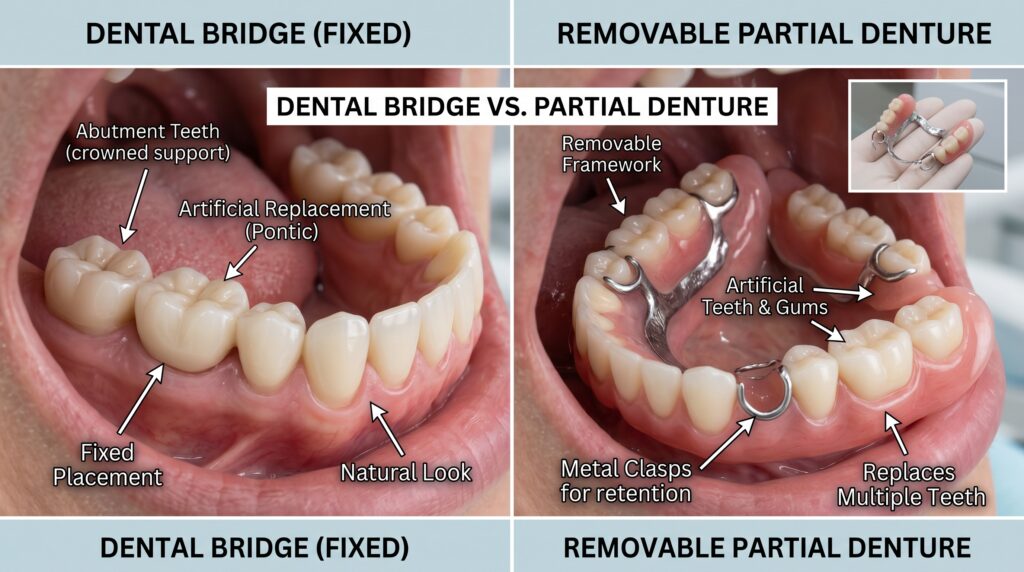
Although they serve the same general purpose, a dental bridge is a fixed solution, while a partial denture is removable.
Understanding the differences can help you choose the option that best fits your dental needs, lifestyle, and budget.
Quick Answer : Bridge or Partial
A dental bridge is a fixed tooth replacement attached to neighboring teeth.
A partial denture is a removable appliance that replaces one or more missing teeth.
Choose a bridge if you want a permanent feeling solution. Choose a partial denture if you need a more affordable and removable option.
What Is a Dental Bridge?
Definition
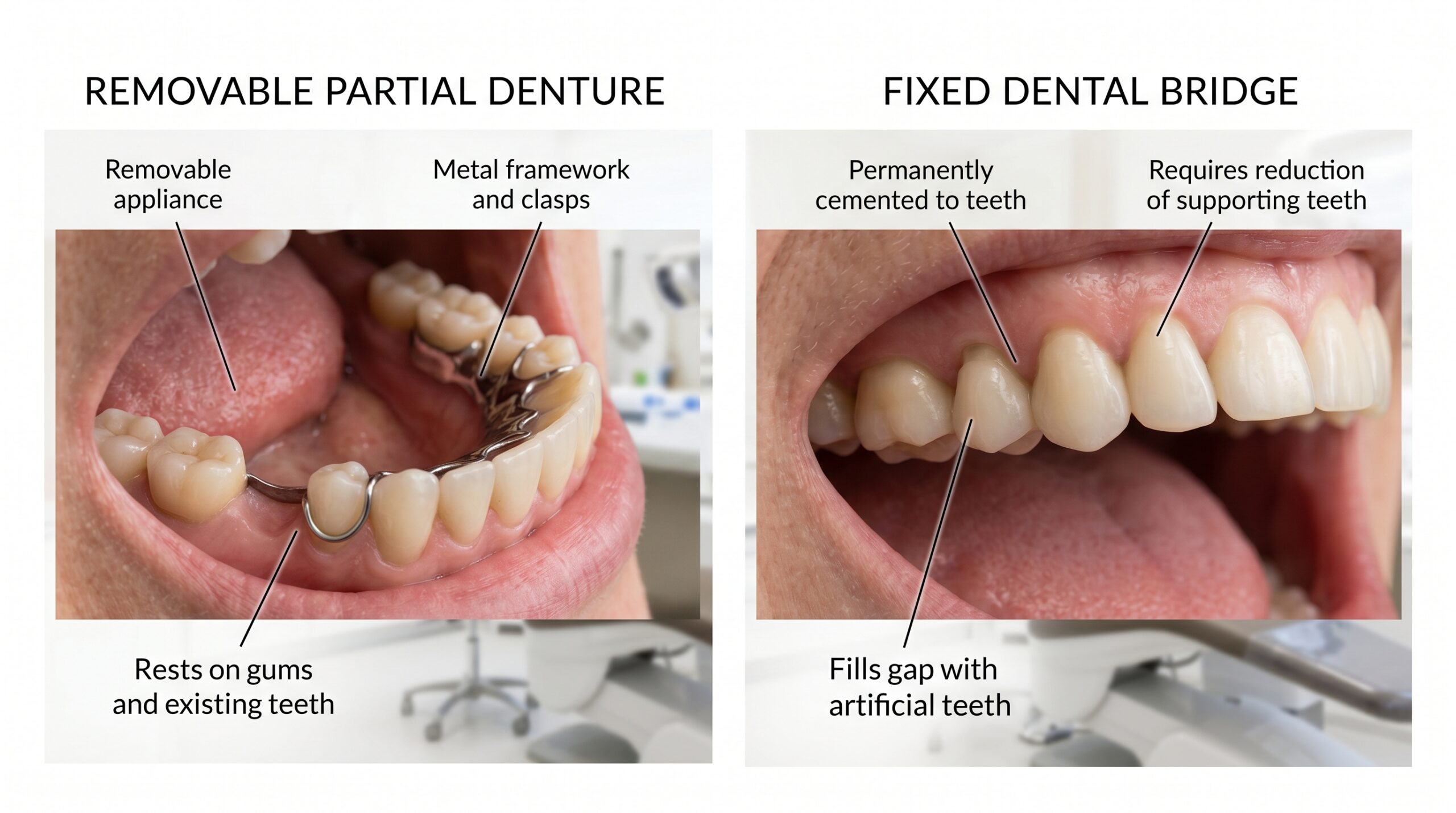
A dental bridge is a fixed restoration that fills the gap left by one or more missing teeth by attaching an artificial tooth to neighboring natural teeth or implants.
Key Features
- Permanently fixed in place
- Looks and feels like natural teeth
- Cannot be removed by the patient
- Helps maintain bite alignment
- Typically made from porcelain, ceramic, or metal materials
Best For
- Replacing one or a few missing teeth
- Patients with healthy neighboring teeth
- People seeking a stable solution
Examples
- Replacing a single missing molar
- Restoring a front tooth gap
- Replacing two adjacent missing teeth
Key Insight
A bridge offers greater stability and a more natural feel than most removable options.
What Is a Partial Denture?
Definition
A partial denture is a removable dental appliance designed to replace one or more missing teeth.
Key Features
- Removable by the patient
- Usually less expensive than a bridge
- Can replace multiple missing teeth
- Easy to adjust or replace
- Often supported by metal or acrylic frameworks
Best For
- Multiple missing teeth
- Budget conscious patients
- Situations where a bridge is not suitable
Examples
- Replacing several missing teeth in different areas
- Temporary tooth replacement
- Patients with limited supporting teeth
Key Insight
A partial denture offers flexibility and affordability but may feel less natural than a bridge.
Bridge vs Partial Denture: Key Differences
Main Differences
- A bridge is fixed, a partial denture is removable
- Bridges generally feel more natural
- Partial dentures are often more affordable
- Bridges require support from nearby teeth or implants
- Partial dentures can replace multiple teeth more easily
- Bridges usually require less daily handling
Comparison Table of Bridge or Partial
| Feature | Dental Bridge | Partial Denture |
|---|---|---|
| Type | Fixed | Removable |
| Comfort | High | Moderate |
| Stability | Excellent | Good |
| Appearance | Very natural | Natural but may be less seamless |
| Cost | Higher | Lower |
| Cleaning | Similar to natural teeth | Must be removed for cleaning |
| Durability | High | Moderate |
| Replacement of Multiple Teeth | Limited | Excellent |
| Daily Removal | No | Yes |
| Best For | Permanent feel | Affordability and flexibility |
Real World Usage Scenarios
Scenario 1
Patient: “I want something that feels like a real tooth.”
Dentist: “A bridge may be your best option.”
🎯 Lesson: Bridges often provide the most natural experience.
Scenario 2
Patient: “I need a lower cost solution.”
Dentist: “A partial denture may fit your budget.”
🎯 Lesson: Partials are generally more affordable.
Scenario 3
Patient: “I am missing several teeth.”
Dentist: “A partial denture can replace multiple teeth effectively.”
🎯 Lesson: Partials work well for larger gaps.
Scenario 4
Patient: “I do not want to remove my teeth every night.”
Dentist: “A bridge is fixed in place.”
🎯 Lesson: Bridges require less daily handling.
Scenario 5
Patient: “I may need future dental changes.”
Dentist: “A partial denture can often be modified more easily.”
🎯 Lesson: Partials offer greater flexibility.
Common Mistakes
Mistake 1: Choosing Based Only on Cost
Why it happens:
Patients focus on upfront expenses.
Correction:
Consider comfort, durability, and long term maintenance as well.
Mistake 2: Assuming a Bridge Works for Every Situation
Why it happens:
Bridges are popular and look natural.
Correction:
They require suitable support from neighboring teeth or implants.
Mistake 3: Thinking Partial Dentures Always Look Artificial
Why it happens:
Older denture designs were more noticeable.
Correction:
Modern partial dentures can provide very natural results.
Mistake 4: Ignoring Maintenance Requirements
Why it happens:
People focus only on appearance.
Correction:
Each option has different cleaning and care needs.
Memory Tricks
Remember Bridge
Bridge = Built In
Think fixed, stable, and permanent feeling.
Remember Partial Denture
Partial = Portable
Think removable and flexible.
Expert Insight
Dental bridges have long been considered a reliable fixed solution for replacing missing teeth. They provide excellent chewing function and often feel closest to natural teeth.
Partial dentures, however, remain an important option because they can replace several teeth without extensive dental work. Advances in dental materials have significantly improved their comfort and appearance.
The best choice depends on factors such as the number of missing teeth, oral health, budget, and long term treatment goals.
Conclusion : Bridge or Partial
When comparing bridge or partial denture, neither option is universally better.
- Choose a bridge if you want a fixed, stable, and natural feeling solution.
- Choose a partial denture if you need a more affordable and flexible option.
- Bridges excel in comfort and stability.
- Partial dentures excel in versatility and cost effectiveness.
The ideal choice depends on your dental condition, lifestyle, and budget. A dentist can help determine which solution will provide the best long term results for your specific needs.
