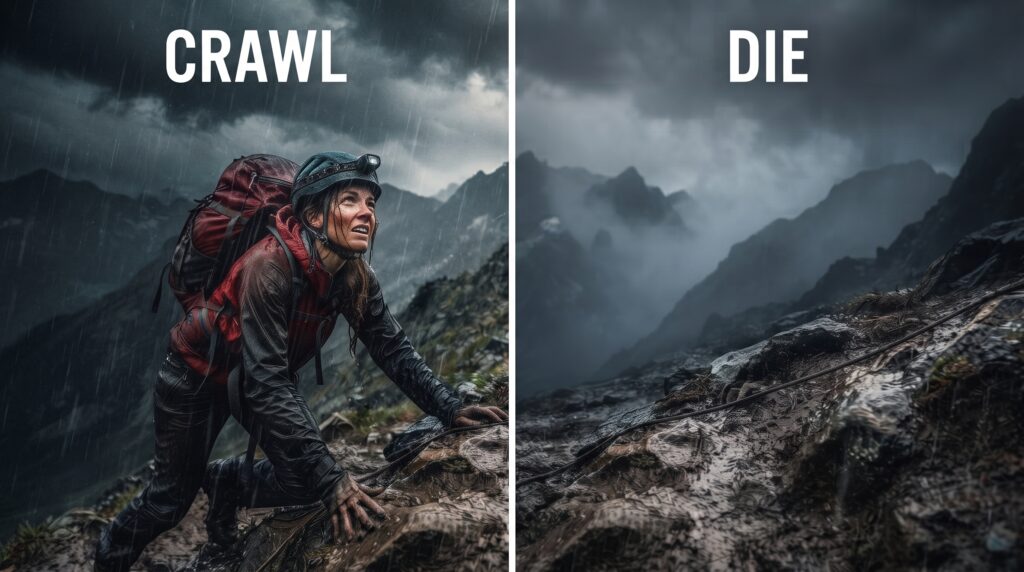
The phrase “crawl or die” is a short, dramatic expression that suggests a person must keep moving forward even when progress is slow or difficult. Instead of giving up completely, the phrase encourages continued effort.
The word crawl means to move slowly, usually close to the ground. The word die has a much stronger meaning and refers literally to losing one’s life. When the two words are combined in the phrase “crawl or die,” the expression is usually understood figuratively rather than literally.
It can describe a difficult situation where continuing to make even small progress feels necessary.
What Does Crawl Mean?
Crawl can be used as a verb or a noun.
As a verb, crawl means to move slowly, often using your hands and knees.
For example:
“ The baby began to crawl across the floor.”
It can also describe very slow movement.
“Traffic was crawling along the highway.”
The word can therefore describe physical movement as well as progress that happens very slowly.

What Does Die Mean?
Die is a verb that normally means to stop living. It is a strong word and should be understood according to its context.
For example:
“The plant will die without water.”
In expressions such as “crawl or die,” however, the word may be used dramatically to express urgency, determination, or the idea that giving up is not an option.
What Does “Crawl or Die” Mean?
The meaning of “crawl or die” depends on context, but its central idea is simple:
Keep moving forward, even if progress is extremely slow.
The phrase can be used to describe determination during difficult circumstances. Someone may not be able to move quickly, but they continue making progress instead of stopping.
For example:
“I’m exhausted, but I have to crawl or die.”
Here, the speaker is expressing the idea that continuing to move forward is better than giving up.
Crawl or Die as a Motivational Phrase
Although the phrase sounds harsh, it can sometimes be used as a motivational expression.
It emphasizes persistence rather than speed. The message is that progress does not always have to be fast. Even a small step can be better than complete inaction.
For example, a student preparing for an important examination might say:
“I don’t understand everything yet, but I’ll crawl or die until I finish this course.”
The speaker is using the phrase figuratively to show determination.
Crawl or Die in Everyday Language
The phrase is not normally used in ordinary conversation as often as simpler expressions such as:
“Keep going.”
“Don’t give up.”
“Move forward.”
“Take it one step at a time.”
Because “crawl or die” has a dramatic tone, it is more suitable for informal, motivational, fictional, or humorous contexts.
Crawl or Die: Literal vs Figurative Meaning
Understanding the difference between literal and figurative meaning is important.
Literal Meaning
A literal interpretation would involve physically crawling and the possibility of death. This is not normally what speakers intend when using the phrase casually.
Figurative Meaning
The figurative meaning is about persistence.
It suggests that a person should continue making progress, even if progress is slow, difficult, or uncomfortable.
This figurative use is more common when the phrase appears in motivational writing, entertainment, or casual speech.
Examples of “Crawl or Die”
Here are several examples that show how the phrase can be used:
- “The project is difficult, but we have to crawl or die.”
- “I may be moving slowly, but I won’t quit.”
- “When things get difficult, his attitude is crawl or die.”
- “She kept studying even when progress was slow.”
- “The team decided to keep moving forward instead of giving up.”
These examples show that the main idea is persistence.
Crawl vs Walk: What’s the Difference?
Crawl and walk both describe movement, but they are different.
To crawl usually means moving close to the ground, often using the hands and knees.
To walk means moving upright on two feet.
The difference can also be figurative.
For example:
“The business is crawling forward.”
This means the business is progressing very slowly.
“The business is walking forward.”
This is less common as an expression, but it could suggest steady progress.
Why Is “Crawl or Die” So Powerful?
The phrase is powerful because it creates a strong contrast between two extreme choices.
Crawl represents slow progress.
Die represents the extreme consequence of stopping, at least in the dramatic wording of the phrase.
Together, they create a memorable expression about continuing despite difficulties.
The phrase can therefore be effective in storytelling, slogans, entertainment, and informal motivational conversations.
Is “Crawl or Die” a Common Expression?
“Crawl or die” is understandable English, but it is not one of the most common everyday idioms.
Native speakers are more likely to use phrases such as “keep going,” “don’t give up,” or “take it one step at a time.”
Because of its dramatic tone, “crawl or die” works best when the speaker intentionally wants to sound intense or determined.
Crawl or Die vs Never Give Up
The ideas behind “crawl or die” and “never give up” are similar, but the tone is different.
“Never give up” is simple, positive, and widely understood.
“Crawl or die” is more dramatic and forceful.
If you are writing formal content, “never give up” may be more appropriate. If you want a strong or dramatic expression, “crawl or die” can create a bigger emotional impact.
FAQs
What does crawl or die mean?
“Crawl or die” generally means to keep moving forward even when progress is very slow or difficult. It is usually used figuratively.
Is crawl or die a motivational phrase?
It can be used as a motivational phrase because it emphasizes persistence and continuing to make progress instead of giving up.
Is crawl or die an idiom?
It can function like an informal expression, but it is not as widely established as common idioms such as “never give up” or “keep your chin up.”
What does crawl mean?
Crawl means to move slowly, usually close to the ground. It can also describe something that moves or progresses very slowly.
What is the opposite of crawl?
Depending on the context, possible opposites include walk, run, move quickly, or progress rapidly.
Can crawl or die be used literally?
It can be interpreted literally, but in most casual or motivational contexts, the phrase is intended figuratively to express determination.
Conclusion
“Crawl or die” is a dramatic expression about continuing to move forward when circumstances are difficult. While crawl refers to slow movement, die creates a strong contrast that gives the phrase its intense tone.
The phrase is generally used figuratively to communicate persistence, determination, and the idea that slow progress is better than giving up. Because it has a strong and dramatic style, it is best suited to informal conversations, motivational contexts, creative writing, and entertainment.
If you want a simpler expression with the same basic message, “never give up” or “keep going” may be more natural choices.