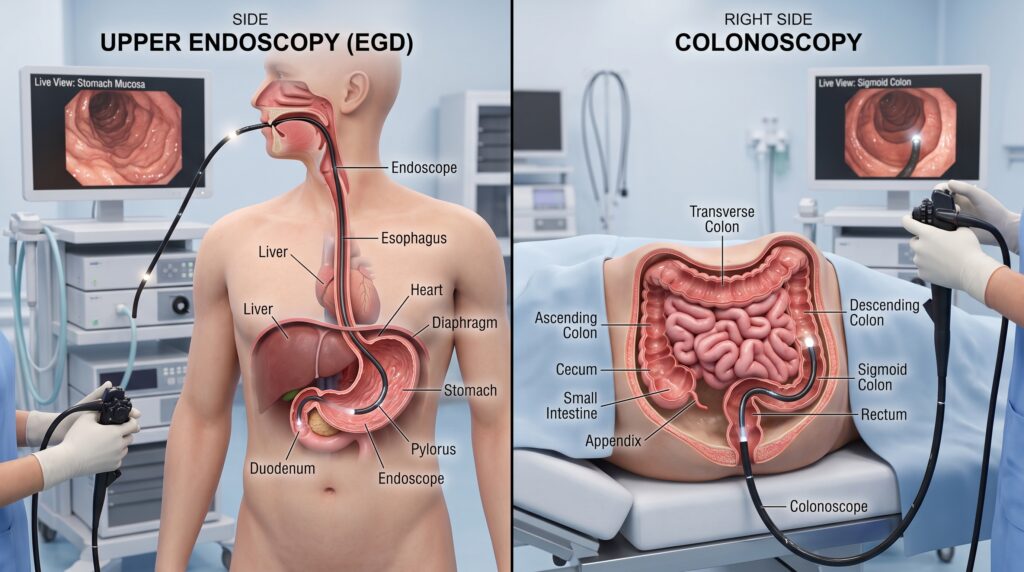
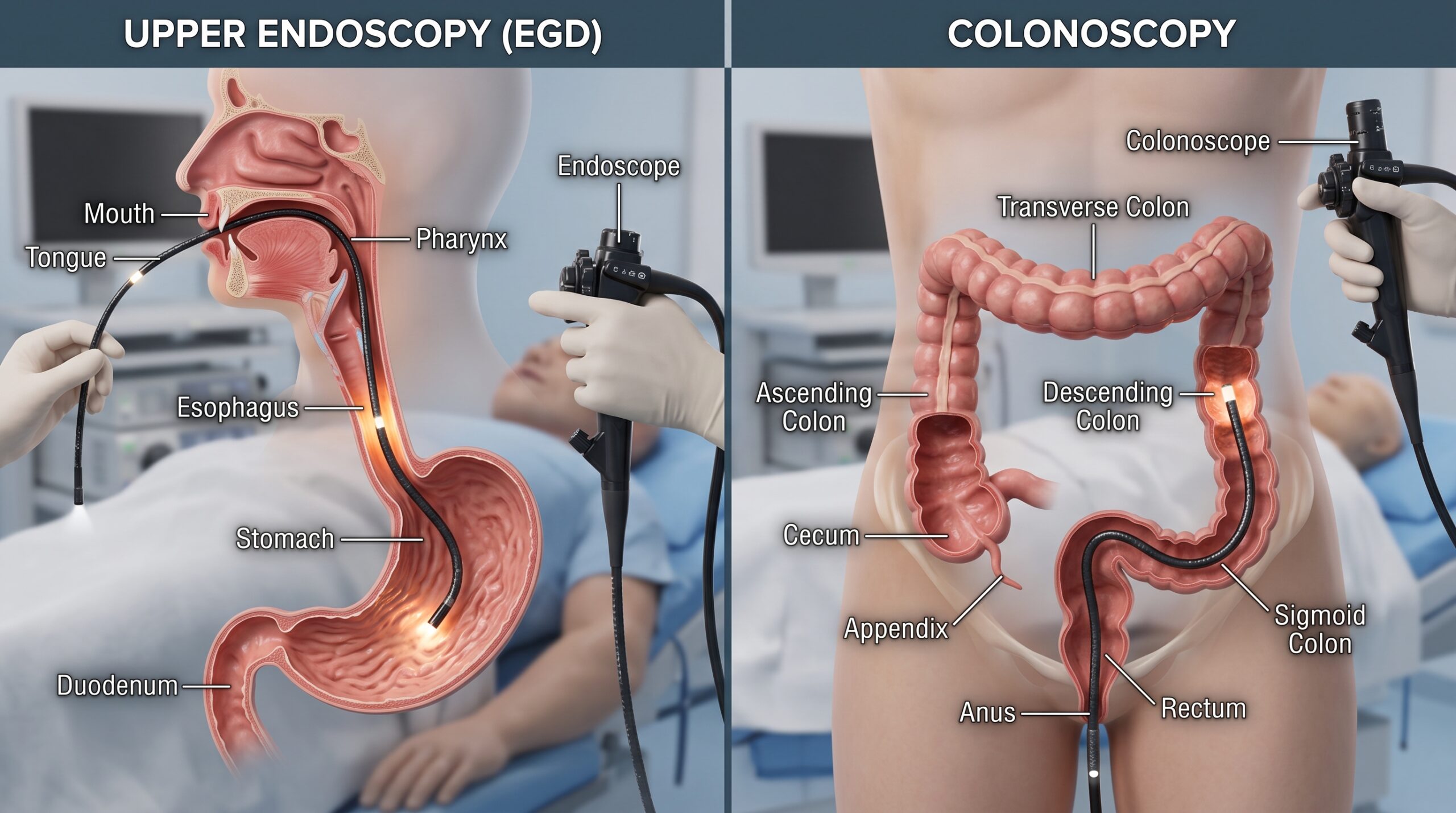
Preparation Differences
Endoscopy Preparation
Preparation usually includes:
- Avoiding food and drinks for several hours before the procedure
- Following medication instructions from your healthcare provider
- Arranging transportation if sedation is used
Colonoscopy Preparation
Preparation is generally more extensive and may include:
- A special diet before the procedure
- A bowel preparation solution to clean the colon
- Fasting as instructed
- Arranging transportation if sedation is used
Key insight: A clean colon helps improve visibility during a colonoscopy.
Recovery After the Procedures
Recovery varies from person to person.
After an endoscopy, some people experience:
- Mild sore throat
- Temporary bloating
- Drowsiness if sedatives were used
After a colonoscopy, some people notice:
- Mild bloating
- Passing gas
- Temporary cramping
- Drowsiness if sedatives were used
Most people return to normal activities according to their healthcare provider’s advice.
Real World Usage Scenarios
Example 1: Frequent Heartburn
A person has long lasting acid reflux and difficulty swallowing.
A healthcare provider may recommend an endoscopy to examine the upper digestive tract.
🎯 Lesson: Upper digestive symptoms are commonly evaluated with an endoscopy.
Example 2: Routine Screening
An adult reaches the recommended age for colorectal cancer screening.
A healthcare provider may recommend a colonoscopy.
🎯 Lesson: Colonoscopy plays an important role in preventive screening.
Example 3: Blood in the Stool
A patient notices blood during bowel movements.
A healthcare provider may recommend a colonoscopy to identify the cause.
🎯 Lesson: Lower digestive symptoms often require examination of the colon.
Example 4: Persistent Stomach Pain
Someone experiences ongoing upper abdominal discomfort.
An endoscopy may help identify possible causes in the upper digestive tract.
🎯 Lesson: The location of symptoms often determines which procedure is appropriate.
Common Misunderstandings
Mistake 1: Thinking They Are the Same Procedure
Why it happens:
Both use a flexible camera.
Correction:
They examine different parts of the digestive system.
Mistake 2: Assuming Everyone Needs Both Tests
Why it happens:
People often hear the procedures mentioned together.
Correction:
The appropriate procedure depends on symptoms, medical history, age, and your healthcare provider’s recommendation.
Mistake 3: Believing Preparation Is Identical
Why it happens:
Both involve digestive system examinations.
Correction:
Colonoscopy generally requires bowel cleansing, while endoscopy usually requires fasting.
Memory Trick: Endoscopy vs Colonoscopy
Remember:
Endoscopy = Upper digestive tract
Colonoscopy = Colon and rectum
Think of it this way:
- Endo → Inside the upper digestive system.
- Colon → The large intestine.
Expert Insight : Endoscopy or Colonoscopy
Although both procedures use similar imaging technology, they serve different clinical purposes.
An endoscopy helps doctors examine the upper digestive tract and may assist in diagnosing conditions affecting the esophagus, stomach, or upper small intestine.
A colonoscopy is widely used to evaluate the colon and rectum and is an important tool for colorectal cancer screening, as well as investigating lower digestive symptoms.
Choosing between the two is based on the patient’s symptoms, risk factors, medical history, and clinical evaluation rather than personal preference.