
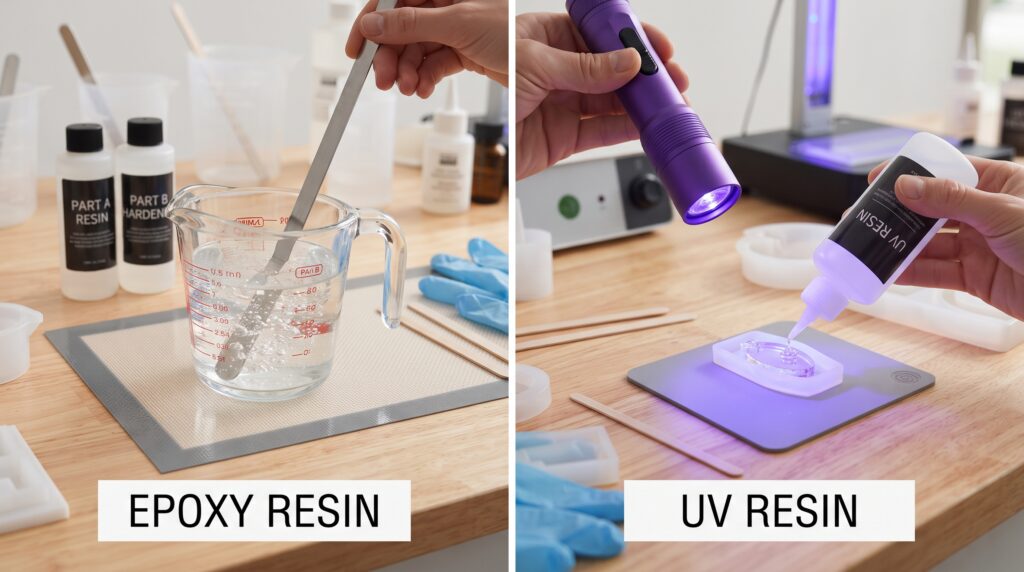
Choosing between epoxy or resin can be confusing, especially for beginners. The two terms are often used together, but they don’t always mean exactly the same thing.
Resin is a broad term for a group of materials that can be natural or synthetic. Epoxy is a specific type of synthetic resin system that normally uses an epoxy resin component and a curing agent or hardener. Epoxy materials are widely used for adhesives, coatings, insulation, composites, and many craft projects.
This difference matters when you’re choosing a material for furniture, jewelry, artwork, flooring, repairs, coatings, or other projects.
So, should you choose epoxy or resin?
The best option depends on what you’re making, the required strength, curing time, appearance, durability, budget, and intended environment
Quick Answer
Epoxy is a specific type of resin system, while resin is a broader term that can describe many different materials.
In everyday craft discussions, however, people often use “resin” to mean a two part casting resin, which can itself be an epoxy resin.
Choose epoxy when you need strong adhesion, durability, protective coatings, or a material designed for demanding applications.
Choose a suitable resin system when your main goal is casting, artistic work, jewelry, decorative objects, or another application where appearance and flow are important.
The most important point is that not every resin is epoxy, but epoxy is a type of resin.

What Is Epoxy?
Epoxy is a type of thermosetting polymer system. Many epoxy products are supplied as two components, commonly called resin and hardener.
When the components are mixed in the correct ratio, a chemical curing reaction creates a cross linked material.
This cured material can provide:
- Strong adhesion
- Good durability
- Chemical resistance
- Moisture resistance
- Hardness
- Good surface protection
- Useful electrical insulation properties
Epoxy is used in industrial applications as well as DIY projects. Its uses include adhesives, coatings, electrical insulation, and composite materials.
Common Uses of Epoxy
Epoxy can be used for:
- Wood projects
- Table coatings
- Garage floors
- Industrial floors
- Adhesives
- Repairs
- Protective coatings
- Artwork
- Electrical components
- Composite materials
The correct formulation depends on the application.
What Is Resin?
Resin is a much broader term.
Resins can refer to natural substances or synthetic polymer materials. Different resin systems have different properties, curing methods, strengths, and applications.
Common synthetic resin families include:
- Epoxy resin
- Polyester resin
- Polyurethane resin
- Acrylic resin
- Vinyl ester resin
Therefore, simply saying “resin” doesn’t tell you exactly what material you’re buying.
This is why reading the product label and technical specifications is important.
Epoxy vs Resin: Key Differences
| Feature | Epoxy | Resin |
|---|---|---|
| Meaning | A specific resin family | Broad material category |
| Components | Often resin plus hardener | Depends on resin type |
| Strength | Often high | Varies widely |
| Adhesion | Usually excellent | Depends on formulation |
| Durability | Generally strong | Depends on type |
| Curing | Chemical reaction | Varies by product |
| Appearance | Can be clear or colored | Varies |
| Craft use | Very common | Very common |
| Industrial use | Extensive | Extensive |
| Chemical resistance | Often good | Depends on type |
| Best for | Coatings, adhesives, crafts, composites | Many different applications |
The table shows why “epoxy vs resin” isn’t always a direct comparison. Epoxy is one category within the larger resin family.
Epoxy or Resin: How They Work
How Epoxy Cures
Many epoxy systems contain two components.
The first component contains epoxy resin.
The second contains a curing agent.
When properly mixed, they react and gradually form a hardened network.
The exact mixing ratio is product specific. Some products require a precise ratio by weight, while others are designed for a particular volume ratio.
Always follow the manufacturer’s instructions.
Using the wrong ratio can result in:
- Soft material
- Sticky surfaces
- Poor curing
- Reduced strength
- Uneven results
How Other Resins Cure
Different resin systems can cure in different ways.
Some use:
- Hardeners
- Catalysts
- Heat
- Ultraviolet light
- Moisture
- Other chemical reactions
This is why you shouldn’t assume that instructions for one resin product will work for another.
Strength and Durability
If strength is your main concern, epoxy is often an excellent choice.
Cured epoxy can form a strong, durable material that works well in adhesives, coatings, and composite applications.
However, “resin” cannot be rated as simply strong or weak because different resin types have very different properties.
For example, a resin designed for decorative casting may have completely different performance characteristics from an industrial structural resin.
Epoxy or Resin for Crafts
Both epoxy and other resin systems are popular for crafts.
Common projects include:
- Jewelry
- Coasters
- Trays
- Art panels
- Decorative objects
- Keychains
- Molds
- Small furniture projects
For craft projects, look for a product specifically designed for the intended application.
Important characteristics include:
- Working time
- Cure time
- Viscosity
- Clarity
- UV resistance
- Bubble release
- Maximum pour depth
- Heat resistance
Epoxy or Resin for Wood
Epoxy is widely used in woodworking.
It can be used for:
- Filling cracks
- Sealing wood
- Creating decorative surfaces
- River tables
- Coating countertops
- Bonding materials
However, not every epoxy product is suitable for deep pours or large wooden surfaces.
Check the manufacturer’s recommended pour depth before starting a project.
Epoxy or Resin for Jewelry
For jewelry and small decorative projects, a casting resin can be useful because appearance and clarity are often important.
Important factors include:
- Crystal clarity
- Low viscosity
- Bubble release
- Cure time
- UV resistance
- Scratch resistance
Choose a product designed specifically for jewelry or small casting applications rather than assuming every epoxy product will produce the same result.
Epoxy or Resin for Flooring
Epoxy is commonly used for floor coatings because cured epoxy can provide a hard and durable surface.
Epoxy flooring may be suitable for:
- Garages
- Workshops
- Warehouses
- Commercial spaces
- Industrial environments
The preparation of the floor is extremely important.
A poor surface preparation process can lead to:
- Peeling
- Bubbling
- Cracking
- Poor adhesion
Epoxy or Resin: Appearance
Appearance varies considerably between products.
Clear epoxy can create a glossy finish and can be mixed with:
- Pigments
- Metallic powders
- Mica
- Decorative materials
- Colorants
Some resin systems are specifically designed for artistic effects.
If appearance is important, check whether the product is designed to remain clear and resist yellowing.
Curing Time
Curing time varies according to the product and environmental conditions.
Factors can include:
- Temperature
- Humidity
- Mixing ratio
- Layer thickness
- Product formulation
- Ventilation
A material may become hard enough to touch before it has reached its full cure.
Don’t assume that a surface that feels hard is automatically ready for heavy use.
Epoxy or Resin: Cost Comparison
Price depends on the formulation, brand, quantity, quality, and intended application.
| Cost Factor | Epoxy | Other Resin Types |
|---|---|---|
| Small craft projects | Moderate to high | Varies |
| Large projects | Can become expensive | Varies |
| Industrial applications | Often higher | Depends on formulation |
| Decorative projects | Moderate | Varies |
| Repairs | Often cost effective | Depends on product |
| Maintenance | Usually low after proper curing | Depends on application |
The cheapest product isn’t necessarily the best option.
A product that fails because it wasn’t designed for your application can cost more after replacement and repair.
Safety Considerations
Uncured resin systems can contain chemicals that may irritate the skin, eyes, or respiratory system.
Always follow the product’s safety instructions.
Basic precautions can include:
- Wear appropriate protective gloves
- Protect your eyes when required
- Work in suitable ventilation
- Avoid skin contact
- Don’t eat or drink while handling chemicals
- Follow the manufacturer’s safety data
- Keep products away from children and pets
Once fully cured, the material can have very different properties from the uncured components.
Don’t treat all resin products as identical.
UV Resistance and Yellowing
Some clear resin systems can yellow when exposed to ultraviolet light over time.
If you’re making a project that will stay outdoors or receive substantial sunlight, check the product’s UV resistance.
UV stability is particularly important for:
- Outdoor furniture
- Decorative artwork
- Jewelry
- Clear coatings
- Table surfaces
A UV resistant formulation may help maintain the appearance of the finished project for longer.
Pros and Cons
Epoxy
Pros
- Excellent adhesion
- Strong and durable
- Useful for coatings
- Good for many repair applications
- Available in clear formulations
- Useful for wood projects
- Suitable for many industrial applications
Cons
- Can be more expensive
- Requires accurate mixing
- Cure time varies
- Some formulations can yellow
- Uncured components require careful handling
- Incorrect application can cause curing problems
Resin
Pros
- Wide range of formulations
- Suitable for many creative projects
- Available in different curing systems
- Useful for casting
- Can provide attractive finishes
- Available for specialized applications
Cons
- Properties vary significantly
- Some types can be brittle
- Some products may yellow
- Incorrect product selection can cause failure
- Curing requirements vary
- Safety precautions are still necessary
Common Mistakes When Choosing Epoxy or Resin
Choosing Based Only on Price
A cheaper product isn’t necessarily the best choice.
Look at the intended application and technical specifications first.
Using the Wrong Mixing Ratio
Two part epoxy products often require a specific ratio.
Don’t guess.
Follow the manufacturer’s instructions precisely.
Ignoring Pour Depth
Some casting products are designed for thin layers, while others are formulated for deeper pours.
Using the wrong product can cause excessive heat, incomplete curing, or other problems.
Ignoring Temperature
Temperature can affect viscosity and curing.
Always follow the manufacturer’s recommended working conditions.
Expecting Every Resin to Behave the Same
Different resin systems have different properties.
A product designed for jewelry may not be appropriate for structural bonding.
Skipping Surface Preparation
For coatings and adhesives, surface preparation is often critical.
Remove contaminants and follow the manufacturer’s preparation instructions.
Epoxy or Resin: Which Is Better?
There isn’t one universal winner.
Choose Epoxy If:
- You need strong adhesion.
- You want a durable coating.
- You’re repairing certain materials.
- You’re working with wood.
- You need a protective surface.
- You want a material suitable for many demanding applications.
Choose Another Resin System If:
- You’re making a specialized casting project.
- Your project requires a particular curing method.
- You need a specific finish or flexibility.
- The manufacturer recommends a different resin type.
- You need properties that standard epoxy doesn’t provide.
The right choice should always be based on the project’s requirements rather than the word “resin” or “epoxy” alone.
FAQs
Is epoxy the same as resin?
No. Epoxy is a type of resin. Resin is a broader term that includes several different material families.
Is epoxy stronger than resin?
It depends on which resin you’re comparing it with. Epoxy can be very strong and durable, but other resin systems can also be engineered for specific high performance applications.
Which is better, epoxy or resin?
Neither is universally better. Epoxy is often a strong choice for adhesives, coatings, repairs, and durable surfaces, while other resin systems may be better for specific casting or manufacturing applications.
Is epoxy resin good for crafts?
Yes. Epoxy resin is widely used for crafts such as jewelry, coasters, artwork, decorative objects, and some furniture projects.
Is epoxy or resin better for wood?
Epoxy is often a good choice for wood projects because of its adhesion and durability. The specific product should be selected according to the type of woodworking project.
Is epoxy good for flooring?
Yes. Epoxy coatings are widely used for floors in garages, workshops, commercial spaces, and industrial environments.
Does epoxy resin yellow?
Some epoxy formulations can yellow with UV exposure. Products with better UV resistance may provide improved color stability.
How long does epoxy take to cure?
Cure time depends on the product, temperature, humidity, layer thickness, and mixing ratio. Always follow the manufacturer’s instructions.
Can you use resin without hardener?
It depends on the type of resin. Many two part epoxy systems require a hardener to cure, while other resin systems may use different curing methods.
Can epoxy be used outdoors?
Some epoxy products can be used outdoors, but outdoor suitability depends on UV resistance, temperature stability, moisture exposure, and the manufacturer’s specifications.
Which is easier for beginners, epoxy or resin?
There isn’t one universal answer. A beginner should choose a product with clear instructions, an appropriate working time, and a formulation designed for the specific project.
Why is my epoxy still sticky?
Possible causes include incorrect mixing ratio, incomplete mixing, unsuitable temperature, or using incompatible components. Follow the manufacturer’s troubleshooting instructions rather than adding extra hardener randomly.
Conclusion
The difference between epoxy or resin becomes much clearer once you understand that epoxy is actually one type of resin.
Epoxy is a popular and powerful material because it can provide strong adhesion, durability, protective coatings, and attractive finishes. It is commonly used for woodworking, repairs, flooring, crafts, composites, and industrial applications.
The word resin, however, covers a much larger group of materials. Different resin systems can have very different properties, curing methods, strengths, flexibility, and uses.
For a strong coating, adhesive, repair, or many woodworking projects, epoxy can be an excellent choice. For specialized casting or creative applications, another resin formulation may be more suitable.
The best choice depends on your project, required strength, appearance, curing method, budget, environmental conditions, and manufacturer’s specifications.
Don’t choose a product simply because it says “epoxy” or “resin.” Check what it is designed to do, follow the instructions carefully, and choose the formulation that matches your project.