
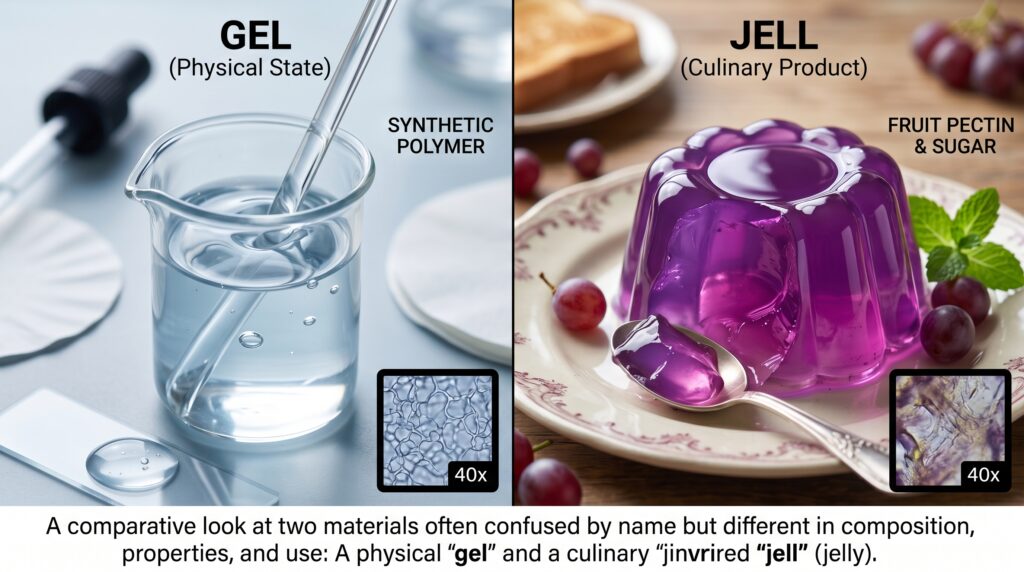
Gel or Jell: Which Word Should You Use?
Many English learners and native speakers alike get confused by gel and jell. The confusion is understandable because both words are related to becoming thicker, firmer, or more organized.
Although they look and sound similar, they serve completely different purposes in English. One is primarily a noun and verb used in science, beauty, and everyday language, while the other is mainly a verb describing the process of something coming together or solidifying.
This guide explains the difference clearly, provides real examples, and helps you avoid common usage mistakes.
Quick Answer : Gel or Jell
Gel is usually a noun or verb referring to a jelly-like substance or the process of becoming gel-like.
Jell is a verb that means to take shape, become clear, or come together successfully.
In modern English, gel is far more common than jell.
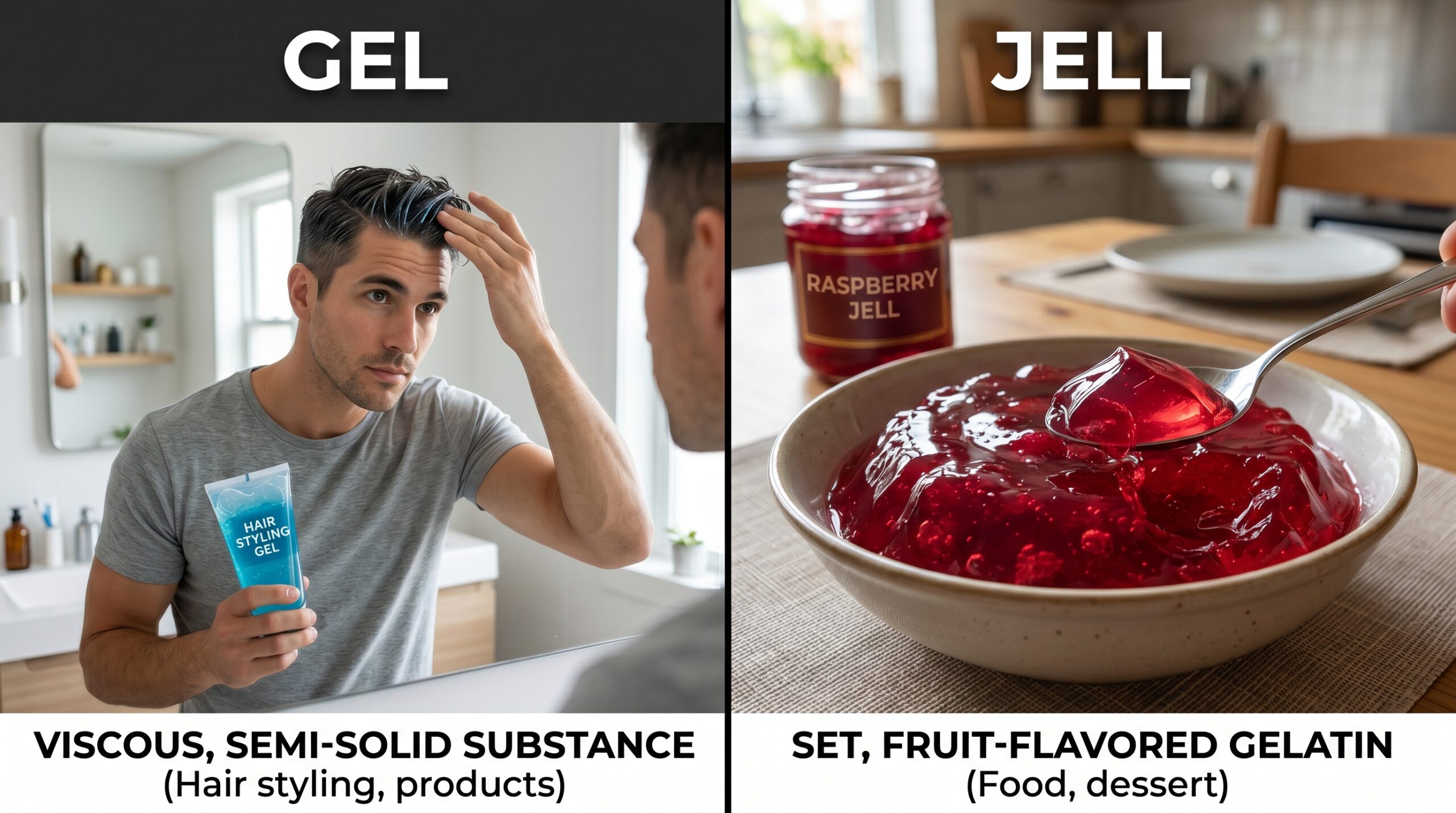
What Does “Gel” Mean?
Definition
Gel refers to a semi-solid substance with a texture between a liquid and a solid. It can also be used as a verb meaning to form into a gel.
Usage Rules
Use gel when referring to:
- Hair products
- Medical substances
- Scientific materials
- Thickened liquids
- Physical gel formation
Examples
Example 1
She applied hair gel before leaving for work.
Example 2
The laboratory mixture began to gel after several hours.
Example 3
The skincare product contains aloe vera gel.
Key Insight
Gel usually relates to a physical substance or a scientific process involving thickening.
What Does “Jell” Mean?
Definition
Jell is a verb meaning to become clearer, more organized, more effective, or more cohesive.
Usage Rules
Use jell when discussing:
- Ideas becoming clear
- Teams working together effectively
- Plans taking shape
- Concepts becoming organized
Examples
Example 1
The team’s strategy finally began to jell.
Example 2
Her ideas started to jell after several meetings.
Example 3
The project took time to jell into a workable plan.
Key Insight
Jell is usually used figuratively rather than physically.
Gel vs Jell: Key Differences
Main Differences
- Gel often refers to a physical substance.
- Jell usually refers to ideas, plans, or teamwork.
- Gel functions as both noun and verb.
- Jell is primarily a verb.
- Gel is much more common in everyday language.
- Jell is frequently used in figurative contexts.
Comparison Table of Gel or Jell
| Feature | Gel | Jell |
|---|---|---|
| Part of Speech | Noun and verb | Primarily verb |
| Meaning | Semi-solid substance or thickening process | Become organized or take shape |
| Usage Type | Physical or scientific | Figurative |
| Common Context | Hair products, medicine, chemistry | Ideas, plans, teamwork |
| Frequency | Very common | Less common |
| Example | Hair gel | Ideas jell |
Real-World Usage Scenarios
Scenario 1
Person A: “I need something to hold my hairstyle.”
Person B: “Use hair gel.”
๐ฏ Lesson: Gel refers to a physical product.
Scenario 2
Person A: “Our business plan is finally coming together.”
Person B: “It’s starting to jell.”
๐ฏ Lesson: Jell refers to ideas becoming organized.
Scenario 3
Person A: “The chemical mixture became thicker overnight.”
Person B: “The mixture began to gel.”
๐ฏ Lesson: Gel can describe physical thickening.
Scenario 4
Person A: “The team works much better together now.”
Person B: “The group has really gelled.”
๐ฏ Lesson: Jell often describes improved cohesion.
Scenario 5
Person A: “Can I say my shampoo jelled?”
Person B: “Only if it physically thickened.”
๐ฏ Lesson: Gel refers to physical changes, not organizational ones.
Common Mistakes
Mistake 1: Using Gel Instead of Jell for Ideas
Incorrect:
“The proposal finally gelled into a clear strategy.”
Better:
“The proposal finally jelled into a clear strategy.”
Why it happens:
People are more familiar with the word gel.
Mistake 2: Using Jell for Physical Products
Incorrect:
“I bought a jell for my hair.”
Correct:
“I bought a gel for my hair.”
Why it happens:
The words sound similar.
Mistake 3: Assuming They Are Interchangeable
Why it happens:
Both words involve the idea of forming or coming together.
Correction:
Remember that gel is usually physical, while jell is often figurative.
Memory Tricks
Remember Gel
Gel = Gooey Material
Think of hair gel, skincare gel, or medical gel.
Remember Jell
Jell = Join Ideas Together
Think of plans, strategies, and teamwork coming together.
Expert Insight
The word jell evolved from the concept of gelatin solidifying into a stable form. Over time, English speakers began using it metaphorically to describe ideas, plans, and groups becoming cohesive.
Meanwhile, gel remained closely associated with physical substances and scientific terminology. This distinction explains why both words share a common origin yet are used differently today.
Modern writing typically uses gel for tangible substances and jell for abstract concepts.
Conclusion:Gel or Jell
When comparing gelย or jell, the difference is simple:
- Use gel for physical substances or thickening processes.
- Use jell when ideas, plans, teams, or concepts come together.
- Remember that gel is usually physical, while jell is generally figurative.
Understanding this distinction will help you communicate more accurately and avoid one of the most common word-choice mistakes in English.
