
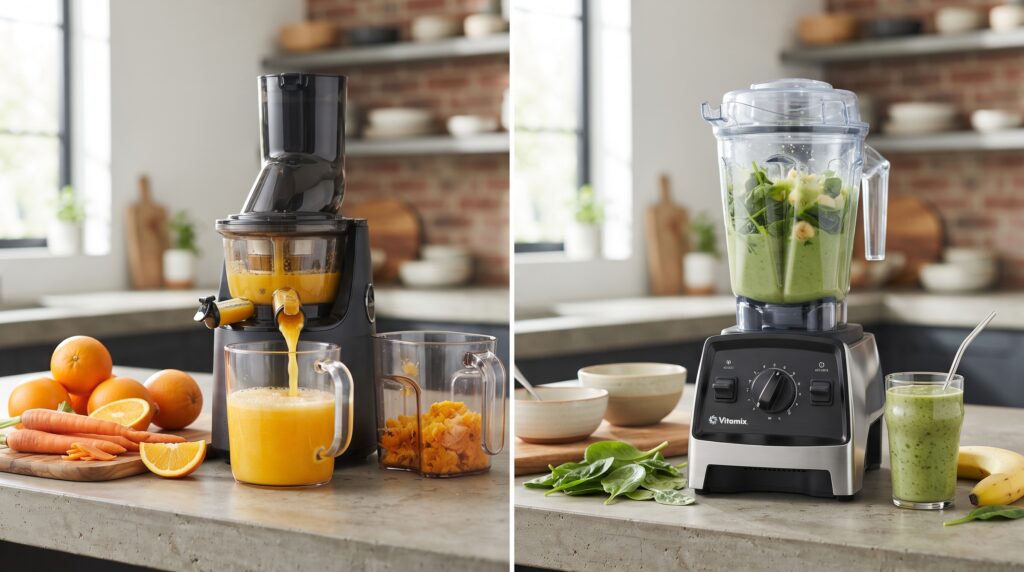
Choosing between a juicer or Vitamix depends on what you want to make and how you prefer to use fruits and vegetables. A juicer is designed to extract liquid from produce, while a Vitamix is a high performance blender designed to blend whole ingredients into smoothies, soups, sauces, frozen desserts, and other foods.
The biggest difference is what happens to the fiber. Juicing separates liquid from much of the pulp, while blending keeps the ingredients in the drink. Cleveland Clinic explains that smoothies retain what goes into the blender, whereas juicers extract liquid and leave the pulp behind.
If your main goal is fresh juice, a dedicated juicer is usually the better tool. If you want one appliance for smoothies and a wider range of recipes, a Vitamix can be the more versatile choice.
Quick Answer
Choose a juicer if you mainly want fresh fruit and vegetable juice with a smooth, liquid texture.
Choose a Vitamix if you want smoothies, soups, sauces, frozen desserts, nut based recipes, and other blended foods in addition to drinks.
Choose a juicer for:
- Fresh fruit juice
- Vegetable juice
- Smooth liquid texture
- Juice focused recipes
- Separating pulp from liquid
- Dedicated juicing
Choose a Vitamix for:
- Smoothies
- Whole food drinks
- Soups
- Sauces
- Frozen desserts
- Dips
- Nut based recipes
- General kitchen versatility
What Is a Juicer?
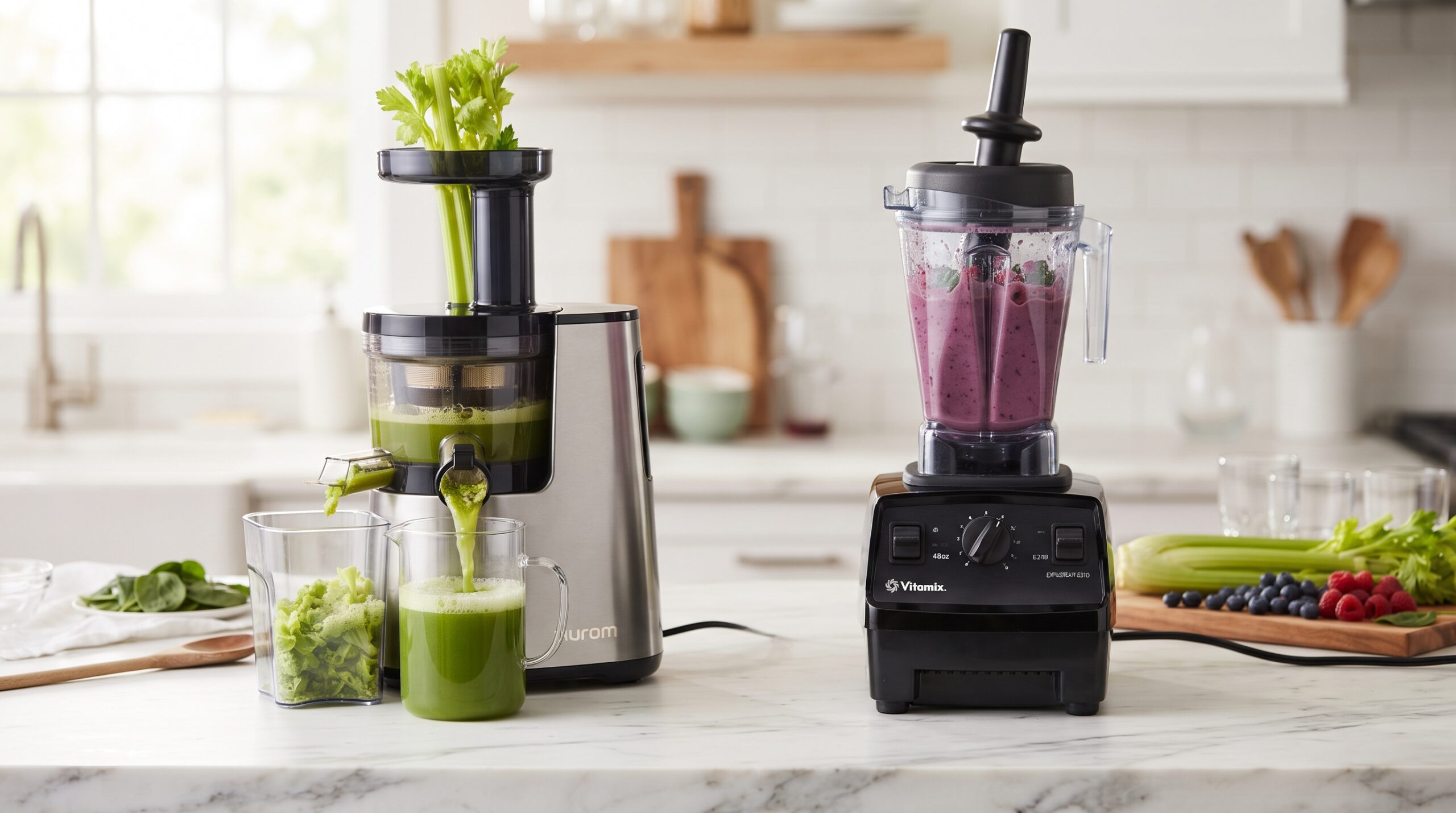
A juicer is a kitchen appliance designed to extract liquid from fruits and vegetables.
During juicing, the machine separates the juice from much of the pulp. This produces a thinner drink than a typical smoothie.
Because the pulp is separated, juice generally contains much less fiber than a smoothie made by blending whole produce. Cleveland Clinic notes that removing the pulp also removes fiber that can contribute to fullness and digestive health.
Juicers can be useful when you specifically want a glass of fresh juice rather than a thick smoothie.
What Is a Vitamix?
A Vitamix is a high performance blender designed to blend whole ingredients.
Unlike a traditional juicer, a Vitamix does not work by separating juice from pulp. The ingredients are broken down and incorporated into the finished mixture.
Vitamix describes its machines as versatile appliances that can be used for a range of foods and drinks.
Depending on the model and recipe, a Vitamix can be used for smoothies, soups, sauces, frozen desserts, dips, and other preparations.
Some current Vitamix models also offer variable speed controls and programmed settings.
Juicer vs Vitamix: Key Differences
| Feature | Juicer | Vitamix |
|---|---|---|
| Main purpose | Extract juice | Blend whole ingredients |
| Texture | Thin and liquid | Thick and smooth |
| Fiber | Much of the pulp is removed | Most ingredients remain |
| Smoothies | Not ideal | Excellent |
| Fresh juice | Excellent | Possible, but not traditional juicing |
| Soups | Limited | Excellent |
| Sauces | Limited | Excellent |
| Frozen desserts | Limited | Excellent |
| Versatility | Juice focused | Highly versatile |
| Pulp separation | Yes | No |
| Best for | Juice lovers | Multi purpose kitchen use |
1. How Each Appliance Works
The biggest difference between a juicer or Vitamix is how each appliance processes produce.
A juicer extracts liquid and separates much of the solid pulp.
A Vitamix blends the ingredients together. This means the finished drink can contain the fiber and other components of the whole food.
Cleveland Clinic describes this distinction clearly: a blender breaks food down into a drink, while a juicer extracts liquid and leaves pulp behind.
2. Fiber and Nutrition
Fiber is one of the most important differences between juice and blended drinks.
When you use a juicer, much of the fiber remains in the discarded pulp. When you use a Vitamix to make a smoothie, the whole ingredients are blended into the drink.
Cleveland Clinic notes that fiber can help with digestion, fullness, cholesterol management, and blood sugar control.
This doesn’t mean juice is automatically unhealthy. Fresh juice can provide vitamins, minerals, and other beneficial compounds. However, removing fiber changes how the drink behaves compared with whole fruits and vegetables.
3. Juice Quality and Texture
If your priority is a smooth glass of juice, a juicer has a clear advantage.
A juicer is specifically designed to separate liquid from pulp. This gives the final drink a thin texture that is difficult to reproduce with a conventional blender.
A Vitamix produces a thicker mixture because the ingredients are blended together.
Therefore:
Best for clear, pulp separated juice: Juicer
Best for thick smoothies: Vitamix
4. Smoothies
For smoothies, the Vitamix is the stronger choice.
A blender allows you to combine fruits, vegetables, liquid, ice, seeds, nuts, and other ingredients into one drink.
Because the ingredients remain in the smoothie, you can create a more substantial drink than traditional juice.
Cleveland Clinic recommends building smoothies around nutritious ingredients and notes that blending can retain the fiber found in whole produce.
5. Versatility
This is where the Vitamix has a major advantage.
A dedicated juicer is primarily designed for making juice.
A Vitamix can be used for many different preparations, depending on the model and recipe.
You can use it to prepare:
- Smoothies
- Soups
- Sauces
- Dips
- Frozen desserts
- Nut based recipes
- Purees
- Drinks
Vitamix’s own recipe resources highlight the broad range of foods that can be prepared with its machines.
If you want one appliance that performs several kitchen tasks, a Vitamix is often the more practical option.
6. Cleanup and Daily Use
Cleanup depends on the exact model.
A juicer can require cleaning several components because pulp and liquid are separated during operation.
A Vitamix can also require cleaning the container and blades, but many models are designed around relatively simple cleaning routines.
Some Vitamix models include self cleaning programs or cleaning guidance, depending on the model.
If you plan to use your appliance every day, consider not only performance but also how easy it is to clean after each use.
7. Cost Comparison
The cost of a juicer or Vitamix varies significantly.
Basic juicers can be relatively affordable, while premium centrifugal, masticating, or cold press machines can cost considerably more.
Vitamix models also range in price depending on features, capacity, controls, and accessories.
Instead of comparing price alone, consider how frequently you’ll use the appliance.
A cheaper appliance that sits unused may provide less value than a more versatile appliance that you use every day.
8. Best Choice for Whole Food Drinks
If you want to consume fruits and vegetables in a blended form while keeping the ingredients together, a Vitamix is generally the better choice.
For example, you can blend:
- Berries
- Banana
- Spinach
- Yogurt
- Oats
- Chia seeds
- Nut butter
- Milk or a milk alternative
This creates a smoothie rather than a traditional juice.
Keeping the whole ingredients can also help you retain fiber that would otherwise be removed during juicing.
9. Best Choice for Dedicated Juice Lovers
If your main goal is to make fresh juice every day, a dedicated juicer is the better choice.
A juicer is designed specifically to extract liquid from produce.
It can be especially useful if you prefer:
- Green juice
- Carrot juice
- Celery juice
- Apple juice
- Citrus based juice
- Mixed vegetable juice
However, juice should not automatically be considered better than whole fruits and vegetables. Removing fiber can make it easier to consume large amounts of natural sugar quickly.
Pros and Cons
Juicer Pros
- Excellent for fresh juice
- Produces a smooth liquid texture
- Separates pulp from juice
- Great for dedicated juice recipes
- Useful for fruit and vegetable juice
Juicer Cons
- Limited compared with a multipurpose blender
- Removes much of the fiber with the pulp
- Can require more cleanup
- May produce leftover pulp
- Not ideal for traditional smoothies
Vitamix Pros
- Highly versatile
- Excellent for smoothies
- Keeps whole ingredients together
- Can prepare soups and sauces
- Can make frozen desserts
- Useful for many recipes
- Suitable for everyday kitchen use
Vitamix’s product materials also emphasize versatility and a range of food preparation uses.
Vitamix Cons
- Does not produce traditional pulp separated juice
- Smoothies can be thicker than juice
- Premium models can be expensive
- Some recipes require enough liquid for effective blending
Juicer or Vitamix: Which Is Better for Health?
There isn’t one universal answer.
If you compare a traditional juice with a whole fruit smoothie, the smoothie generally retains more fiber because the ingredients remain in the drink.
Cleveland Clinic explains that juicing removes fiber and can make it easier to consume more sugar from fruit in a shorter period.
However, the overall nutritional value depends on the ingredients and the rest of your diet.
A smoothie made mostly from sugary ingredients can still contain a large amount of sugar and calories.
The best choice is usually the appliance that helps you consistently prepare nutritious foods and drinks that fit your dietary needs.
Juicer or Vitamix for Weight Loss
Neither appliance automatically causes weight loss.
What matters is the overall diet, portion sizes, calorie intake, protein, fiber, activity, and long term eating pattern.
Juice can make it easy to consume large quantities of fruit quickly because the fiber has been removed. Cleveland Clinic also cautions against relying on juice cleanses for weight loss because they can provide inadequate calories, protein, and fiber.
If you’re using a blender for weight management, focus on balanced smoothies containing ingredients such as vegetables, fruit, protein sources, and fiber rich foods.
Juicer or Vitamix for Green Drinks
Both appliances can make green drinks, but the result is different.
A juicer can create a thin green juice from ingredients such as:
- Spinach
- Kale
- Cucumber
- Celery
- Green apple
A Vitamix can blend those ingredients into a thicker smoothie.
If you want liquid juice, choose the juicer.
If you want a whole food smoothie, choose the Vitamix.
Common Mistakes When Choosing a Juicer or Vitamix
1. Buying a Juicer When You Actually Want Smoothies
If your main goal is smoothies, a dedicated juicer may not be the best investment.
A Vitamix is designed for blending whole ingredients.
2. Buying a Vitamix Expecting Traditional Juice
A Vitamix can blend fruits and vegetables, but it does not work like a dedicated juicer that separates pulp from liquid.
If pulp free juice is your priority, choose a juicer.
3. Ignoring Fiber
Don’t assume that removing pulp makes a drink healthier.
Fiber is an important part of fruits and vegetables, and juicing removes much of it.
4. Choosing Based Only on Price
Consider how often you will use the appliance and what recipes you want to prepare.
5. Ignoring Cleanup
An appliance that is difficult to clean may discourage frequent use.
Consider cleaning time before making your final decision.
Juicer or Vitamix: Which Should You Buy?
Choose a juicer if you are passionate about fresh juice and want a thin, pulp separated drink.
Choose a Vitamix if you want a versatile appliance for smoothies, soups, sauces, frozen desserts, and other recipes.
If you’re undecided and want only one appliance, the Vitamix can be the more versatile choice because it handles many tasks beyond drinks.
If you specifically want fresh juice and don’t need the additional functions of a blender, a juicer is the more focused choice.
Juicer or Vitamix: Best Choice by Category
| Category | Winner |
| Fresh juice | Juicer |
| Smoothies | Vitamix |
| Fiber retention | Vitamix |
| Pulp separation | Juicer |
| Soups | Vitamix |
| Sauces | Vitamix |
| Frozen desserts | Vitamix |
| Juice focused recipes | Juicer |
| Versatility | Vitamix |
| Whole food drinks | Vitamix |
| Thin liquid texture | Juicer |
| Multi purpose kitchen use | Vitamix |
FAQs
Is a Vitamix better than a juicer?
A Vitamix is better if you want a versatile appliance for smoothies and many food preparation tasks. A juicer is better if your primary goal is extracting fresh juice.
Can a Vitamix make juice?
A Vitamix can blend fruits and vegetables into a drink, but it does not separate pulp in the same way as a dedicated juicer.
Is juicing healthier than blending?
Not necessarily. Juicing removes much of the fiber from fruits and vegetables, while blending keeps the ingredients together.
Which is better for smoothies, a juicer or Vitamix?
A Vitamix is better for smoothies because it is designed to blend whole ingredients.
Which is better for fresh vegetable juice?
A dedicated juicer is generally better for making traditional vegetable juice because it separates liquid from pulp.
Does a Vitamix remove fiber?
A Vitamix does not normally separate the fiber from whole fruits and vegetables. When you blend whole produce, the ingredients remain in the finished drink.
Can you make green juice in a Vitamix?
Yes, you can blend green vegetables and other ingredients in a Vitamix. However, the result will be a smoothie rather than traditional pulp separated green juice.
Which is easier to use, a juicer or Vitamix?
It depends on the model and recipe. A Vitamix can be convenient for smoothies and many blended foods, while a juicer is more specialized for juice.
Which is more versatile, a juicer or Vitamix?
A Vitamix is generally more versatile because it can be used for drinks and many food preparation tasks.
Should I buy a juicer or Vitamix?
Buy a juicer if fresh juice is your main goal. Buy a Vitamix if you want smoothies and a multipurpose kitchen appliance.
Conclusion
The choice between juicer or Vitamix comes down to your main purpose.
A juicer is the better choice when you want fresh, smooth juice with much of the pulp separated. It is a specialized appliance designed around juice extraction.
A Vitamix is the better choice when you want versatility. It can blend whole fruits and vegetables into smoothies and can also be used for foods such as soups, sauces, dips, and frozen desserts.
The biggest nutritional difference is fiber. Juicing removes much of the pulp and therefore much of the fiber, while blending whole ingredients keeps them in the finished drink.
For dedicated juice lovers, choose a juicer.
For smoothies, whole food drinks, and broader kitchen use, choose a Vitamix.
If you want one appliance that can handle the widest range of recipes, Vitamix is the stronger overall choice.