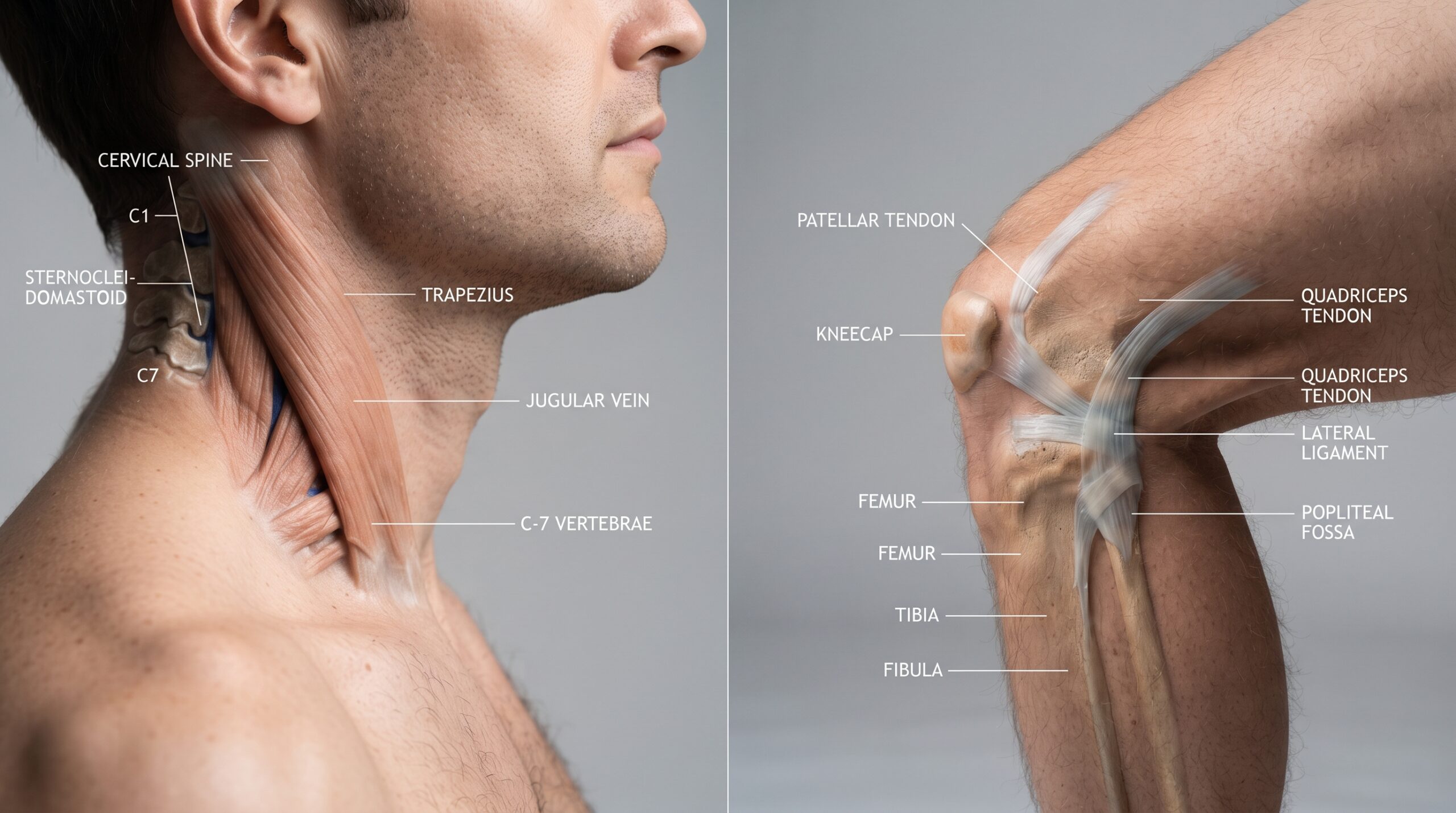
Why Do People Write “Kneck”?
The confusion usually comes from English words that begin with a silent K, including:
- Knee
- Knife
- Knock
- Knob
- Kneel
- Knot
Since these words start with KN, some learners assume neck follows the same pattern.
However, neck has always been spelled without a silent K in modern English.
Key insight: Similar pronunciation does not always mean words follow the same spelling pattern.
When Should You Use “Neck”?
Use neck whenever referring to:
The Human Body
- Neck pain
- Neck muscles
- Neck injury
- Neck exercises
Objects
- Bottle neck
- Guitar neck
- Vase neck
Idioms
- Neck and neck
- Pain in the neck
- Stick your neck out
- Breathe down someone’s neck
These expressions always use the spelling neck.
Real World Usage Scenarios
Example 1: At the Doctor
Incorrect: My kneck hurts.
Correct: My neck hurts.
🎯 Lesson: Medical terms always use neck.
Example 2: School Assignment
Incorrect: The giraffe has a long kneck.
Correct: The giraffe has a long neck.
🎯 Lesson: Use neck when referring to body parts.
Example 3: Music Class
Incorrect: The guitar kneck is damaged.
Correct: The guitar neck is damaged.
🎯 Lesson: Musical instruments also use the spelling neck.
Example 4: Everyday Conversation
Incorrect: I slept wrong and hurt my kneck.
Correct: I slept wrong and hurt my neck.
🎯 Lesson: The correct spelling never includes a silent K.
Common Mistakes
Mistake 1: Copying the Pattern of “Knee”
Why it happens:
Many English words begin with KN.
Correction:
Remember that neck is an exception and never starts with K.
Mistake 2: Relying Only on Pronunciation
Why it happens:
English spelling often differs from pronunciation.
Correction:
Check a dictionary when you’re unsure about spelling.
Mistake 3: Autocorrect Doesn’t Catch It
Why it happens:
Some spell checkers may not immediately flag every typo, especially in names or specialized contexts.
Correction:
Proofread carefully and verify unfamiliar spellings.
Memory Trick: Neck vs Kneck
Remember:
Neck = No K
Think of this phrase:
“No K in Neck.”
It’s short, simple, and easy to remember whenever you’re writing.
Expert Insight : Neck or Kneck
English contains many words with silent letters because of its historical development and borrowing from other languages. Words such as knee, knife, and knock retained their silent K, but neck evolved with a different spelling pattern.
Modern dictionaries, grammar guides, educational materials, and professional publications consistently recognize neck as the only correct spelling. Using kneck in academic, business, or professional writing is considered a spelling error and may reduce the credibility of your work.
Frequently Asked Questions
Is “kneck” a real word?
No. Kneck is a misspelling and is not recognized as a standard English word.
Why do people spell neck as “kneck”?
The mistake often happens because words like knee and knife begin with a silent K, leading some writers to apply the same pattern incorrectly.
Is “neck” correct in American and British English?
Yes. Neck is the correct spelling in both American and British English.
How can I remember the correct spelling?
Use the phrase “No K in Neck.” It is a simple memory trick that helps avoid this common spelling mistake.