
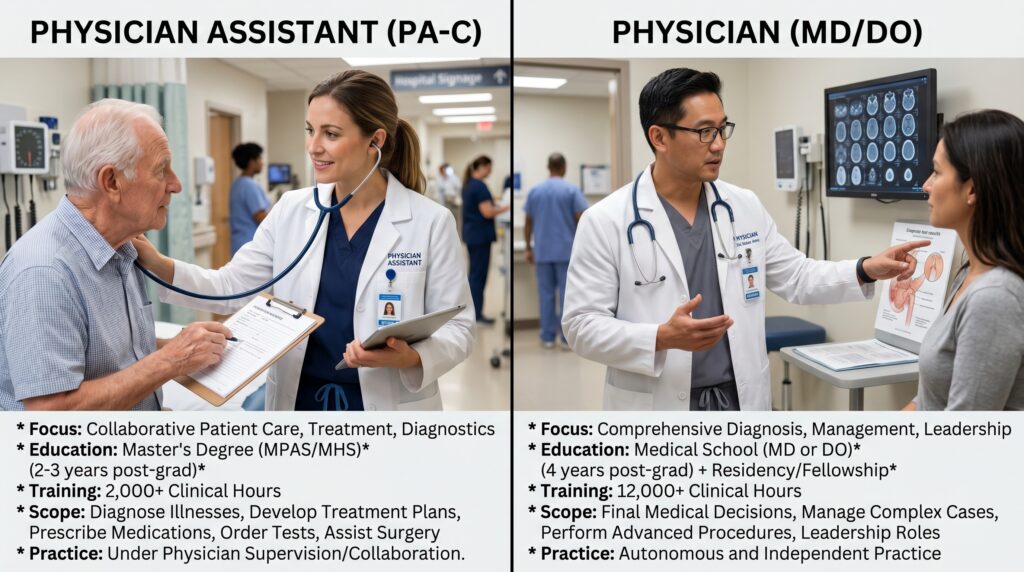
pa or doctor

PA or Doctor: 7 Ultimate Differences Explained to Choose the Right Healthcare Provider

PA or Doctor: What’s the Difference?

If you are visiting a clinic or hospital, you might see a PA (Physician Assistant) or a doctor, and it can be confusing to know who is who.

Many patients assume they are the same or that a PA is just a “junior doctor.” That is not accurate. Both roles are trained medical professionals, but they differ in education, authority, and level of responsibility.

Although they often work together in the same healthcare team, they are not interchangeable. Understanding the difference helps you know who is treating you and what level of care to expect.

Quick Answer : Pa or Doctor

A doctor (physician) completes full medical school and has the highest level of medical authority and independence.

A PA (Physician Assistant) is a highly trained medical professional who diagnoses and treats patients under a doctor’s supervision or collaboration, depending on the country.

Doctors have more training and independent authority, while PAs provide high quality care with a shorter training path.

pa or doctor


What Is a PA (Physician Assistant)?

Definition

A Physician Assistant is a licensed healthcare professional trained to diagnose illnesses, prescribe medication (in many regions), and assist in patient care under a supervising physician model.

Education and Training

  • Bachelor’s degree (usually science related)
  • PA master’s program (2 to 3 years)
  • Clinical rotations in multiple specialties
  • Licensing exams

Responsibilities

  • Taking patient histories
  • Performing physical exams
  • Diagnosing common conditions
  • Prescribing medication (varies by country)
  • Assisting in surgeries
  • Ordering and interpreting tests

Real Examples

Example 1

A PA treats a patient with flu symptoms and prescribes medication.

Example 2

A PA assists in a surgical procedure under a surgeon’s supervision.

Example 3

A PA manages routine follow up care in a clinic.

Key Insight

PAs provide high level medical care but typically work as part of a physician led team.


What Is a Doctor?

Definition

A doctor, also called a physician, is a fully trained medical professional who diagnoses, treats, and manages diseases independently after completing medical school and residency training.

Education and Training

  • Pre medical education (4 years)
  • Medical school (4 years)
  • Residency training (3 to 7+ years)
  • Optional specialization (fellowship)

Responsibilities

  • Diagnosing complex conditions
  • Creating treatment plans
  • Performing surgeries (specialists)
  • Leading medical teams
  • Supervising PAs and nurses
  • Managing critical care cases

Real Examples

Example 1

A doctor diagnoses cancer after reviewing test results.

Example 2

A surgeon performs a complex operation.

Example 3

A physician manages a patient with multiple chronic diseases.

Key Insight

Doctors have the highest level of medical training and decision making authority.


PA vs Doctor: Key Differences

Main Differences

  • Doctors have longer education and training.
  • PAs have shorter, more focused training.
  • Doctors can specialize more deeply.
  • PAs often support doctors in care delivery.
  • Doctors handle more complex and high risk cases.
  • PAs focus on general and supportive clinical care.

Comparison Table of Pa or Doctor

FeaturePA (Physician Assistant)Doctor (Physician)
Education Length~5–7 years total~10–15 years total
IndependenceSupervised or collaborativeFully independent
Scope of PracticeBroad but limitedFull medical authority
SpecializationLimitedExtensive
Surgery RoleAssistingLeading or performing
Decision AuthorityModerateHighest
Training FocusPractical clinical careDeep medical science

Real World Usage Scenarios

Scenario 1

Patient: “Who will see me today?”

Receptionist: “A PA will see you first, then a doctor if needed.”

🎯 Lesson: PAs often handle initial assessments.


Scenario 2

Patient: “Is a PA qualified enough for treatment?”

Doctor: “Yes, they are fully trained healthcare professionals.”

🎯 Lesson: PAs are licensed clinicians.


Scenario 3

Hospital: “Doctor is handling the complex surgery.”

Assistant: “PA is helping with preparation.”

🎯 Lesson: Doctors lead complex procedures.


Scenario 4

Patient: “My condition is complicated.”

Doctor: “You will be managed by a physician.”

🎯 Lesson: Complex cases require doctors.


Scenario 5

Clinic: “PA is managing routine follow-ups.”

Doctor: “Doctor oversees overall treatment plan.”

🎯 Lesson: Both roles work together.


Common Mistakes

Mistake 1: Thinking PAs Are Not Qualified

Why it happens:

People assume only doctors are real medical professionals.

Correction:

PAs are licensed and highly trained.


Mistake 2: Assuming They Have the Same Authority

Why it happens:

Both roles diagnose and treat patients.

Correction:

Doctors have broader independence and authority.


Mistake 3: Ignoring Team Based Care

Why it happens:

Patients focus on individual roles.

Correction:

Modern healthcare is collaborative.


Mistake 4: Not Knowing Who You Are Seeing

Why it happens:

Titles are not always explained clearly.

Correction:

Always check provider credentials if unsure.


Memory Tricks

Remember PA

PA = Practical Assistant in care team

Think supportive, efficient, and clinical.

Remember Doctor

Doctor = Decision maker and diagnoser

Think authority, complexity, and leadership.


Expert Insight

Healthcare systems increasingly rely on team based care models. Physician Assistants were introduced to improve access to healthcare, reduce waiting times, and support physicians in managing large patient loads.

Doctors remain central to complex decision making, especially in surgery, critical care, and specialized medicine. However, PAs significantly improve healthcare efficiency by handling routine and moderate complexity cases.

The combination of both roles improves overall patient access and system performance.

Conclusion : Pa or Doctor

When comparing PA or doctor, the key difference is level of training and independence.

  • Choose understanding of PA as a highly trained clinician who supports and manages many patient cases.
  • Recognize a doctor as the highest trained medical professional with full diagnostic and treatment authority.
  • Both work together to deliver complete patient care.

Neither role is “better,” but they serve different and equally important functions in healthcare.

Scroll to Top