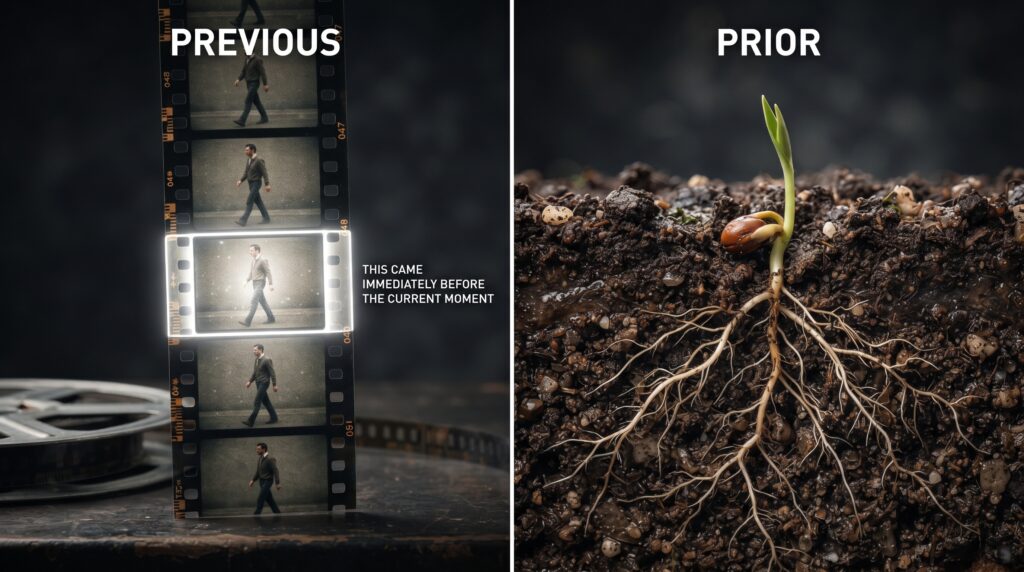
Choosing between previous or prior can be confusing because both words are used to describe something that happened before another event, time, or situation.
In many sentences, previous and prior can be used interchangeably. However, they are not always equally natural. Previous is common in everyday English, while prior can sound more formal and is frequently used in professional, legal, academic, and official writing.
For example, you can say, “I met her during my previous job.” You can also say, “I had no prior experience.” Both sentences refer to something that happened before, but the words have slightly different patterns and tones.
Understanding the difference between previous or prior can help you choose the most natural word for your sentence.
Quick Answer
Previous and prior both generally mean something that came before another event, time, person, or situation.
The main difference is usage and tone.
Previous is more common in everyday English.
Prior is often more formal and is common in phrases such as:
- Prior experience
- Prior knowledge
- Prior approval
- Prior notice
- Prior agreement
- Prior authorization
Simple rule
Use previous for general everyday references to something that came before.
Use prior when you want a more formal expression or when it naturally fits an established phrase.
For example:
Previous: I visited the restaurant the previous week.
Prior: You need prior approval before making the change.

What Does Previous Mean?
Previous is an adjective that means something that came before another thing in time, order, or position.
It is commonly used in everyday English.
Examples include:
- My previous job was in an office.
- I read the previous chapter.
- She called me the previous evening.
- The previous owner renovated the house.
- We discussed this during our previous meeting.
Previous can refer to something immediately before or something that occurred earlier.
Previous in Everyday English
Previous is especially common when talking about:
- Previous jobs
- Previous experiences
- Previous meetings
- Previous chapters
- Previous years
- Previous versions
- Previous conversations
- Previous attempts
For example:
I liked the previous version of the software.
Here, previous means the version that came before the current one.
What Does Prior Mean?
Prior can also mean something that happened or existed before another event or time.
It is often used as an adjective.
Examples include:
- Prior experience is required.
- You need prior approval.
- We received prior notice.
- He had no prior knowledge of the issue.
- The company reached a prior agreement.
Prior is especially common in formal or professional contexts.
Previous vs Prior: Key Differences
| Feature | Previous | Prior |
|---|---|---|
| Basic meaning | Happened before | Happened before |
| Grammar | Usually adjective | Usually adjective |
| Everyday usage | Very common | Less common |
| Formal writing | Common | Very common |
| Professional writing | Common | Common |
| Legal writing | Used | Very common |
| Academic writing | Common | Common |
| Natural phrases | Previous experience, previous year | Prior experience, prior approval |
| Tone | Neutral | Often more formal |
| Best use | General situations | Formal or established expressions |
| Main idea | Something before | Something before |
The biggest difference is not basic meaning. It is usage, tone, and common word combinations.
Previous or Prior: Are They Synonyms?
Yes, they are often synonyms.
For example:
I had no previous experience.
and
I had no prior experience.
Both sentences mean that the person had no experience before that point.
However, the second sentence sounds slightly more formal.
Similarly:
The previous owner lived here for ten years.
The prior owner lived here for ten years.
Both can be understood, but previous owner is generally more natural in ordinary conversation.
When Should You Use Previous?
Use previous when referring to something that came before another thing in a general or everyday context.
Example 1
I enjoyed the previous episode.
This means the episode that came before the current episode.
Example 2
My previous employer was very supportive.
This refers to the employer before the current one.
Example 3
Please read the previous paragraph.
This refers to the paragraph immediately before the current paragraph.
Example 4
The previous year was difficult.
This refers to the year before the current year or the year being discussed.
When Should You Use Prior?
Use prior when the sentence has a formal, professional, legal, academic, or official tone.
It is particularly natural in certain fixed expressions.
Prior experience
Prior experience is preferred.
This is extremely common in job descriptions.
Prior approval
The project requires prior approval.
This means approval must be obtained beforehand.
Prior notice
Employees must receive prior notice.
This means notice must be given before something happens.
Prior knowledge
Students should have some prior knowledge of mathematics.
This means knowledge gained before the current learning situation.
Prior agreement
The parties reached a prior agreement.
This sounds more formal than “previous agreement.”
Previous or Prior in Job Applications
Both words can appear in employment contexts.
However, prior experience is particularly common.
For example:
Candidates should have prior experience in customer service.
This sounds natural and professional.
You can also say:
Candidates should have previous experience in customer service.
This is also correct.
The choice depends largely on style.
Previous or Prior in Academic Writing
Both words are acceptable in academic writing.
For example:
Previous studies have examined this issue.
This is extremely common in research writing.
You may also see:
Prior research has examined this issue.
Prior can give the sentence a slightly more formal tone.
Both are grammatically correct.
Previous or Prior in Legal Writing
Prior is particularly common in legal and official language.
Examples include:
- Prior authorization
- Prior notice
- Prior agreement
- Prior conviction
- Prior consent
- Prior knowledge
However, the correct terminology depends on the legal context and jurisdiction.
Don’t replace established legal terminology simply because another word appears similar.
Previous or Prior: Grammar Examples
Here are some useful examples.
| Sentence | Correct Word | Reason |
| I read the previous chapter. | Previous | Everyday reference |
| Prior approval is required. | Prior | Formal phrase |
| My previous job was in marketing. | Previous | Natural everyday usage |
| Prior experience is preferred. | Prior | Common professional phrase |
| She called me the previous evening. | Previous | Time reference |
| We had no prior knowledge. | Prior | Formal expression |
| The previous owner sold the house. | Previous | Natural everyday phrase |
| The company gave prior notice. | Prior | Formal expression |
Previous vs Prior in Time Expressions
Previous is often useful when talking about a specific period that came before another period.
Examples:
- The previous day
- The previous week
- The previous month
- The previous year
- The previous evening
- The previous night
For example:
I met him the previous day.
Prior can also refer to an earlier time, but it often sounds more formal.
For example:
The issue had been discussed prior to the meeting.
Prior to vs Before
One important difference is the expression prior to.
Prior to means before.
For example:
Prior to the meeting, we reviewed the documents.
This means:
Before the meeting, we reviewed the documents.
Prior to is grammatically correct, but before is usually simpler and more natural in everyday English.
In professional or formal writing, prior to may be appropriate when it fits the style.
Common Mistakes With Previous and Prior
Mistake 1: Assuming They Are Always Interchangeable
Although their meanings overlap, some combinations sound much more natural with one word.
For example:
Prior approval is a very common phrase.
“Previous approval” can mean something different because it may refer to an approval that happened earlier.
Mistake 2: Using Prior Everywhere
Prior can sound overly formal in casual conversation.
Instead of:
Prior to dinner, I went shopping.
You can simply say:
Before dinner, I went shopping.
Mistake 3: Thinking Previous Always Means Immediately Before
Previous can refer to something earlier, but the exact meaning depends on context.
For example:
My previous job
usually means the job before my current job.
Mistake 4: Confusing Prior With Former
Prior and former can overlap, but they aren’t always identical.
Former employer usually identifies an employer someone no longer works for.
Prior employer can also refer to an earlier employer, but it sounds more formal.
Mistake 5: Using “Prior Before”
Avoid phrases such as:
Prior before the meeting
This is redundant.
Use:
Before the meeting
or:
Prior to the meeting

Pros and Cons
Previous
Pros
- Very common
- Easy to understand
- Natural in conversation
- Suitable for general writing
- Works well with time references
- Useful for everyday situations
Cons
- Can sound less formal
- May not fit some established professional phrases
- Can be less precise in certain formal contexts
Prior
Pros
- Common in formal writing
- Useful in professional contexts
- Common in legal language
- Works well in established expressions
- Concise and precise
Cons
- Can sound formal in casual conversation
- May sound unnatural in some everyday sentences
- Shouldn’t be used simply to make writing sound more sophisticated
Previous or Prior: Easy Memory Trick
Use this simple rule:
Previous = everyday earlier
Prior = formal earlier
Think of phrases such as:
Previous day
Previous job
Previous chapter
Then remember formal expressions such as:
Prior approval
Prior notice
Prior experience
Prior knowledge
This isn’t an absolute grammar rule, but it is a useful way to remember the most natural patterns.
FAQs
Is previous or prior correct?
Both are correct. They generally refer to something that happened or existed before another point in time. The better choice depends on context and tone.
Is prior more formal than previous?
Usually, yes. Prior is commonly used in formal, professional, academic, and legal writing, while previous is more common in everyday English.
Can I use previous instead of prior?
Often, yes. For example, both “previous experience” and “prior experience” are grammatically correct. However, some established expressions sound more natural with prior.
Can I use prior instead of previous?
Sometimes. Prior is common in formal expressions such as “prior approval” and “prior notice,” but it can sound unnecessarily formal in casual sentences.
Which is better, previous experience or prior experience?
Both are correct. Prior experience is particularly common in job descriptions and professional writing.
Which is correct, previous owner or prior owner?
Both can be correct. Previous owner is generally more natural in everyday English, while prior owner sounds more formal.
What is the difference between prior and previous?
Both mean something that came before. Previous is generally more common in everyday English, while prior is often more formal and common in established expressions.
Is prior to the same as before?
Yes. Prior to means before. However, “before” is usually simpler and more natural in everyday writing.
Is previous past tense?
No. Previous is an adjective. It describes something that came before another thing in time, order, or position.
Is prior an adjective?
Yes. Prior can function as an adjective meaning earlier or existing before a particular time or event.
Which word is better for formal writing?
Prior can be useful in formal writing, but previous is also completely acceptable in many contexts. Choose the word that sounds natural for the sentence.
Can previous and prior be used together?
Usually, there is no need to use both because they can express the same idea. Avoid unnecessary repetition.
Conclusion
The difference between previous or prior is mainly about usage, tone, and context rather than basic meaning.
Previous is the more common choice in everyday English. It works naturally with expressions such as previous job, previous year, previous chapter, previous owner, and previous experience.
Prior is also correct, but it often sounds more formal. It is especially common in expressions such as prior approval, prior notice, prior knowledge, prior agreement, and prior experience.
If you’re writing a casual sentence, previous is often the safest choice. If you’re writing a professional, academic, legal, or official sentence, prior may be more natural.
The easiest rule to remember is:
Previous is usually better for everyday English. Prior is often better for formal or established expressions.
Once you understand this difference, choosing between previous or prior becomes much easier and your English will sound more natural and precise.