
Quartzite or Quartz: Which Countertop Material Is Better?
If you’re planning a kitchen or bathroom renovation, you’ve probably encountered the debate: quartzite or quartz?
The confusion is understandable because the names sound almost identical. Many homeowners assume they are the same material or closely related products. In reality, they are very different.
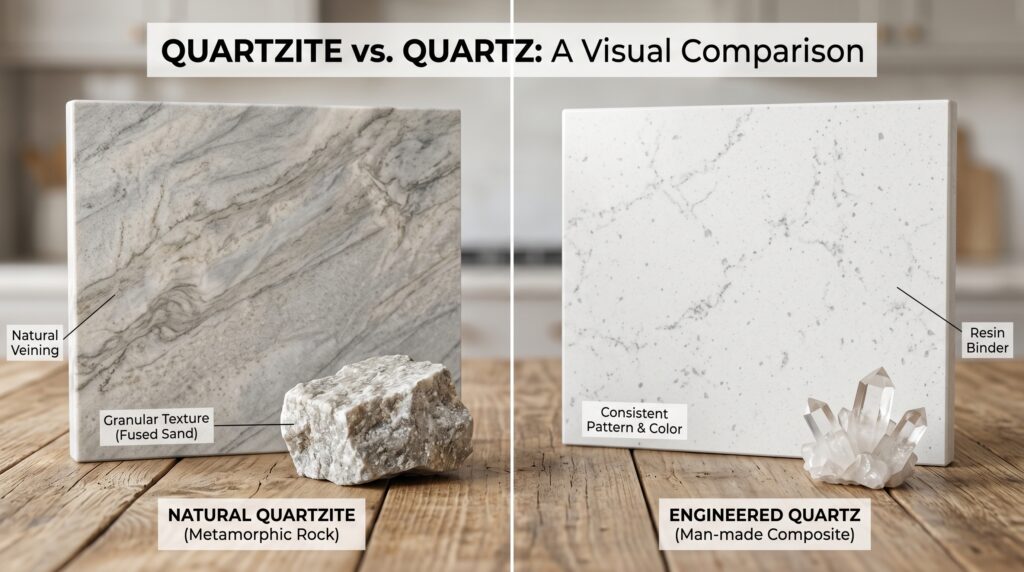
Although they look similar at first glance, quartzite is a natural stone, while quartz is an engineered surface. This difference affects durability, maintenance, appearance, and cost.
This guide explains everything you need to know to make the right choice for your home.
Quick Answer : Quartzite or Quartz
Quartzite is a natural stone known for its unique appearance and excellent heat resistance.
Quartz is an engineered material known for low maintenance, consistency, and stain resistance.
Choose quartzite if you want natural beauty and uniqueness. Choose quartz if you want convenience and easy upkeep.
What Is Quartzite?
Definition
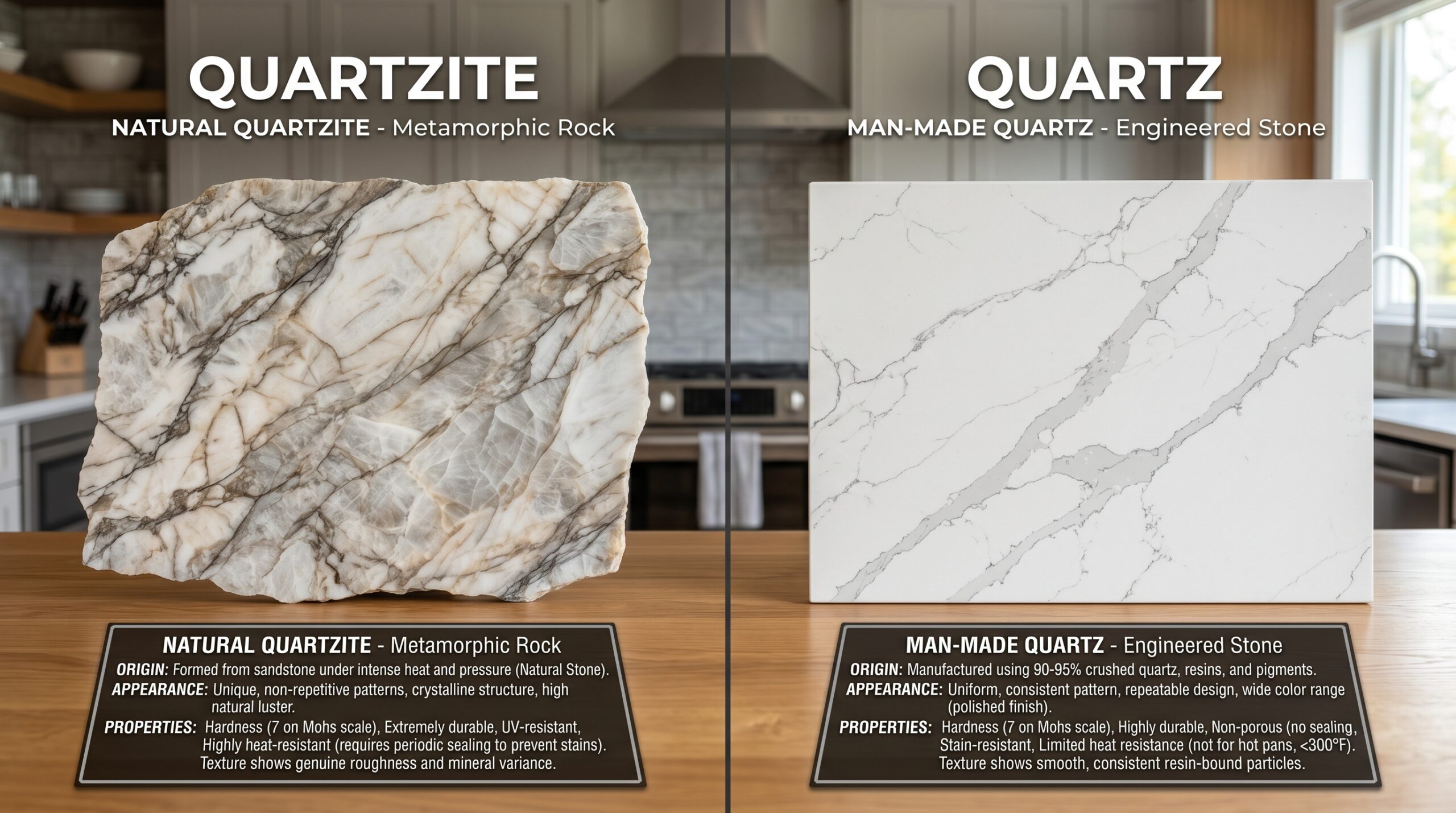
Quartzite is a natural metamorphic rock formed when sandstone is subjected to intense heat and pressure over millions of years.
Key Characteristics
- Natural stone
- Unique patterns and veining
- High heat resistance
- Extremely durable
- Requires periodic sealing
Best Uses
- Luxury kitchens
- Bathroom countertops
- Wall features
- High-end residential projects
Examples
Example 1
A homeowner selects quartzite for a one-of-a-kind kitchen island.
Example 2
A designer uses quartzite to create a natural stone backsplash.
Example 3
A luxury home features quartzite countertops throughout the kitchen.
Key Insight
Every quartzite slab is unique because it is formed naturally.
What Is Quartz?
Definition
Quartz countertops are engineered surfaces made from crushed natural quartz combined with resins and pigments.
Key Characteristics
- Manufactured product
- Consistent appearance
- Non-porous surface
- Low maintenance
- Wide range of colors and designs
Best Uses
- Busy family kitchens
- Bathrooms
- Commercial spaces
- Modern interior designs
Examples
Example 1
A family chooses quartz because it requires little maintenance.
Example 2
A homeowner selects a quartz countertop with a marble-like appearance.
Example 3
A restaurant installs quartz surfaces for easy cleaning.
Key Insight
Quartz is designed for durability and convenience rather than natural uniqueness.
Quartzite vs Quartz: Key Differences
Main Differences
- Quartzite is natural; quartz is engineered.
- Quartzite requires sealing; quartz generally does not.
- Quartzite handles heat better.
- Quartz offers more color consistency.
- Quartzite has naturally occurring patterns.
- Quartz is usually easier to maintain.
Comparison Table of Quartzite or Quartz
| Feature | Quartzite | Quartz |
|---|---|---|
| Material Type | Natural stone | Engineered surface |
| Appearance | Unique natural patterns | Consistent designs |
| Maintenance | Moderate | Low |
| Sealing Required | Usually yes | No |
| Heat Resistance | Excellent | Good |
| Stain Resistance | Good when sealed | Excellent |
| Color Consistency | Varies naturally | Highly consistent |
| Durability | Very high | Very high |
| Best For | Natural stone lovers | Low-maintenance homeowners |
Real-World Usage Scenarios
Scenario 1
Homeowner: “I want a completely unique countertop.”
Designer: “Quartzite may be your best option.”
🎯 Lesson: Natural stone offers one-of-a-kind beauty.
Scenario 2
Homeowner: “I don’t want to worry about sealing.”
Designer: “Quartz is likely the better choice.”
🎯 Lesson: Quartz simplifies maintenance.
Scenario 3
Cook: “I often place hot cookware on surfaces.”
Designer: “Quartzite generally provides better heat resistance.”
🎯 Lesson: Heat tolerance can influence material selection.
Scenario 4
Homeowner: “I want all countertops to look identical.”
Designer: “Quartz offers greater consistency.”
🎯 Lesson: Engineered surfaces provide uniformity.
Scenario 5
Homeowner: “I love natural stone aesthetics.”
Designer: “Quartzite delivers authentic geological patterns.”
🎯 Lesson: Natural appearance is a major selling point of quartzite.
Common Mistakes
Mistake 1: Assuming Quartzite and Quartz Are the Same
Why it happens:
The names are very similar.
Correction:
Quartzite is natural stone, while quartz is engineered.
Mistake 2: Ignoring Maintenance Requirements
Why it happens:
Homeowners focus only on appearance.
Correction:
Consider long-term upkeep before choosing.
Mistake 3: Assuming All Natural Stone Behaves the Same
Why it happens:
People group all stone surfaces together.
Correction:
Different stones have different maintenance and durability profiles.
Mistake 4: Prioritizing Trends Over Lifestyle
Why it happens:
Design inspiration often influences decisions.
Correction:
Choose a material that fits your daily habits.
Memory Tricks
Remember Quartzite
Quartzite = Quarry + Natural Stone
Think natural formation and unique patterns.
Remember Quartz
Quartz = Quick Maintenance
Think easy cleaning and consistency.
Expert Insight
One of the biggest misconceptions in countertop shopping is believing quartzite and quartz are variations of the same material.
In reality, they represent two different categories of surfaces. Quartzite appeals to homeowners who value natural stone authenticity and geological uniqueness. Quartz appeals to those who prioritize convenience, consistency, and modern engineering.
As countertop technology advances, both materials remain among the most popular premium choices because they excel in different ways rather than directly replacing one another.
Conclusion : Quartzite or Quartz
When comparing quartzite or quartz, the best choice depends on your priorities.
- Choose quartzite if you want natural beauty, uniqueness, and excellent heat resistance.
- Choose quartz if you want low maintenance, stain resistance, and consistent appearance.
- Consider your lifestyle, design preferences, and maintenance expectations before making a decision.
Both materials are premium countertop options, but the right one is the one that best matches how you live and use your space.
