
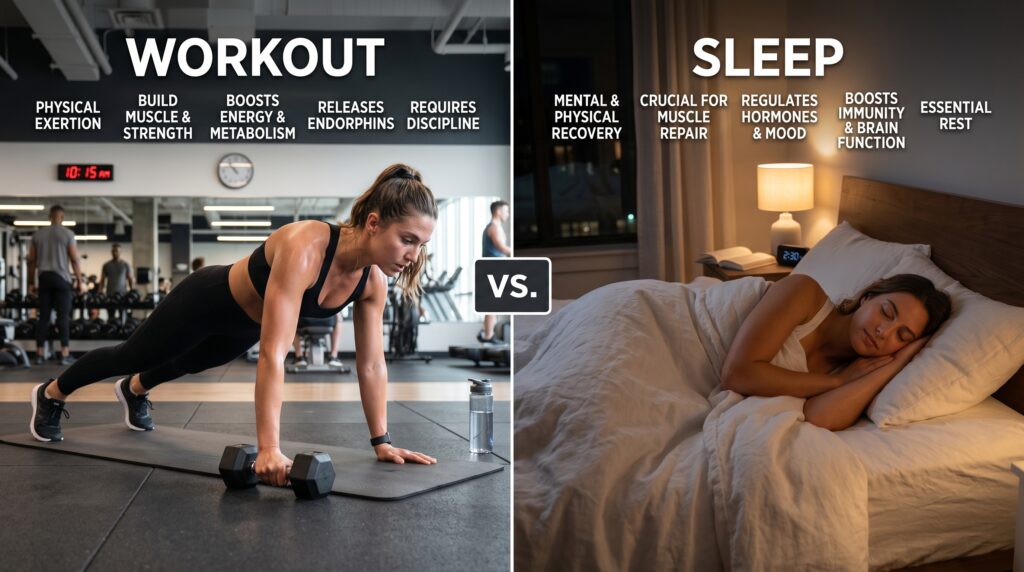
Sleep or workout

Sleep or Workout: 7 Key Differences to Improve Your Health and Daily Energy

Sleep or Workout: Which Is More Important?

If you’ve ever had to choose between getting extra sleep or squeezing in a workout, you’re not alone.

Many people face this dilemma when they have a busy schedule. You set an early alarm for the gym, but you’re running on only a few hours of sleep. Should you exercise anyway, or stay in bed and recover?

Although sleep and exercise are both essential for good health, they serve completely different purposes. Understanding how they affect your body can help you make smarter decisions and avoid common fitness mistakes.

This guide explains the differences, benefits, and situations where one may be more important than the other.


Quick Answer: Sleep or Workout?

If you’re severely sleep deprived, getting more sleep is usually more beneficial than forcing a workout.

If you’re well rested, regular exercise is essential for long term health, fitness, and disease prevention.

The ideal solution is not choosing one over the other. It’s consistently prioritizing both.
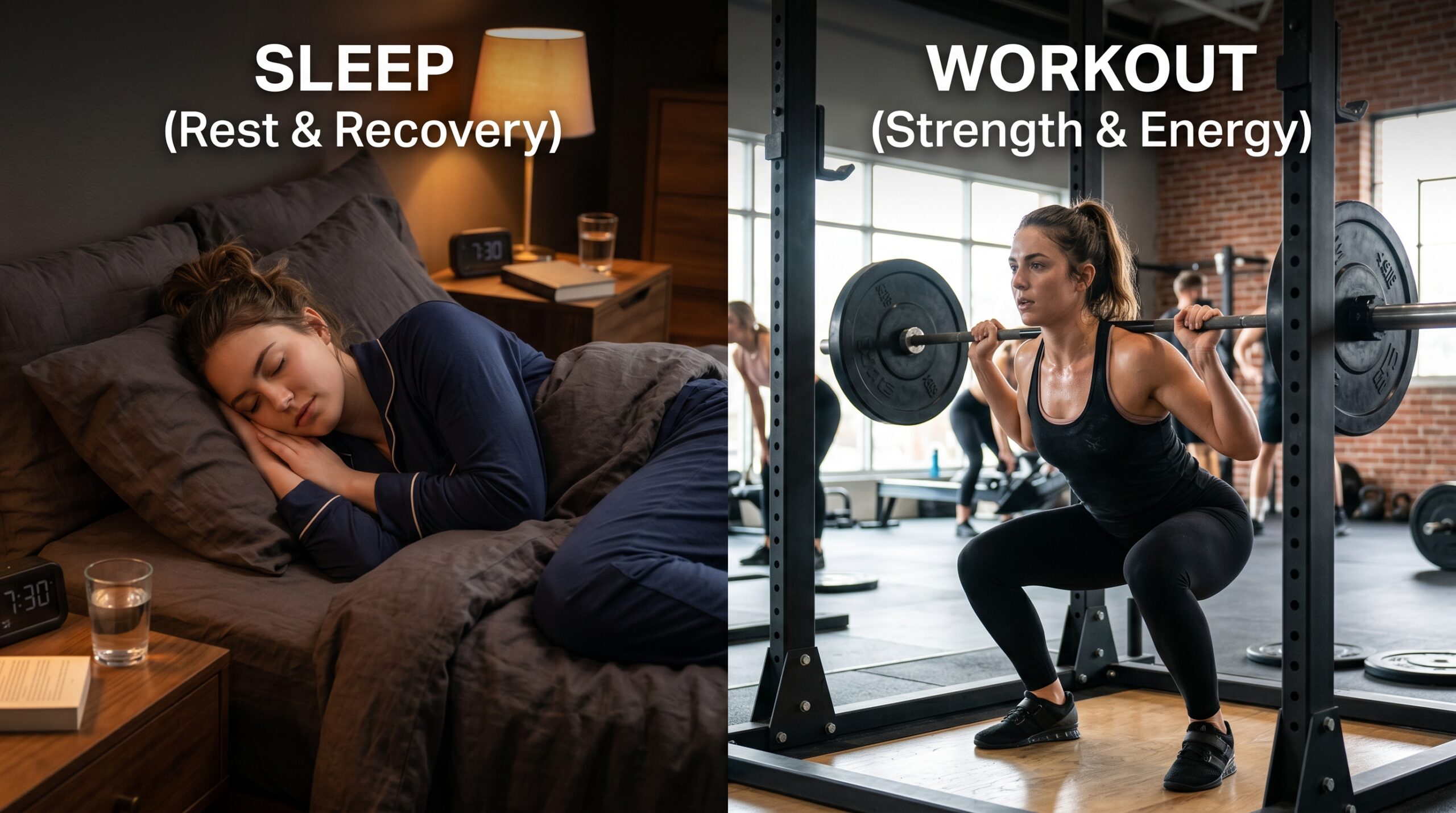
Sleep or workout


What Is Sleep?

Definition

Sleep is a natural biological process during which the body and brain recover, repair tissues, regulate hormones, consolidate memories, and restore energy.

Why Sleep Matters

During sleep, your body:

  • Repairs muscles
  • Regulates hormones
  • Strengthens the immune system
  • Supports brain function
  • Improves mood and concentration

Benefits of Quality Sleep

  • Better recovery
  • Improved mental performance
  • Stronger immunity
  • Reduced stress
  • Healthier metabolism

Real Examples

Example 1

A student who sleeps eight hours often performs better on exams than one who stays up all night studying.

Example 2

An athlete recovers faster after intense training when getting adequate sleep.

Example 3

A professional feels more productive after a full night’s sleep.

Key Insight

Sleep is the foundation that supports nearly every function in the human body.


What Is a Workout?

Definition

A workout is a planned period of physical activity designed to improve strength, endurance, flexibility, cardiovascular health, or overall fitness.

Why Exercise Matters

Regular workouts help:

  • Build muscle
  • Strengthen the heart
  • Improve endurance
  • Burn calories
  • Support mental health

Benefits of Exercise

  • Better physical fitness
  • Reduced disease risk
  • Improved mood
  • Increased energy levels
  • Enhanced longevity

Real Examples

Example 1

A person who walks daily improves cardiovascular health.

Example 2

Strength training increases muscle mass and bone density.

Example 3

Regular exercise reduces stress and anxiety.

Key Insight

Exercise improves physical capacity, but recovery largely happens during sleep.


Sleep vs Workout: Key Differences

Main Differences

  • Sleep restores the body; workouts challenge it.
  • Sleep supports recovery; workouts create adaptation.
  • Sleep affects every organ system.
  • Exercise improves fitness and physical performance.
  • Lack of sleep can reduce workout effectiveness.
  • Workouts cannot fully compensate for chronic sleep deprivation.

Comparison Table of Sleep or Workout

Feature Sleep Workout
Primary Purpose Recovery and repair Physical adaptation
Energy Impact Restores energy Uses energy
Muscle Growth Supports recovery Stimulates growth
Brain Function Essential Beneficial
Weight Management Influences hormones Burns calories
Stress Reduction High High
Daily Requirement Essential Recommended
Recovery Role Critical Limited

Real World Usage Scenarios

Scenario 1

Person A: “I slept only four hours last night.”

Person B: “Extra sleep may be more beneficial than an intense workout.”

🎯 Lesson: Severe sleep deprivation increases fatigue and injury risk.


Scenario 2

Person A: “I slept eight hours and feel great.”

Person B: “Now is an excellent time to exercise.”

🎯 Lesson: Proper rest improves workout quality.


Scenario 3

Person A: “I want to build muscle.”

Person B: “You need both strength training and sufficient sleep.”

🎯 Lesson: Muscle growth depends on exercise and recovery.


Scenario 4

Person A: “I’m constantly exhausted.”

Person B: “Review your sleep habits before increasing workout intensity.”

🎯 Lesson: Recovery problems often begin with poor sleep.


Scenario 5

Person A: “Can exercise replace sleep?”

Person B: “No. They serve different biological functions.”

🎯 Lesson: One cannot fully replace the other.


Common Mistakes

Mistake 1: Sacrificing Sleep for Daily Workouts

Why it happens:

People believe more exercise always produces better results.

Correction:

Chronic sleep deprivation can reduce performance and recovery.


Mistake 2: Using Exercise to Offset Poor Sleep

Why it happens:

People hope workouts will compensate for fatigue.

Correction:

Exercise helps health, but cannot replace adequate sleep.


Mistake 3: Ignoring Recovery

Why it happens:

Fitness goals often focus only on training.

Correction:

Recovery is where many physical adaptations occur.


Mistake 4: Believing More Is Always Better

Why it happens:

Motivation can lead to overtraining.

Correction:

Balance exercise with proper recovery and sleep.


Memory Tricks

Remember Sleep

Sleep = Repair, Restore, Recover

Think of your body’s maintenance system.

Remember Workout

Workout = Build, Strengthen, Improve

Think of challenging the body to become stronger.


Expert Insight

Sports scientists and health researchers consistently find that sleep and exercise work together rather than compete.

Exercise creates microscopic stress on muscles and physiological systems. Sleep is when much of the repair and adaptation process occurs. Poor sleep can affect reaction time, hormone production, appetite regulation, recovery, and athletic performance.

In fact, many fitness professionals consider sleep one of the most powerful performance enhancers available because it influences nearly every aspect of physical and mental health.

Conclusion: Sleep or Workout?

When comparing sleep or workout, the best answer is usually both.

  • Prioritize sleep when you are significantly sleep deprived.
  • Prioritize exercise as part of a consistent long term health routine.
  • Remember that exercise drives improvement, while sleep enables recovery and adaptation.

If forced to choose after a very poor night’s sleep, additional rest is often the smarter short term decision. Over the long run, however, the healthiest lifestyle includes both quality sleep and regular exercise working together.

Scroll to Top