
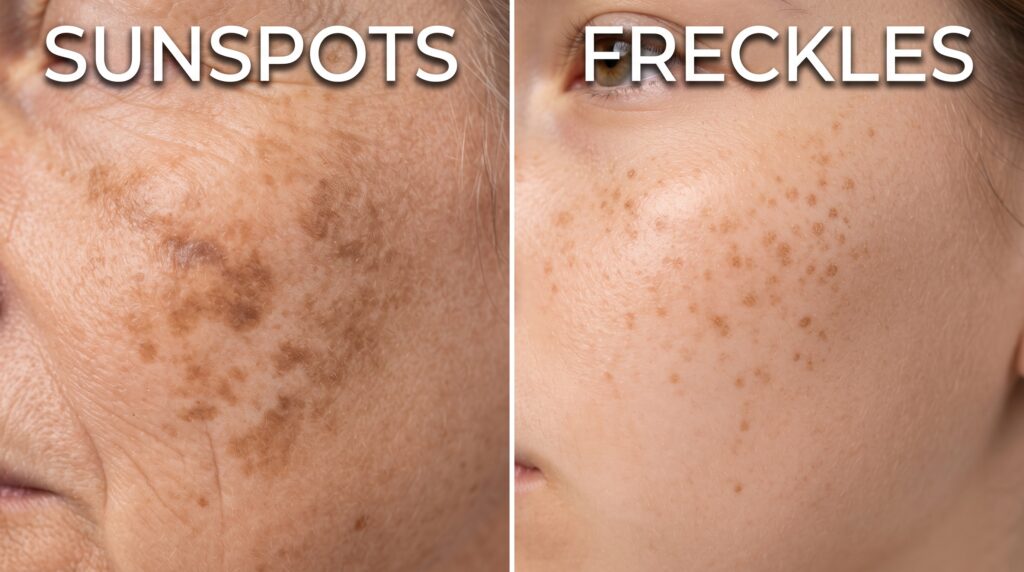
Have you noticed small brown spots appearing on your face, hands, shoulders, or other areas exposed to the sun? You may wonder whether they are sunspots or freckles.
Although sunspots and freckles can look similar, they aren’t exactly the same. Both are linked to melanin and sun exposure, but they have different causes, patterns, and typical appearances.
Freckles are usually small, flat spots that can become more noticeable after sun exposure. Sunspots, often called age spots or solar lentigines, tend to be larger and more persistent. Sunspots commonly develop after repeated ultraviolet exposure over time.
Knowing the difference between sunspots or freckles can help you understand your skin better and decide when professional evaluation may be appropriate.
Quick Answer
Freckles are usually small, flat, light brown to dark brown spots that are influenced by genetics and become more visible with sun exposure.
Sunspots are usually larger, more clearly defined areas of pigmentation caused by cumulative ultraviolet exposure. They tend to remain visible throughout the year.
The simplest distinction is this:
Freckles often become darker in the sun and lighter when sun exposure decreases, while sunspots tend to remain more persistent.
However, appearance alone cannot always identify a skin lesion accurately. A dermatologist should evaluate any spot that is changing, unusual, bleeding, or otherwise concerning.
What Are Freckles?
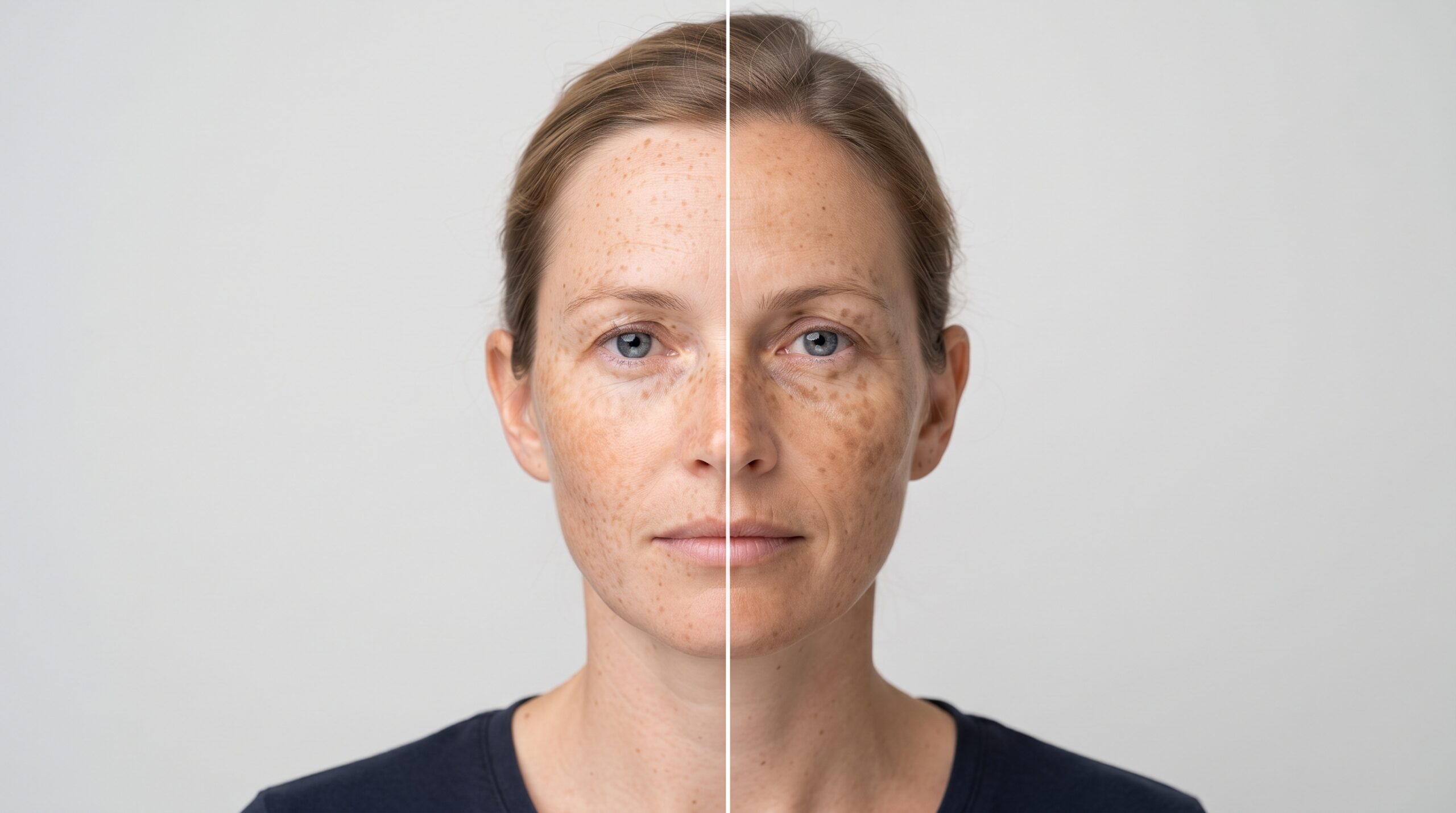
Freckles are small areas of increased pigmentation that commonly appear on sun exposed skin.
They are associated with increased melanin production and genetic factors. People with certain skin types and genetic backgrounds are more likely to develop freckles.
Common locations include:
- Face
- Nose
- Cheeks
- Shoulders
- Arms
- Upper chest
Freckles are usually:
- Small
- Flat
- Round or irregular
- Light brown to reddish brown
- More noticeable after sun exposure
Freckles can become less noticeable during periods of lower sun exposure.
What Are Sunspots?
Sunspots are flat areas of increased pigmentation that develop on skin exposed to ultraviolet radiation over time.
They are also known as:
- Age spots
- Liver spots
- Solar lentigines
Despite the name “liver spots,” they aren’t caused by a liver problem.
Sunspots commonly appear on:
- Face
- Hands
- Shoulders
- Arms
- Upper chest
They are often larger and more persistent than freckles.
Sunspots vs Freckles: Key Differences
| Feature | Freckles | Sunspots |
|---|---|---|
| Typical size | Usually small | Often larger |
| Main causes | Genetics and sun exposure | Cumulative UV exposure |
| Color | Light brown to reddish brown | Tan, brown, or darker brown |
| Sun exposure effect | Often become darker | Usually remain visible |
| Seasonal changes | Common | Less noticeable |
| Persistence | May fade | Usually persistent |
| Typical age | Can appear during childhood | More common with increasing age |
| Common locations | Face, shoulders, arms | Face, hands, shoulders, arms |
| Shape | Round or irregular | Usually well defined |
| Number | Often numerous | Can be single or multiple |
| Main concern | Usually harmless | Usually harmless, but changing spots need evaluation |
Sunspots or Freckles: How to Tell the Difference
Several features can help you distinguish them.
Size
Freckles are generally smaller.
Sunspots can be larger and more noticeable.
However, size alone isn’t enough to identify a spot.
Seasonal Changes
Freckles often become darker during periods of increased sun exposure and may fade when exposure decreases.
Sunspots tend to remain visible throughout the year.
Age of Appearance
Freckles can develop early in life, particularly in people who are genetically predisposed to them.
Sunspots are more commonly associated with cumulative sun exposure and become more frequent with age.
Appearance
Freckles often appear as multiple small spots.
Sunspots may appear as larger, clearly defined patches of pigmentation.
Causes of Freckles
Freckles are influenced by both genetics and ultraviolet exposure.
A pigment called melanin gives skin its color. When skin is exposed to ultraviolet radiation, melanin production can increase.
Genetics influence how strongly someone’s skin responds to sunlight.
This means that two people can receive similar sun exposure but develop very different amounts of freckles.
Causes of Sunspots
Sunspots are mainly associated with cumulative ultraviolet exposure.
Over many years, repeated exposure to sunlight can cause changes in pigment producing cells.
Factors that may increase the likelihood of sunspots include:
- Frequent sun exposure
- Outdoor activities
- Lack of sun protection
- Increasing age
- History of sunburn
- Repeated ultraviolet exposure
Sunspots are therefore a visible sign of accumulated sun exposure.
Sunspots or Freckles on the Face
The face is one of the most common locations for both freckles and sunspots.
Freckles may appear across the nose and cheeks, while sunspots can occur on the cheeks, forehead, temples, and other exposed areas.
Because many different skin conditions can cause brown or dark spots, don’t rely only on photographs or online comparisons when evaluating a new or changing mark.
Are Sunspots and Freckles Dangerous?
Most freckles and typical sunspots are harmless.
However, not every brown spot is a freckle or sunspot.
A changing pigmented lesion can sometimes indicate a more serious skin condition.
Pay attention to changes in:
- Size
- Shape
- Color
- Border
- Texture
Seek medical evaluation if a spot is:
- Rapidly changing
- Bleeding
- Crusting
- Painful
- Itchy
- Very different from your other spots
- Developing an unusual shape or multiple colors
A dermatologist can examine suspicious pigmentation and determine whether further testing is needed.
Treatment for Freckles
Freckles don’t always need treatment.
If you want to reduce their appearance, a dermatologist may discuss options such as:
- Prescription creams
- Chemical peels
- Laser treatments
- Other pigment reducing procedures
Treatment choice depends on skin type, pigmentation, location, and the cause of the spots.
Trying aggressive treatments without professional guidance can cause irritation or additional pigmentation, especially in darker skin tones.
Treatment for Sunspots
Sunspots can sometimes be lightened with professional or topical treatments.
Possible approaches include:
- Prescription creams
- Chemical peels
- Laser treatment
- Intense pulsed light treatment
- Cryotherapy in selected cases
A dermatologist should determine whether a spot is actually a sunspot before cosmetic treatment.
This is important because some skin cancers can resemble harmless pigmentation.
Sunspots or Freckles: Prevention
The most useful step for preventing both freckles from becoming darker and additional sun damage is good sun protection.
Helpful habits include:
- Use broad spectrum sunscreen
- Reapply sunscreen as directed
- Wear protective clothing
- Use a wide brimmed hat
- Seek shade when UV levels are high
- Avoid intentional tanning
- Limit unnecessary midday sun exposure
Sun protection can also help prevent existing pigmentation from becoming more noticeable.
Sunscreen for Sunspots and Freckles
A broad spectrum sunscreen can protect against both UVA and UVB radiation.
For everyday use, choose a sunscreen that suits your skin type and lifestyle.
Look for:
- Broad spectrum protection
- SPF 30 or higher
- Water resistance when appropriate
- Comfortable texture that encourages daily use
The most important sunscreen is one you’ll use consistently and correctly.
Skincare Ingredients for Pigmentation
Some skincare ingredients are commonly used to improve uneven pigmentation.
These can include:
- Vitamin C
- Niacinamide
- Retinoids
- Azelaic acid
- Certain exfoliating acids
Not every ingredient is suitable for everyone.
Some products can cause irritation, and irritation can make pigmentation more noticeable in some people.
Introduce new products gradually and consider professional advice if you have persistent or significant pigmentation.
Sunspots or Freckles: Can They Be Removed Permanently?
There is no guarantee that pigmentation will never return.
Sun exposure can cause new pigmentation even after successful treatment.
Professional treatments may significantly reduce the appearance of certain sunspots or freckles, but ongoing sun protection remains important.
Freckles can also become darker again after UV exposure.
Pros and Cons of Treatment
Treating Freckles
Pros
- Can reduce visible pigmentation
- May create a more even appearance
- Several treatment options are available
- Professional treatments can produce noticeable results
Cons
- Freckles can return or darken
- Some treatments can irritate the skin
- Results vary between individuals
- Professional treatments can be expensive
Treating Sunspots
Pros
- Can improve uneven skin tone
- Some treatments work relatively quickly
- Professional options are available
- Can reduce the appearance of persistent pigmentation
Cons
- New sunspots can develop
- Some treatments require multiple sessions
- Irritation or temporary redness can occur
- Some pigmentation may be difficult to treat
Common Mistakes When Choosing Sunspots or Freckles Treatments
Ignoring Sunscreen
Treating pigmentation without protecting your skin from UV exposure can make results harder to maintain.
Assuming Every Brown Spot Is a Sunspot
Different skin conditions can look similar.
Using Too Many Active Ingredients
Combining several strong products can irritate your skin.
Picking or Scratching Spots
Physical irritation can increase inflammation and potentially worsen discoloration.
Expecting Immediate Results
Pigmentation often takes time to improve.
Using Unproven Whitening Products
Some unregulated products can contain harmful ingredients or cause significant irritation.
Sunspots or Freckles: Which Is More Common?
Both are common.
Freckles are particularly common in people with genetic susceptibility and certain skin types.
Sunspots become increasingly common with cumulative ultraviolet exposure and age.
Your genetics, skin type, lifestyle, and sun exposure history all influence which type of pigmentation you are more likely to develop.
FAQs
Are sunspots and freckles the same thing?
No. Freckles and sunspots are different types of pigmentation. Freckles are strongly influenced by genetics and sun exposure, while sunspots are primarily associated with cumulative ultraviolet exposure.
Are freckles caused by the sun?
Sun exposure can make freckles darker and more noticeable. Genetics also play an important role in whether someone develops freckles.
Do freckles disappear?
Freckles may become lighter when sun exposure decreases, although they don’t necessarily disappear completely.
Do sunspots go away on their own?
Sunspots are generally persistent and don’t usually disappear without treatment.
Are sunspots dangerous?
Typical sunspots are usually harmless, but some concerning skin lesions can resemble sunspots. Any spot that changes, bleeds, crusts, or looks unusual should be evaluated by a dermatologist.
Which is darker, sunspots or freckles?
Either can vary in color. Sunspots are often tan or brown and may be more clearly defined, while freckles are commonly light brown to reddish brown.
Can sunscreen prevent freckles?
Sunscreen can reduce UV exposure and may help prevent freckles from becoming darker. It also helps protect against additional sun damage.
Can sunscreen remove sunspots?
Sunscreen doesn’t normally remove existing sunspots. It helps prevent further UV damage and can reduce the chance of additional pigmentation.
What is the best treatment for sunspots?
Treatment depends on the individual spot and skin type. Options can include topical treatments, chemical peels, laser treatment, or intense pulsed light. A dermatologist can recommend an appropriate option.
Can freckles turn into skin cancer?
Freckles themselves are generally harmless. However, a new or changing pigmented spot should not automatically be assumed to be a freckle.
Can you have both sunspots and freckles?
Yes. A person can have freckles and sunspots at the same time.
When should I see a dermatologist?
See a dermatologist if a pigmented spot changes rapidly, develops an irregular border, has multiple colors, bleeds, crusts, becomes painful, or looks significantly different from your other spots.
Conclusion
Knowing the difference between sunspots or freckles can make it easier to understand common types of skin pigmentation.
Freckles are generally small, flat spots influenced by genetics and sun exposure. They often become darker after spending time in the sun and may become less noticeable during periods of reduced exposure.
Sunspots are usually more persistent areas of pigmentation associated with cumulative ultraviolet exposure. They commonly appear on sun exposed areas such as the face, hands, shoulders, and arms.
Both can usually be managed with consistent sun protection and, when desired, appropriate cosmetic or dermatological treatments.
The most important step is to protect your skin from excessive UV exposure. If a brown or pigmented spot changes in appearance, bleeds, crusts, becomes painful, or looks unusual, have it checked by a qualified dermatologist rather than assuming it is simply a sunspot or freckle.