
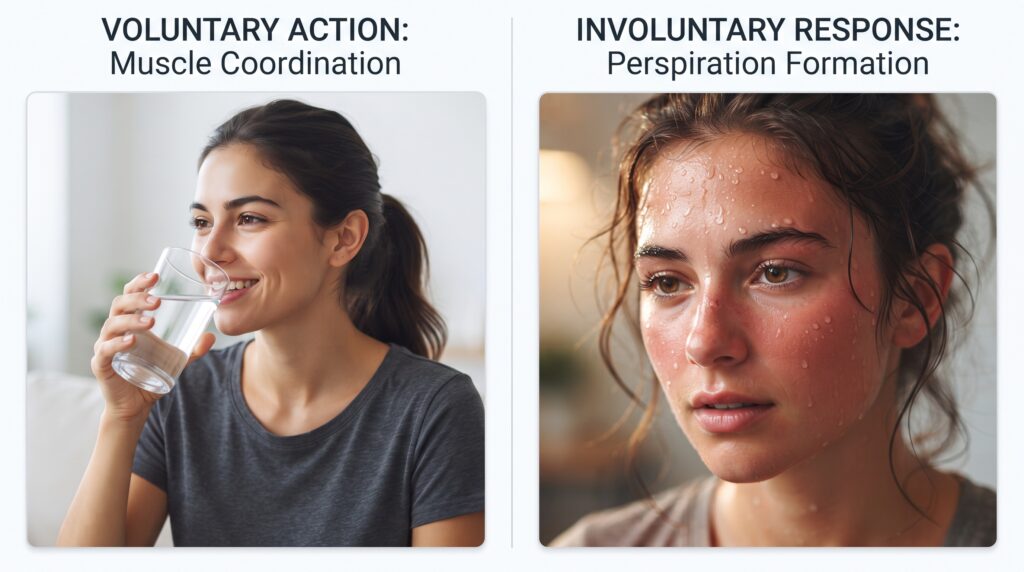
The difference between voluntary or involuntary can sometimes be confusing because both words describe actions or events, but they refer to very different situations. Understanding this distinction is useful in everyday English, psychology, biology, medicine, law, employment, and many other areas.
Something voluntary happens because a person chooses or intends to do it. Something involuntary happens without conscious choice or control.
For example, deciding to raise your hand is a voluntary action. Your heartbeat, on the other hand, normally continues without you consciously telling your heart to beat.
Knowing when to use voluntary or involuntary can help you communicate more accurately and avoid common vocabulary mistakes.
Quick Answer
Voluntary means something is done intentionally, willingly, or by personal choice.
Involuntary means something happens without conscious intention, choice, or control.
Simple examples
Voluntary action:
Choosing to walk to the store.
Involuntary action:
Blinking when something suddenly approaches your eye.
The easiest rule is:
Voluntary = chosen or controlled.
Involuntary = not consciously chosen or controlled.
However, the exact meaning can depend on the context.
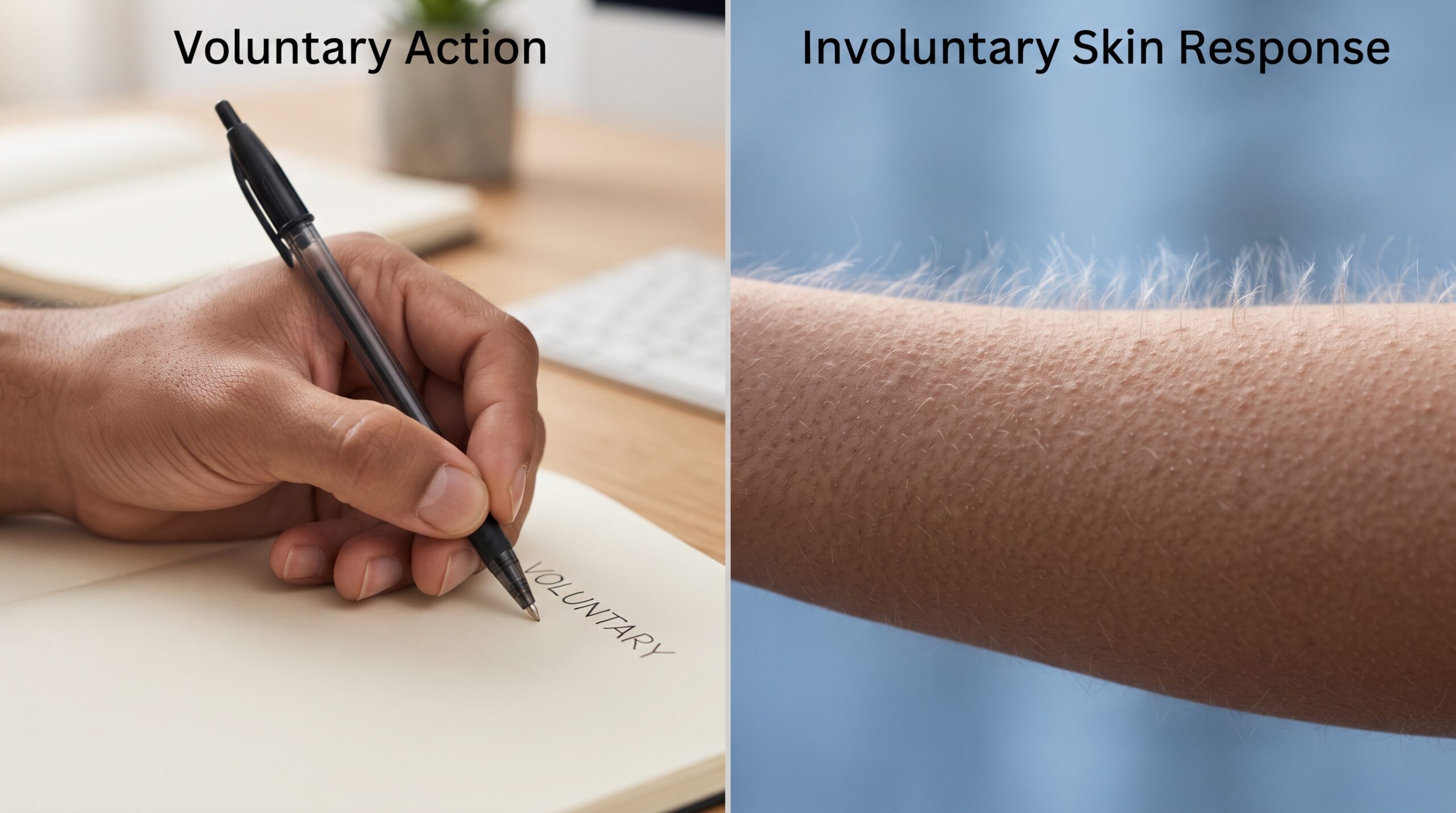
What Does Voluntary Mean?
Voluntary describes something that a person chooses to do freely or intentionally.
Examples include:
- Volunteering for a project
- Choosing to exercise
- Raising your hand
- Deciding what to eat
- Signing up for a class
- Helping someone by choice
- Joining an organization willingly
The important idea is choice.
If you decide to perform an action because you want to do it, that action is generally voluntary.
Voluntary in Everyday English
The word voluntary can describe many different situations.
For example:
Voluntary work means work someone chooses to do without being required to do it.
Voluntary participation means people participate because they choose to.
Voluntary payment means a payment made willingly rather than because it is legally required.
What Does Involuntary Mean?
Involuntary describes something that happens without conscious choice or intentional control.
Examples include:
- Sneezing
- Blinking
- Some reflexes
- Your heart beating
- Shivering
- Certain automatic body functions
The meaning can also apply outside biology.
For example, someone might give an involuntary reaction after hearing surprising news.
They may laugh, gasp, or move suddenly without consciously planning the response.
Voluntary vs Involuntary: Key Differences
| Feature | Voluntary | Involuntary |
|---|---|---|
| Meaning | Done by choice | Happens without conscious choice |
| Control | Usually under conscious control | Usually outside conscious control |
| Intention | Usually intentional | Usually unintentional |
| Decision | Requires a choice | Does not require a conscious decision |
| Example | Walking | Sneezing |
| Behavior | Deliberate | Automatic or spontaneous |
| Body movement | Often consciously controlled | Often automatically controlled |
| Common context | Decisions and actions | Reflexes and automatic functions |
| Opposite | Involuntary | Voluntary |
| Mental awareness | Usually aware of the action | May not consciously control it |
| Main idea | Choice | Lack of conscious control |
How Voluntary Actions Work
A voluntary action usually begins with a conscious decision.
For example, imagine that you decide to pick up a book.
The process involves:
- You decide to pick up the book.
- Your brain sends signals to the appropriate muscles.
- Your muscles move your arm and hand.
- You grasp the book.
The action is voluntary because you consciously chose to perform it.
Other examples include:
- Running
- Writing
- Speaking
- Standing
- Sitting
- Eating
- Typing
- Opening a door
How Involuntary Actions Work
Involuntary actions generally occur without conscious decision.
Your body has many automatic systems that operate without requiring constant attention.
Examples include:
- Heartbeat
- Digestion
- Pupil changes
- Some reflexes
- Shivering
- Certain glandular functions
These processes are essential because consciously controlling every automatic body function would be impossible.
Voluntary or Involuntary Movement
Human movement can generally be divided into voluntary and involuntary movement.
Voluntary Movement
Voluntary movement occurs when you consciously decide to move.
Examples include:
- Walking
- Running
- Writing
- Picking up an object
- Turning your head
- Raising your arm
Involuntary Movement
Involuntary movement occurs without conscious control.
Examples can include:
- Reflex movements
- Certain muscle contractions
- Shivering
- Some automatic movements
Not every movement fits neatly into one category because some body actions can involve both conscious and automatic processes.
Voluntary or Involuntary in Biology
The distinction is particularly important in biology.
The nervous system controls many different types of body activity.
The somatic nervous system is associated with voluntary control of skeletal muscles, while the autonomic nervous system regulates many involuntary functions.
Automatic functions can include regulation of:
- Heart rate
- Digestion
- Blood vessel activity
- Certain gland functions
- Breathing patterns
Breathing is an interesting example because it can be consciously controlled for a period of time, but it is also regulated automatically by the body.
Voluntary or Involuntary in Psychology
In psychology, voluntary behavior generally involves conscious intention or decision making.
Involuntary reactions may occur automatically in response to a stimulus.
For example, someone may intentionally smile because they are happy. However, they might also suddenly react with surprise after hearing a loud noise.
The distinction can become complicated because human behavior isn’t always completely voluntary or completely involuntary.
Emotions, habits, reflexes, and environmental influences can all affect behavior.
Voluntary or Involuntary in Law
The words can also have specific meanings in legal contexts.
A voluntary action is generally associated with a person’s conscious choice or willingness.
An involuntary action may occur without conscious control or intention.
Legal definitions can vary depending on the jurisdiction and specific situation, so general dictionary meanings should not be treated as legal advice.
Voluntary or Involuntary in Employment
The distinction is also common in employment terminology.
For example:
Voluntary resignation means an employee chooses to leave their job.
Involuntary termination generally means an employer ends the employment relationship.
These terms can have important legal and financial consequences, depending on local employment laws and the circumstances.
Voluntary or Involuntary Examples
Here are some simple examples.
Voluntary
- She voluntarily joined the club.
- He chose to volunteer at the event.
- I voluntarily accepted the responsibility.
- They decided to participate.
- She raised her hand intentionally.
Involuntary
- He sneezed involuntarily.
- She gave an involuntary gasp.
- The child blinked involuntarily.
- His hand moved in a reflexive response.
- Her heart continued beating automatically.
Voluntary or Involuntary Breathing
Breathing is an interesting example because it can involve both voluntary and involuntary control.
You can consciously decide to:
- Take a deep breath
- Hold your breath temporarily
- Breathe faster
- Slow your breathing for a short period
At the same time, your body automatically regulates breathing based on its physiological needs.
Therefore, breathing isn’t simply one or the other.
Voluntary or Involuntary Reflexes
Reflexes are generally considered involuntary responses.
For example, when you touch something unexpectedly hot, your body can quickly respond before you consciously process the situation.
This rapid response helps protect the body from injury.
Common examples include:
- Pulling your hand away from something hot
- Blinking when something approaches your eye
- Knee jerk response
- Coughing
- Sneezing
Common Mistakes When Using Voluntary and Involuntary
Mistake 1: Thinking Voluntary Means Easy
Voluntary means chosen or willing. It doesn’t mean easy.
Someone can voluntarily choose to do something difficult.
Mistake 2: Thinking Involuntary Means Accidental in Every Situation
Involuntary usually means not consciously controlled.
It doesn’t necessarily mean that something was caused by an accident.
Mistake 3: Assuming Every Body Function Is Involuntary
Some body functions can involve both conscious and automatic control.
Breathing is a good example.
Mistake 4: Confusing Voluntary With Volunteering
The words are related, but they aren’t always interchangeable.
Voluntary means done by choice.
Volunteer refers to a person who willingly offers their time or services.
Mistake 5: Using Involuntary for Something You Simply Didn’t Want to Do
Something isn’t necessarily involuntary just because you didn’t want to do it.
If you consciously chose to do something despite not wanting to, the action may still be voluntary.
Pros and Cons
Voluntary Actions
Pros
- Allow conscious decision making
- Provide greater control
- Help people achieve goals
- Support intentional behavior
- Make planning possible
Cons
- Require conscious effort
- Can involve difficult decisions
- May require concentration
- Can be influenced by emotions and habits
Involuntary Actions
Pros
- Allow automatic body functions
- Protect the body through reflexes
- Reduce the need for conscious control
- Support essential physiological processes
Cons
- Cannot always be consciously controlled
- May occur unexpectedly
- Can sometimes interfere with intentional actions
- Some involuntary reactions can be uncomfortable
Voluntary or Involuntary: Easy Memory Trick
Use this simple trick:
Voluntary = Volunteer = Choice
Think of a volunteer. A volunteer chooses to help.
Involuntary = Involuntary = No conscious choice
If something happens without your conscious decision, it is generally involuntary.
This simple association can make the difference easier to remember.
FAQs
What is the difference between voluntary and involuntary?
Voluntary means something is done intentionally or by choice. Involuntary means something happens without conscious choice or control.
Is walking voluntary or involuntary?
Walking is generally a voluntary action because you consciously decide to walk. Some aspects of walking can become automatic with practice.
Is breathing voluntary or involuntary?
Breathing can be both. You can consciously control your breathing for a period of time, but your body also regulates breathing automatically.
Is blinking voluntary or involuntary?
Blinking is generally an involuntary action, although you can consciously blink when you choose to.
Is sneezing voluntary or involuntary?
Sneezing is generally an involuntary reflex, although some people may be able to influence when a sneeze occurs.
Is heartbeat voluntary or involuntary?
Your heartbeat is normally an involuntary function regulated automatically by the body’s systems.
Is digestion voluntary or involuntary?
Digestion is primarily involuntary. Your digestive system performs most of its functions automatically.
What is a voluntary action?
A voluntary action is an action performed because a person consciously chooses or intends to perform it.
What is an involuntary action?
An involuntary action occurs without conscious choice or intentional control.
Can an action be both voluntary and involuntary?
Yes. Some activities involve both forms of control. Breathing is a common example because you can consciously control it while your body also regulates it automatically.
Is voluntary the opposite of involuntary?
Yes. Voluntary and involuntary are commonly used as opposites when describing whether something is consciously chosen or controlled.
What is an example of voluntary behavior?
Choosing to study, exercise, write, speak, or volunteer are examples of voluntary behavior.
What is an example of involuntary behavior?
Sneezing, blinking, shivering, and many automatic body functions are examples of involuntary actions.
Conclusion
Understanding voluntary or involuntary becomes much easier when you focus on one main idea: choice and conscious control.
A voluntary action is generally something you choose or intentionally perform. Walking, writing, speaking, and volunteering are common examples.
An involuntary action happens without conscious choice or control. Sneezing, blinking, many reflexes, heartbeat, and digestion are common examples.
The distinction is useful in everyday English as well as biology, psychology, employment, and other fields.
When you’re unsure which word to use, ask yourself a simple question:
Did the person consciously choose or control the action?
If the answer is yes, voluntary is usually the appropriate word. If the action happened automatically or without conscious control, involuntary is usually the better choice.